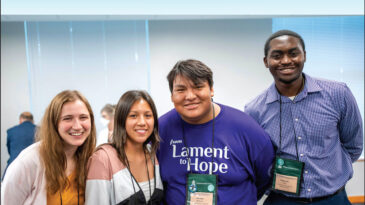
Most American churches have sought to diversify their membership in recent decades so that that the 21st century faith community would better resemble that of the first Christian Pentecost two millennia ago. But when two hundred-plus Presbyterians gathered for the 15th National Multicultural Church Conference in Ft. Worth this mid-summer, they weren’t just talking dreamy-eyed ideals. They were talking turkey about the reality on the ground, presenting concrete models and strategies to confront some of the greatest crises facing real people in real time.
COLLABORATION, COMPETITION, ACCOUNTABILITY
True to the term “keynote,” the first address set a perfect pitch for the four-day conference. Rep. Stacey Y. Abrams, House Minority Leader for the Georgia General Assembly, shared her own spiritual journey as the child of parents who both converted from Baptist to Methodist and then, at the age of 40, answered God’s call to pastoral ministry. “I was always fearing that God would call me to the ministry, too, so I did everything I could do to assure that God wouldn’t want me.” The laughs doubled when she added, “I became a politician.”
Still her parents — especially her mom — served as role models for her. She bragged that her mother was assigned as pastor of a three-church circuit and was the first to survive there a full year. She even succeeded in leading them to merge into one congregation and acquired a whole new building. She insisted on painting it pink “so nobody would notice,” she said with a snicker.
In a town that had never had an integrated prom, her mother organized an integrated pre-prom party.
“Mom called us urban pioneers, which really meant ‘poor’.” But she said that her mother taught her that no matter how little you have, there always is somebody with less that you have been sent to serve.” Accordingly, one of her life’s biggest questions has been, “How do we become domestic missionaries of his grace?”
Equipped with a law degree from Yale, she has put her training to work mostly for non-profit organizations. She co-founded and serves as senior vice president of the NOWaccount Network Corporation, a financial services firm. Abrams also co-founded Nourish, Inc., a beverage company with a focus on infants and toddlers.
But she has especially poured her efforts into politics, which she defined as “nothing more than the community of people coming together to put their resources to the service of people we will never see … to people who will never say, ‘Thank you.’”
Abrams is the first woman to lead either party in the Georgia General Assembly and the first African-American to lead in the House of Representatives. She explained to the conferees that any representative wishing to serve as a Georga party leader has to present her/himself along with credentials. She told her colleagues, “I’ve been a minority for a really long time. I’m really good at it.”
She quipped, “The day I became the leader, 80 people switched parties.”
She shared three key words of guidance for continued service in church and community.
First: collaboration. Not as a tactic, but a belief. “I really do believe that you need to collaborate,” she affirmed. “Multiculturalism is broader than race, religion and region. Collaboration on God’s journey has to look beyond the superficial and find the real. We have to be willing to talk with somebody other than ourselves.”
Second: competition. When your position is the right position you have to use politics as “a means toward an end. The other side will tell a lie as many times as it takes to convince them and everybody else that it is the truth.” Sadly, in response, we tell the truth once, “and if nobody says, ‘Amen,’ we shut up.” You have to press the point that health care is a moral issue, that immigration is a biblical issue, that the seven-year Jubilee — the systematic cancelling of debts — is a God-idea. The same with income and equality, voter suppression and a host of other issues.
Third: accountability. Politicians need to be held to account for what they do, both in their motives and their outcomes. Politicians, Adams said, “are like teenage girls. We respond to money, peer pressure and attention. When we refuse to hold our politicians to account, we get what we deserve.”

A MULTICULTURAL, MIGRANT, MULTINATIONAL FUTURE
Joseph Clifford, pastor of First Presbyterian Church, Dallas, turned the topic from public politics to ecclesiastical challenges when preaching in the conference’s opening worship service. Recounting the oft-repeated news of church shrinkage, he turned the subject from the hand-wringing Anglo context to the multicultural. “American Christianity still has plenty of young people. They just aren’t white,” he said. “The majority of younger Christians in America are people of color. Among the 18 to 29-year-old Christians, only 26 percent of them are white.”
“The future of the church is multicultural,” he declared. “That’s not just the culture. That’s what God wants.” And then he exclaimed, “And God gets what God wants.” In fact, he offered a glimpse from the Book of Revelation of what God long ago laid out as the ultimate, predestined goal: “a vast crowd, too great to count, from every nation and tribe and people and language, standing in front of the throne and before the Lamb.” He also added, “And we’re Presbyterians. We believe in predestination.”
Clifford pressed the point in some of its most pointed political implications. “Can we imagine meeting the resurrected Christ in the face of a stranger? Oh, first we need to seal the border to keep out the stranger … Oops that’s another sermon.”
Speaking of strangers, Luis Rivera-Pagán, delivered the second morning’s plenary address titled, “Xenophilia or xenophobia: Toward a theology of migration.” Though the title sounded academically dense, excusable by the fact that he is the Henry Winters Luce Professor Emeritus of Ecumenics at Princeton Theological Seminary, it delivered a pointed call for distinctively Christ-centered mission in this era of unprecedented human migration.
The central motif of Hebrew thought — both its personal history and its essential theology — is found in the experience of migration. From Haran and Ur to Palestine, from Egypt through the desert to the Promised Land. “So important was this story of migration, slavery and liberation for the biblical people of Israel that it became the core of an annual liturgy of remembrance and gratitude.
“It reenacted the wounded memory of the afflictions and humiliations suffered by an immigrant people, strangers in the midst of an empire; the recollection of their hard and arduous labor, of the contempt and disdain that is so frequently the fate of the stranger and foreigner who possesses a different skin pigmentation, language, religion or culture. But it was also the memory of the events of liberation, when God heard the dolorous cries of the suffering immigrants. And the remembrance of another kind of migration, in search of a land where they might live in freedom, peace and righteousness, a land they might call theirs.”
He pressed his point: “We might ask: Who today might be the wandering Arameans and what nation might represent Egypt these days, a strong but fearful empire?”
American anxiety about the ‘browning’ of the country is especially highlighted in the frequent use of “the derogatory term ‘illegal alien’ as if the illegality defines “not a specific delinquency, but the entire being of the migrant.” That is being underlined, he suggested, by the threatening and sinister connotations around the word alien that are conjured in the four films with Sigourney Weaver “fighting back atrocious creatures.”
After recounting example after example, and trend upon trend, Rivera-Pagán referenced the work of the late Harvard Professor Samuel P. Huntington, the intellectual father of the theory of the “clash of civilizations,” cofounder of the journal Foreign Policy and author of the book “Who are We? The Challenges to America’s National Identity.” Huntington spelled out what he called “The Hispanic Challenge,” and went on to say that America’s identity as an “Anglo-Protestant culture” has been formed by a long history of wars against a succession of enemies and that the national identity “seems to require the image of a dangerous adversary.” In turn, Huntington identifies the Latin-Hispanic migration to be an exceptional “threat to the cultural and possibly political integrity” of the U.S. and even names as the “newest ‘perfect enemy’ … the Latin American immigrant.”
Participants in the conference, considering the recent influx of children from Central America, could not help but feel the discomfort that this scholar was pressing. Rivera-Pagán pushed that very point. Referencing the .tens of thousands of children and teenagers fleeing poverty and violence.to immigrate to the U.S., .daring to survive the gangs of human traffickers, the so-called .coyotes,.to, at the end of that arduous and dangerous pilgrimage, face detention, contempt and deportation,” he said that their “dreadful situation has truly become a humanitarian crisis of epic dimensions.”
He asked, how can Christians resist the efforts to turn the Latino/Hispanics into our newest national scapegoats?
First, by recalling and proclaiming the plethora of commands and examples of loving the stranger that are weaved through the history of the people of God in both testaments of the Christian Bible. In other words, the church can promote the word that “the divine command to care for the stranger was the matrix of an ethics of hospitality.”
Second, by learning from the examples when the people of God violated such expectations, as when they allowed the taking of slaves from among the foreigners (Leviticus 25, Deuteronomy 20, etc.) and other “texts of terror,” as labeled by Phyllis Trible.
Third, by paying special attention to Jesus’ treatment of the Samaritans, the “other” so generally disdained by many Israelis of his day.
And, fourth, Jesus’ teaching about “the least of these.”
“We need to countervail the xenophobia that contaminates public discourse in the United States and other Western nations with an embracing, exclusion-rejecting, perspective of the stranger, the alien, the ‘other,’” Revera-Pagan declared. Instead we must pursue what he named, “xenophilia, a concept that comprises hospitality, love and care for the stranger.”

Jooseop Keum delivered the final plenary speech, overviewing the new ecumenical affirmation on mission and evangelism, “Together towards Life: Mission and Evangelism in Changing Landscapes,” prepared by the Commission on World Mission and Evangelism (CWME) and unanimously approved as the official statement of the World Council of Churches. Keum, the secretary of CWME, noted that the percentage of Christians in the world — 33 percent — has not changed significantly in the past 100 years.
Still, he highlighted the fact that 100 years ago, Pentecostalism was just beginning. Now, it makes up 25 percent of all Christians, Roman Catholicism encompasses 50 percent and the remaining 25 percent is comprised of the Orthodox and mainline Protestant. Referencing the Apostle Peter’s preaching on Pentecost, he said that we mainliners are good at believing and baptizing, “but we are bad at receiving the Holy Spirit.”
Indeed, he added, “Church has become like an elephant: hard to move, really hard to dance.” He pressed further: Can we believe that “God can make the elephant dance?”
That’s not the only thing that has changed. Migration not only has created challenges for national borders. It also has brought about a huge shift in Christian population. For example, in 1910 when the first CWME gathering met in Edinburgh, 70 percent of the world’s Christians resided in Europe and America, whereas today 70 percent live in the global south.
Also, environmental damage is sorely impacting poorer countries while the wealthy keep promoting the hope that free markets will bring about economic growth which, in turn, will bring prosperity and a salvation here on earth: a totally anti-Christian notion.
Still, Keum assured that mission begins in the being of the Triune God, and the love that binds the Trinity together also overflows to humanity and the entire creation. “The missionary God who sent the Son into the world empowers us to be a community of hope and life to the world. … How important it is to receive the Holy Spirit to be living witnesses to the coming reign of God!” he exclaimed.
In addition to the plenary addresses, conferees participated in lengthy workshops tackling such topics as Migration Emerging Ministries, Theology & Multicultural Education, Justice & Power Dynamics/A Global Perspective of Power & Privilege, Models of Multicultural Ministries, African American Transformational Leadership, Evangelism & Church Growth in a Changing Landscape, Designing Worship for the Multicultural Church, and several others.
No, this was not just a happy-clappy gathering of pie-in-the-sky idealism. It was very real believers talking turkey about the reality on the ground, presenting concrete models and strategies to confront some of the greatest crises facing real people in real time.