Three Presbyterians arrested as part of civil disobedience this week in Ferguson, Missouri, say they stepped forward because of systemic racial injustice against people of color – and their belief that people of faith need to stand alongside the young blacks who have been protesting for more than two months now in Ferguson.

“There is a new generation of leadership arising on the streets of Ferguson,” said Shannon Craigo-Snell, a professor of theology at Louisville Presbyterian Theological Seminary. “Racist policing is a legacy of Jim Crow. It has really been ramped up in recent years by the militarization of the police, and it’s reaching a point where our children are getting shot on the street with regularity. Mike Brown is one of many” – a white Ferguson police officer, Darren Wilson, shot black 18-year-old Michael Brown on Aug. 9, and a grand jury now is considering whether to bring charges against Wilson. “It’s just simply unacceptable.”
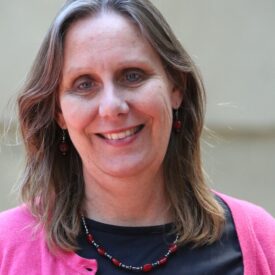
Black young adults being arrested in Ferguson are being called “thugs” and “criminals,” while “I’m a white middle-aged woman with grey hair and a clergy collar,” Craigo-Snell said. “It’s harder to pretend I’m a dangerous criminal. It’s ridiculous to arrest me for praying in public, for peacefully protesting . . . My hope is that my participation in this will expose the racist logic in American policing.”
Craigo-Snell drove to Ferguson to participate in an organized weekend of civil disobedience. She was among about 50 people – including Jim Wallis of Sojourners, professor and author Cornel West and religious leaders from a variety of faith traditions – who were arrested Oct. 13. For all three, it was their first time to be arrested – “Oh, hoot, yes!” Craigo-Snell said – and something they each were a little afraid to have happen.

“I prayed for the strength to be able to do what I thought was right,” said David Wigger, 28, who is a student at Louisville Presbyterian Theological Seminary (with a concentration in black church studies), a former young adult volunteer in Kenya for the Presbyterian Church (U.S.A.), and currently is serving a field education internship in the PC(USA) Young Adult Volunteer office. Wigger was charged with disturbing the peace, a misdemeanor, and said he does not know what will happen next with his case.
The protests in Ferguson are “really being led by the youth who are most affected right now,” Wigger said. “It’s the teenagers and those in their early 20s who are being shot at and arrested.”
Emily Heitzman, a 33-year-old Presbyterian minister who also was arrested, serves as pastor with youth and households for four congregations (three Lutheran, one American Baptist) in Edgewood, a neighborhood on the north side of Chicago. She works with many teenagers of color – including African Americans and immigrants from Africa and Latin America – and says many of those teenagers share firsthand stories of their encounters with the police.
“They’re riding their bikes – maybe it’s a little dark out, it’s early evening,” Heitzman said. “They’re riding their bikes through the alley to take a short-cut to a friend’s house, and the police stop and search them. . . I don’t have to tell my youth who are white in my groups to be careful, don’t wear a hoodie, if you see the police you need to smile at them,” but the black and Latino teenagers all hear that from their parents. “Make sure you don’t talk back. Make sure you’re very careful.”
Heitzman said the testimony of the teenagers in her youth groups and the example set by the young activists in Ferguson compelled her to act.
“They want people to stand with them – it’s really important,” she said. “They shouldn’t have to be the only ones speaking up. As leaders of faith, we need to be standing up and saying this is wrong and it must stop . . . In the Christian tradition, Jesus took a whole lot of chances. He spoke out boldly and loudly and radically – talk about a community organizer. If we call ourselves followers, then we’ve got to be taking a stand . . . There’s a difference between peacemaking and peacekeeping. A lot of times we try to keep the peace. We don’t want to cause any tension. We don’t want to say anything that’s going to shake things up. The good news of the gospel shakes me up.”
At an interfaith meeting on Oct. 12, Wigger heard young blacks from Ferguson angrily ask older religious and civil rights leaders, “Where have you been? We have been here for months. Why are you just coming now?”
On the day of the arrests, religious leaders gathered early in the morning for prayer, singing and worship. Hundreds marched to the Ferguson Police Department, where those willing to be arrested formed separate lines. Some knelt and confessed their own sins, “for the part we have played in systemic racism,” Wigger said – then stepped forward and asked the line of police officers barring them from entering the building to confess their complicity too. “Some were stoic, they tried to ignore it,” Wigger said. “Others engaged. Some argued.”
The police officer to whom he spoke “was not saying anything. He was looking ahead. But his eyes were getting a little teary. He just said, ‘If you could see into my heart.’ That was all he could say . . . One of the rabbis next to me said, ‘I appreciate your service’ . . . We are trying to serve our country too.”
For him, one of the most powerful moments – after standing for hours in the rain in protest – was when a chorus rose up of the spiritual “Wade in the water, God’s going to trouble the water,” and then, “the heavens just opened up,” and it poured.
While the arrests brought some moments of discomfort – the protestors were wet, tired and shivering – all three said they were treated with respect.
Craigo-Snell also brought with her to the protest two other students from Louisville seminary – Beth Ruhl and Zach Heimach – and her 14-year-old son, Jacob. Weeks ago, in the initial surge of protests following Brown’s killing, Craigo-Snell also drove to St. Louis to participate in protests. She hesitated at first, but then went after Jacob told her as soon as he got out of bed: “Mom, I think we need to go to Ferguson.” Fearing for his safety, she didn’t take Jacob with her, and she didn’t tell him she had gone until she had come home.
“He was devastated,” Craigo-Snell said. “He reads in the news that kids his age, his cohort, his generation, are being gunned down in the streets. He wants that to stop.”
This time, Jacob went with her; and the Louisville seminary students – who chose not to be arrested – promised to make sure her son could get home safely, no matter what happened to her. She brought Jacob, but “you could equally say he took me with him,” Craigo-Snell said. Like the young African American protesters in Ferguson, “he is passionate about justice.”
For more information:
Here is a blog post from Emily Heitzman about her arrest.
Here is a poem David Wigger wrote about the Ferguson protest.
For a radio interview with David Wigger, listen here.