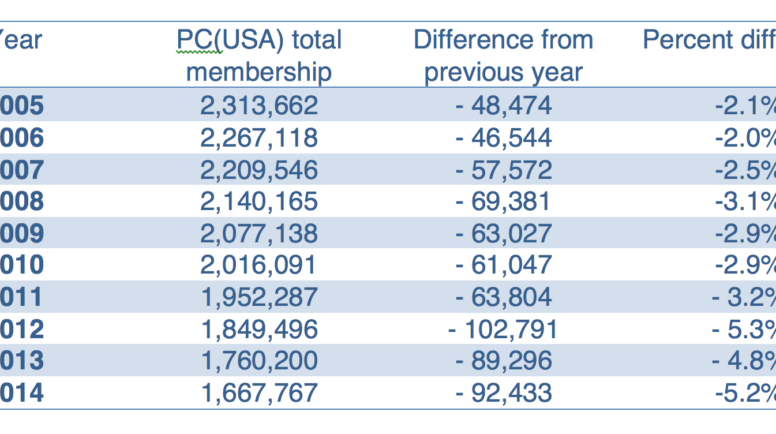
The Presbyterian Church (U.S.A.) lost another 92,433 members from 2013 to 2014 – dropping the denomination’s membership from 1.76 million in 2013 to 1.66 million in 2014. That annual membership decline, reported in the 2014 statistical report – the latest of the annual statistical reports report released by the Office of the General Assembly – reflects a series of ongoing trends.
- The PC(USA) has been losing members for decades. Its membership now is less than 40 percent of its peak membership of 4.25 million in 1965.
- Over the last decade, the denomination has lost about 650,000 members – dropping from 2.31 million members in 2005 to 1.66 million in 2014.

- In part, that reflects the exodus of evangelical Presbyterians who disagreed with PC(USA) policy decisions – particularly the decisions of recent General Assemblies to allow the ordination of sexually active gays and lesbians, and to permit PC(USA) ministers to perform same-gender marriages, although there have been other controversial decisions as well. The statistics on the numbers of PC(USA) congregations dismissed – including some of the PC(USA)’s largest churches, and with many of them going to ECO: A Covenant Order of Evangelical Presbyterian – show the picture:

Pew Research Study report
The PC(USA)’s pattern of continued membership decline mirrors a Pew Research Study report released this month that shows that the percentage of American adults who identify as Christian is dropping (from 78.4 percent in 2007 to 70.6 percent in 2014). During the same time, the percentage of American adults declaring no religious affiliation – the “nones” – increased from 16.1 percent to 22.8 percent, just shy of a quarter of the U.S. population.
The Pew report also identified the declines in mainline Protestant membership that the PC(USA) has been experiencing for years now. The percentage of American adults defining themselves as mainline Protestants dropped from 18.1 percent in 2007 to 14.7 percent in 2004.
“While many U.S. religious groups are aging, the unaffiliated are comparatively young – and getting younger, on average, over time,” the Pew report stated. The median age of unaffiliated adults was 36 in 2014, compared to a median age of mainline Protestants of 52.
The Pew report also states that “as the millennial generation enters adulthood, its members display much lower levels of religious affiliation, including less connection with Christian churches, than older generations.” Fewer than six in 10 millennials (those born after 1980) identify with any branch of Christianity, compared with 70 percent of older generations, including Baby Boomers and Gen Xers. Among millennials, only 16 percent are Catholic and only 11 percent say they are mainline Protestants. About one in five describe themselves as evangelical Protestants.
The Pew report also demonstrates how mainline Protestantism is disproportionately white – with 19 percent of non-Hispanic whites identifying themselves as mainline Protestant in 2014, compared with 4 percent of blacks and 5 percent of Hispanics. The PC(USA) statistical report shows the denomination to be more than 91 percent white.
PC(USA) statistical report
The 2014 report also includes these nuggets of information:
- The number of children being baptized in the denomination continues to decline – down from 21,422 in 2011 to 17,027 in 2014.
- The number of those participating in Christian education is dropping too – from 802,109 in 2011 to 612,528 in 2014.
- There was a significant drop last year in the number of candidates for ordination to teaching elder – from 1,086 candidates in 2013 to 562 in 2014 (a decline of 524 people, or 48 percent).