by Lauren Schneider and Tom Pardo
Lake View Presbyterian Church

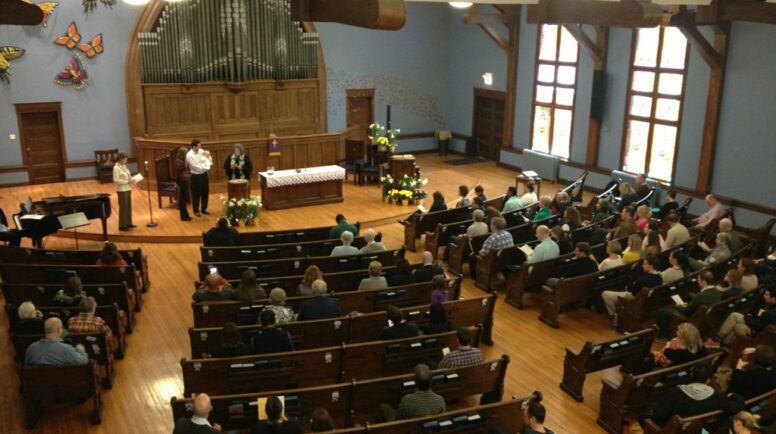
In January 2012, I first entered the distinctive yet unassuming red-shingled building with subtle stained glass windows and four-story steeple on the corner of Broadway and Addison in Chicago’s East Lake View neighborhood. I had moved to Chicago the previous week. I had no friends or family in this city of 2.7 million people and was looking for a place where I might be known, a place with an open and welcoming community to help me belong somewhere within the anonymity of this thriving urban metropolis. Like so many others before me and since, that Sunday I found that Lake View Presbyterian Church gives people — all people — a place to be known, loved and spiritually fed right in their neighborhood.
Lake View Presbyterian Church has held a prominent place in Chicago’s Northside community since the 1880s. Despite fluctuations over time, its membership has multiplied by five in the last 15 years to about 250 members. Joy Douglas Strome, pastor of Lake View since 1996, explained, “We are in an unusual position compared with a lot of churches in urban areas in terms of growing rather than shrinking.” But regardless of shifting numbers, Joy believes that the core “congregational DNA” has remained the same. She said, “Our DNA has run pretty deep — the heart for justice work and welcome … you can see vestiges of that all the way back to the very beginnings. I think in that regard, it’s the neighborhood church: the church that’s looking out to serve its neighbors. That part always feels cool, like we’re linked to something greater than just these last 15 years.”
Conserving the church’s core beliefs throughout its history is balanced with being nimble enough to respond to changes in the neighborhood and its community. Joy views this more as an art than a science, but “shifting with the needs of the community is really key; the context of where you are and making sure that you’re relevant to who is coming to your church and trying to pay attention to that [is important].” Lake View’s continuing community involvement and social justice activism is also part of what keeps the church relevant to its population. “I think people initially come,” Joy said, “first, because of our location, because we do have a very good location, but second, because of our stance on welcome and diversity, which for liberal progressives right now is kind of a bottom line. If you can’t claim that, you’re not going to be relevant to anybody who is thinking about the world that way.” Lake View is a More Light congregation, a designation which has long been central to its identity, communicating to neighbors that all people are safe and welcome inside. Joy said, “We had parents seeking us out because they wanted to raise their kids in an affirming congregation, and they wanted to teach their children about being inclusive and welcoming … . If you live in this neighborhood, you generally have consensus around some of the key justice issues. While you may not have consensus on what action looks like related to that, you at least have consensus on ‘Yes, I want justice for all my neighbors.’” Activism for social justice takes many forms at Lake View — from opening its doors to homeless LGBTQ youth on Friday nights at Café Pride to serving lunches to seniors in the Golden Diners ministry, from operating an alternative high school for disadvantaged students to taking action in anti-violence campaigns.

Joy also credits lively Sunday worship services as another factor in Lake View’s vitality. She explained, “It’s not pristine, it’s not perfect, it’s not ‘high church,’ but what we do comes from the heart and it’s not boring! Lively worship is, I think, the key to having people stay.” Keeping the services lively includes appealing to multiple intelligences and engaging the senses while still remaining connected to our roots in the reformed Presbyterian tradition. “There are some key features that are the same every week,” Joy said, “but we’re not slavish to the way they’re carried out, so if we want to do a video in place of something, we’ll do a video in place of something. If we want to do a sung version of something instead of a spoken version, we’ll do that. We try really hard to have images and touch and engage all the senses. If we can engage them all in one service, I’m a really happy camper!” Sunday services are yet another example of the nimbleness that characterizes Lake View, since congregants never know when they may be led to sing a hymn in the middle of the sermon or participate in a prayer that engages the body in movement and connection with a neighbor.
It’s hard not to look forward to the exciting ways Lake View will continue to grow and be involved in the local community. Joy hopes that whether the church continues to grow numerically, that it continues to grow in faithfulness and spirituality. “If we’re going to try to listen to how God is calling us to be a useful member of this changing neighborhood, we can’t be static, and we can’t be stuck — we have to be moving all the time, and so that growth can come either numerically or spiritually or in program or in witness or whatever it turns out to be, but the growth piece is important.” Co ntinued spiritual growth is only one of a number of Joy’s hopes for Lake View’s future: “I hope we will continue to be dissatisfied with injustice and look for ways to make a difference in the neighborhood and in the world that way. I hope that we’re going to provide for the next generation and all these little kids around us, and that we’ll be able to do that creatively and will teach them about being welcoming. I hope we’re going to be sensitive to the needs of this community, whatever those are. There are also some really ‘hungry’ rich people out there, and some really hungry poor people — all of them have needs that we have to figure out how to feed.”
Finally, Joy hopes that Lake View might serve as a “counter-voice to the denomination’s obsession with death,” referring to the fixation of Presbyterian churches’ attention on declining numbers across many congregations and presbyteries. According to Joy, “I think that our obsession with death is self-fulfilling: The more we talk about it, the more we die. It’s not to say that we don’t need to be paying attention and trying some different things, but I’m really excited about the decision [in the Outlook] to focus on congregations that are vibrant and full of life. I think that’s a more powerful way to testify to how God’s calling the church today than just to wring our hands all the time about things that just aren’t going right.” For its part, Lake View Presbyterian Church will not be wringing its hands while there is still work to be done and needs to fulfill. In Joy’s words, “we’ve been flexible enough to see our call here for what it is: a chance leave a legacy of ministry for the next generation that is rooted in our past and responsive to the future!”

First Presbyterian Church of Arlington Heights
When Alex Lang arrived in Arlington Heights, Illinois, in late August 2013 to become pastor of First Presbyterian Church, he made it clear that he wanted to lead a Matthew 25 congregation, one whose primary focus was to serve the least and the lost. This vision was a daunting challenge for this congregation of 1,100 located in the northwest suburbs of Chicago. First Pres, as it is affectionately known by its members, had just emerged from a tumultuous three-and-a-half year transition period and were just gearing up for new pastoral leadership. Questions abounded: Were we ready to do this? Will we heed the call to even greater service?
First Pres has been worshiping and serving God in Arlington Heights for 160 years. Operating on an annual budget of approximately $1 million, the church is known for its mission activities including serving as a shelter on Tuesday nights for those who are homeless, leading Vacation Bible School for Dakota Sioux children in South Dakota, and continuing a 30-plus year relationship with a small congregation in the Dominican Republic. First Pres is also recognized for excellent Christian education for all ages, inspiring contemporary, blended and traditional worship, and a richly diverse music ministry. Throughout its history, this congregation has been dedicated to knowing Christ and making him known to the world.
In the months since Alex’s arrival, his vision for a Matthew 25 church in the 21st century has become the shared vision of the congregation. The vision has three pillars: relational, missional and caring ministries. It draws upon the strengths that characterize this congregation, yet stretches us to understand and act with clearer focus about what Christ means by discipleship.

The first pillar — relational ministry — is rooted in Christ’s commissioning of disciples in Matthew 28:19. The congregation is seeking relationships with people who are unchurched. It wants to make certain that all who walk through the doors feel truly welcome. First Pres desires to help all people feel connected to this community of faith through small group ministry and other service and fellowship opportunities.
Jesus’ revealing statement about serving him through serving the least among us (Matthew 25:40) is the spiritual foundation for the second pillar of the vision — missional ministry. In 2015, the congregation will conduct extensive research into how First Pres can best serve those in our community who need our help the most. The congregtion will choose a mission opportunity that excites and motivates everyone — yes, everyone — to serve.
 Caring ministry is the third pillar, grounded in John 13:34-35: “Just as I have loved you, you also should love one another.” Caring for the congregation will expand beyond the pastoral staff to include greater lay participation. The deacons will be refocused to attend to those most in need within the congregation. Stephen Ministry will be revitalized to care for people in the congregation who need a listening ear.
Change is always unsettling, even for a congregation that has witnessed significant change throughout its history. First Pres has weathered a heart-wrenching Civil War and numerous wars thereafter, faced down bankruptcy during the Great Depressio
n, and experienced wall-busting attendance during the postwar “Golden Age” of American church life. The congregation knows one thing is certain: God is the Creator of new things, who walks alongside them to give encouragement and confidence during this time of change. Granted, the people do not know how all of the vision originally put forth by Alex will come to fruition, but they put their trust and faith in the One who will show them the way.
Conclusion
The Lake View and First Presbyterian congregations reveal several key components that are present in vital congregations:
- Strong, creative pastoral leadership makes a difference. Both Joy and Alex have been willing to take the leadership risks that are necessary for vital ministry.
- Both congregations have adopted a strong focus on ministry outside of their own walls. Studies of millennials reveal that they are looking for spiritual communities who do meaningful, life-changing work. Lake View and First Presbyterian both offer all generations the opportunity to make a difference.
- Both congregations have chosen to ignore the “bad news” about PC(USA) membership statistics to create “good news” of their own and God’s making.
Are these two congregations anomalies or are they examples of how the PC(USA) can be a growing force in the 21st century? We choose to believe the latter.
LAUREN SCHNEIDER is a member of Lake View Presbyterian Church in Chicago and grew up going to First Presbyterian Church of Grapevine, Texas. She works at the University of Chicago and has called Chicago home for the past three years, but she will always miss the amazing chips and queso found only in Texas. TOM PARDO is a ruling elder and former clerk of session. He is actively involved in the music ministry of First Presbyterian Church.