by George Wilson
I was a prison ministry skeptic. Why would I want to help get sentences reduced for those whom I generally felt deserved the punishment they received?
That was how I felt when the phone rang one morning and a friend said, “George, I cannot think of anyone I would rather have accompany me in doing prison ministry. You were a good friend to me.” The caller had been in the church I served after he was released from prison on parole. He violated his parole and returned to prison. We kept in contact and I tried to provide spiritual support. When he was released, he began to serve in Kairos prison ministry. That morning, I told him about my skepticism. He suggested that I join him one time and, if I still felt the same way, I could drop out.
I continued with Kairos for seven years until my health prevented me from serving.
Kairos preparation begins about 6 weeks before the team enters the prison for four consecutive days. For six Saturdays in a row, the team met for about four hours. Everyone must attend the training, even if he or she has done this before. During this time, those who have attended before also taught proper prison demeanor. Everyone who will give a formal talk in the prison must practice before this group where we will be critiqued lovingly. In addition to training, it is also a bonding time so that we would know each other very well by the time we entered the prison.

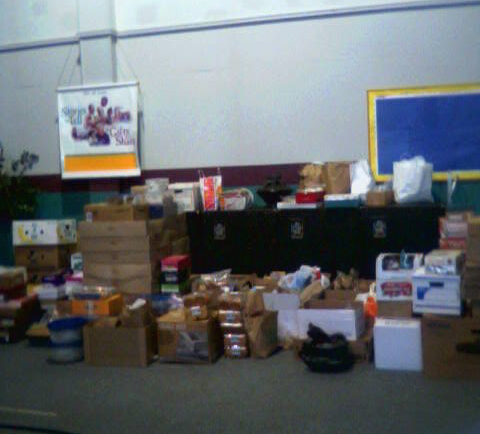
The Kairos team is supported by a church near the prison. Wednesday night before we enter the prison, we hold our final training meeting at the supporting church. We arrive bringing 6,000 dozen cookies that have been prepared by the churches we serve (Yes: 6,000 dozen!). We will use all of them in our four days of ministry. We will end the day with a foot-washing — similar to the way Christ commissioned his disciples on his last night with them. It is an emotional time.
Thursday dawns and we continue our preparation. A team heads for the prison to set up the gym that we will use for ministry space. One section of the gym becomes a chapel, surrounded by curtains and with a cross on a table in the front. Another area is set up with a piano keyboard and sound equipment. Inmates will help with the music along with our own music leader. There will be seven round tables with six inmates and three leaders each, one of whom must be an ordained minister. The minister is available to the inmates in case they need a time of confession during emotional events. All of our equipment must be inspected and set up before we enter at 3 p.m.
The first day is a nervous time. The prison chaplain and his team have selected 42 inmates to participate. Each of us has become a sponsor for one or two inmates. We have written to them and now we will meet them. As they trickle into the gym, they are asked to sit in the bleachers. Their names are called and we sponsors meet them with a nametag and take them for coffee and cookies. We will be their contact throughout the weekend to answer questions and simply be a friend. We do not know their reasons for being in prison and do not want to know lest it prejudice us against them. We are to love them and to teach them how to love as Christ loves us. Prejudice has no place here.
Each inmate is encouraged to go to the microphone with his sponsor and tell what he expects from the weekend; we are to tell what brought us to this ministry. Most have come because they have heard about the food, coffee and cookies that we provide; we have come because of the miraculous change that seems to inevitably take place.
The first presentation is made by one of our volunteers who is an ex-inmate. He begins, “Several years ago I was sitting where you are. It was because of the choices I had made. Now, I am making different choices and I don’t plan to return … .” This begins our first training course on how to live together as Christians. Participants are given an opportunity to respond and we end the evening with a chapel service. During the talk and chapel service, some of our volunteers take a dozen cookies in a bag to every inmate — about 1,000. We do this every night. (That is the reason we need 6,000 dozen cookies!)
Afterward, we return to the church where our support team has prepared a meal and we prepare for the next day — supporting those who will speak and offering prayers for them.
The next day, we enter the prison by 8 a.m. Talks are given, the Good News is shared and our love is spread throughout. Participants begin to understand that we really do love them. One inmate said, “No one has ever said that they loved me. Now I know that I am loved.” That is the central message of the weekend. The next day will be much the same with more emphasis on tearing down walls of separation and knowing Christ.
On the last day, we remind participants during a chapel service that tomorrow they must return to the prison environment where it is very difficult to continue living in the way of love and care. We have taught them to start prayer groups, encouraged Bible study and the prison chaplain will provide them with materials to get the groups going. Remaining Christian requires some effort, we remind them.
Our team will return one Saturday each month to continue our teaching, remind them of the love of Christ and provide an opportunity to talk about the difficulty of being Christian in prison. We become so close as friends that we almost forget where we are until we go out of the gates where they cannot accompany us.
Is this ministry effective? My answer is an emphatic yes. Many continue with us for years, becoming more and more involved in the chapel services and with our ministry. A study at Lieber Correctional Institution in South Carolina estimated that participating with Kairos for 2 years reduces the recidivism rate from about 85 percent to about 10 percent.
So, why prison ministry? Because Jesus tasked us to do it.
GEORGE WILSON was ordained in 1983 after serving 21 years in the United States Air Force. Now living in Roanoke, Virginia, he previously served churches in South Carolina and was pastor of the First Presbyterian Church in Greenwood during his involvement with Kairos.