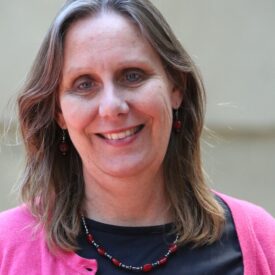
Luis Antonio (Tony) De La Rosa has been named the interim executive director of the Presbyterian Mission Agency. He will begin his service on Dec. 1.
In introducing De La Rosa, Marilyn Gamm, chair of the Presbyterian Mission Agency board, said “We love this person’s energy and passion,” and said De La Rosa told those interviewing him: “The Presbyterian Mission Agency needs a huge injection of hope.”
De La Rosa is a ruling elder in the Presbyterian Church (U.S.A.) and recently served as a commissioned ruling elder and interim lay pastor of Newport Presbyterian Church in Bellevue, Washington. A lifelong Presbyterian, he formerly served as the clerk of session at Immanuel Presbyterian Church in Los Angeles and as the interim executive presbyter of the Presbytery of New York City.
De La Rosa received a Bachelor of Arts, Master of Divinity and Juris Doctor degrees from Yale University. As an attorney, he worked with L.A. Care Health Plan, the nation’s largest public health maintenance organization. In the 90s, he served as the executive director of the Los Angeles Center for Law and Justice.
He is the second Latino, and the first openly gay person, to lead the Presbyterian Mission Agency. De La Rosa and his husband, Michael P. Bendgen, were married in June at Immanuel Presbyterian Church. The couple will relocate from their residences in Los Angeles and Bellevue to Louisville later this year.
 During his remarks to the board, De La Rosa tipped his hat to the service of Frank Diaz, the first Latino agency leader. In the 1990s, Diaz served as interim executive director of the then General Assembly Council, a predecessor of the PMA.
“This has been quite a day for Latino faith leaders,” he quipped during a news conference – a nod to the exuberance greeting Pope Francis on his U.S. visit. “I’d like to see my self as just part of an ongoing trend within the church. I’m half Mexican and half Puerto Rican. My father was fro Vera Cruz, Mexico. My mother was from a tiny little town in southeast Puerto Rico. That meant, naturally, I was born in Chicago.”
Not long after that, the family moved to Los Angeles where De La Rosa said he grew up in a neighborhood that was mostly Mexican-American and Asian. “My faith experience has also endured a great deal of diversity,” he said – including time at Calvary Presbyterian Church where he was ordained a ruling elder and at Immanuel Presbyterian, where worship is held in both Spanish and English and where he is currently a member.
“I have had the benefit of incredible experiences in the life of the (Presbyterian) church that have sort of run counter to the presumed trend of being homogenous, white, European, upper-middle class,” De La Rosa said.
The executive committee began searching for an interim after Linda Valentine, who had served as executive director since 2006, announced this summer that she would resign, and did so July 10. Valentine said she was leaving not because of controversies troubling the church over the past year (involving the 1001 New Worshiping Communities and Special Offerings programs, for example) but out of a sense that God was calling her to other things.
The new interim executive director will have responsibility for leading the Presbyterian Mission Agency at a significant time – as budgets for 2017 and 2018 are being developed and as the PC(USA) is running out of unrestricted reserves that have been used in the past to balance the budget. One thing yet to be determined: If the denomination’s national staff needs to endure more layoffs or significant restructuring, will that decision be made by the interim or by whoever is selected as Valentine’s long-term replacement?
Also, it’s becoming clear that the conversation about systemic changes needed in the PC(USA) is growing both broader and more imperative. Heath Rada, moderator of the 2014 General Assembly, to some extent stole the thunder from the announcement of the new interim by issuing a “Call to the church” at the same meeting – a call to recognize that Presbyterians are mistrustful of the national church and unwilling to support it financially until they have a greater sense of confidence in the denomination’s direction. Rada is calling for the PC(USA) to move quickly towards reform, to take “bold and immediate steps.”
The Committee on the Office of the General Assembly is preparing to announce the means by which the churchwide assessment of what reforms need to happen of which Rada spoke would take place.
Rada’s call to the church grew out of conversations he and other Presbyterian leaders were having about funding for PC(USA) World Mission – and the projections which show that World Mission may face a $4.5 million shortfall by 2017, which would force the PC(USA) to recall about 40 of the 162 mission co-workers it now has assigned internationally. As a result of those initial conversations, Rada said, he became aware of the urgent need for change.
People are not giving to the church because of a “lack of trust,” including of the PC(USA)’s national staff in Louisville, Rada told the Presbyterian Mission Agency Board’s executive committee, and from “a total desire to see where we’re going on the part of members of our denomination before people want to give money.”
That lack of trust “is manifested in many ways,” Rada said, including “departing congregations, confused members concerning who we are as the PC(USA), disinterested local sessions and congregations when it comes to national church initiatives (unless they are controversial) struggling mid-councils, frustrated and anxious staff in our national offices, many of whom are wary and disillusioned, and financial supporters who are seeking other ways than through our denomination to share their money.”
Earline Williams, the PC(USA)’s chief financial officer, told the executive committee Sept. 23 that while the denomination’s financial report so far for this year is favorable – spending is under budget as of August 31 – she does not want to “create a false sense of security.” Unless something changes, the PC(USA) will draw its unrestricted reserves down to the required minimum by 2017 at the latest.
The budget and mission work plan for 2017 and 2018 will “create the road map for us to live in to our financial reality, that we cannot spend more than we receive, much like our own households,” Williams said. “We are prayerful that someone will write a large check” of unrestricted funds.
To handle things in the immediate days after Valentine’s departure, the executive committee named Barry Creech and Williams as temporary co-managers of the agency. Williams is the deputy executive director of shared services and the PC(USA)’s chief financial officer. Creech is director of policy, administration and board support.
During a news conference, De La Rosa said he had not spoken to Rada about his report, so could not speak to it specifically. He acknowledged there is a lack of trust in the PC(USA) and “there’s a lack of trust in the country. I don’t think the church is immune from greater trends,” noting a tendency toward a “fear of changes.”
Structures often are blamed “when they are not able to perfectly navigate through those changes,” he said. “Part of leadership therefore is to address some of that anxiety, hold a mirror to it, name it and then redirect the energy toward the creative responses that change calls from us.”
Gamm said De La Rosa is expected to serve from one to three years – exactly how long will depend on factors including the search process for a called executive; the efforts to shape the PC(USA) budget for 2017 and 2018; and other challenges facing the church. The financial challenges “are huge,” she said, and “can’t be magically solved overnight.”

As De La Rosa takes on that work, the board doesn’t want him to feel constrained “to rush to make decisions we might all regret,” Gamm said. “We are trying to leave enough flexibility to not hamstring the spirit and not unduly tie someone up so they can’t do a good job.”
The General Assembly would need to elect the next called executive director – who would assume the role after De La Rosa’s interim service would end. But Gamm said there is a model other PC(USA) agencies have used, such as with James Rissler, whom the Presbyterian Investment and Loan Program (PILP) named its president and chief executive officer in October 2014. In that scenario, the appointment is made between General Assemblies, Gamm said, and the next assembly confirms it.
The board has begun the search for an executive director to succeed Valentine – with some hoping that a candidate might be ready to present to the 2016 General Assembly when it meets June 18-25 in Portland.
The nominating and governance subcommittee is recommending that the board appoint seven of its members to serve on the search committee:
- Landon Whitsitt (chair)
- Marsha Zell Anson
- Jeffrey Joe
- Joseph Morrow
- Kears Pollock
- Patsy Smith
- Wendy Tajima
The recommendation states that several others would serve as ex-officio members of the search committee: Marilyn Gamm, chair of the board; Rada; and a representative of the Committee on the Office of the General Assembly.
Click here to read a Q&A with De La Rosa and the Presbyterian News Service.