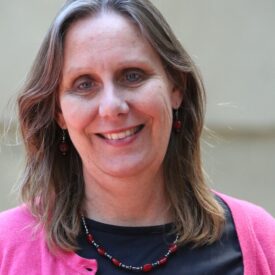
Think of Todd M. Johnson as a man who paints a collage picture of world Christianity, fact by fact.
As in:
- For 900 years, from the time of Jesus until the early 10th century, the majority of Christians were Africans and Asians.
- Then things changed dramatically – at the time of the Reformation, more than 90 percent of the world’s Christians were Europeans.
- And now things have shifted again: starting in the early 1980s, Christians in the global South have outnumbered those in the northern hemisphere.
Johnson is an associate professor of global Christianity and director of the Center for the Study of Global Christianity at Gordon-Conwell Theological Seminary in Massachusetts. He also is co-author or co-editor of a number of books tracing the demography and history of global Christianity, including “The World’s Religions in Figures” and “Our Global Families: Christians Embracing Common Identity in a Changing World.”

On Nov. 12, he gave the annual Presler Lecture at Louisville Presbyterian Theological Seminary.
Johnson uses his platform to educate people about the demographic shifts in world religion – and to make the case that better understanding will make for a better world. Christianity is fragmented, he contends – with more than 45,000 Christian denominations in the world and 150 Presbyterian denominations in Korea alone.
The percentage of the world’s population that is Christian has remained fairly steady since 1900 – about one-third of the world’s people are Christian, he said. Within that figure, however, lie tangible shifts – what he described as a “dynamic, changing situation”:
- In 1910, more than 80 percent of the world’s Christians were from Europe and North America. A century later, by 2010, that figure fell to under 40 percent.
- The majority of Christians now are from Latin America.
- By 2100, it’s expected that half the world’s Christians will be from Africa.

The way Christianity is being practiced is changing as well – particularly with the contextualization of faith to represent the local traditions of ethnic and language groups from around the world.
“The single biggest renovation project in Christianity … is the decolonization of Christianity,” Johnson said. That trend is explored, he said, in books such as Richard Twiss’s “Rescuing the Gospel From the Cowboys: A Native American Expression of the Jesus Way” or Hwa Yung’s “Mangoes or Bananas? The Quest for An Authentic Asian Christian Theology.”
When Native Americans were sent to Christian boarding schools, “if they spoke their mother tongue, they were hit with a stick,” Johnson said. “That’s the opposite of what indigenous Christianity is all about.”
While the world now has fairly large atheist and agnostic populations, as a whole the world is actually is becoming more religious – in part because of the growth of faith in China. “The most religiously diverse place in the world is Asia,” Johnson said. In Singapore, for example, no single religious group claims more than a third of the population.
Among other points he made:

Migration. Nearly half the people on the move now are Christian, many of them from Latin America, according to the 2012 “Faith on the Move” report from Pew Research Center’s Forum on Religion & Public Life. Muslims, who make up 23 percent of the world’s population, accounted for 27 percent of the migrants. By 2100, Muslims and Christians together are expected to account for two-thirds of the world’s population, up from one-third in 1800. “Those two religions need to learn to get along,” Johnson said.
Mission. Most Christian outreach “never reaches non-Christians” – but instead involves efforts to evangelize Christians from other denominations, Johnson said. One study found that Orthodox churchgoers from Ukraine reported they had been approached an average of 27 times a month by evangelicals, he said. Yet 86 percent of all Hindus, Muslims and Buddhists report they do not personally know a Christian.
Worldwide, one in six people live in slums. Yet only about one in 500 mission workers and one in 10,000 pastors live in slums, Johnson said.
“We have a relationship gap that’s absolutely essential to overcome,” he said. “It makes no sense to share faith without friendship, without hospitality, without actually knowing people … You don’t just beam the gospel message and have no contact with people.”
Christians need to learn “to really embrace their global human family” and to work in solidarity with secular people involved in humanitarian and justice work around the world, Johnson said.
Understanding. “We’re all in this together,” he said. Christians need to strengthen their understanding of the world’s other religions – “atheists actually score the highest on the tests of other religions,” he said – and to get to know and understand those of other faith traditions.
Practice hospitality. Johnson’s wife, Tricia, teaches English as a Second Language in Boston – and this Thanksgiving, as they typically do, the Johnson family will invite some of her ESL students to join them for dinner. Before eating, they go around the table introducing themselves, and Johnson said he typically asks those present how long they’ve been in the United States.
“Every person, every single time,” says this is the first time an American family has ever invited them for dinner, he said. They come from “Iraq, Saudi Arabia, Peru – it doesn’t matter. They’re not invited into people’s homes.”
Learn to appreciate the ways in which Christianity is lived out in non-Western contexts or outside one’s own denominational tradition. Last year, Johnson said, he went to Uzbekistan – and there met mission workers from India, Brazil, China and Australia. Working with Cambodians in Thailand, he was the only American on a team that included representatives from the Philippines, Malaysia, South Africa and Switzerland.
The Cambodians asked, “Who are you? You’re from all over the world. You don’t seem to represent any national agenda.”
They were able to answer, “if you’re really interested in Christianity, this is what it looks like” – all races, all ethnicities, all languages, all belonging.
Johnson said: “I hope that becomes more normal in the decades ahead.”