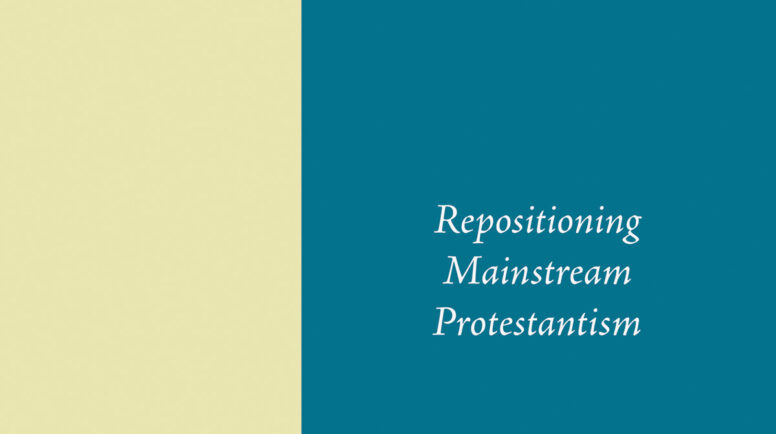
 by Ronald P. Byars
Cascade Books, Eugene, Ore. 124 pages
REVIEWED BY JOHN M. MULDER
“We are living, as far as any sort of religious faith is concerned, in a time of cultural and spiritual crisis.”
That is the opening salvo of Ronald P. Byars’ excellent and brief analysis and prescription for mainline Protestantism. Byars continues, “And yet, if one visits services in American Protestant churches, it is not always clear whether anyone in charge has noticed the crisis. The crisis, like nearly all crises, poses a theological challenge. Not just, or even primarily, a challenge to academic theology, but one that is more pressing: a challenge to the theology that animates congregations, the sort that cries out to be embedded in preaching and worship. The challenge to those who preach is one that requires discovering speech adequate to express the deepest affirmations of the church’s faith in ways accessible to the minds and hearts of people whose daily lives expose them to often benign but powerful antitheses to the gospel.”
Byars is a retired professor of preaching and worship at Union Seminary in Virginia, and he has served for many years in pastoral ministry in Michigan and Kentucky. He brings to this book not only deep experience in congregations and the classroom, but also a profound love of the church — especially its worship. The key to “repositioning mainline Protestantism,” he argues, is recovering the “orthodoxy” of the church, represented by its ecumenical creeds, and then embodying that orthodoxy in the worship of the church. That worship, he insists, must always be directed to a concern for the poor, which is the heart of Christian discipleship.
He recognizes that the term “orthodoxy” makes many mainline Protestants squirm, but he insists it contains the affirmations of the church, not simply the critiques, of contending religious and cultural options. He is especially good on rejecting the tendency to define mainline Protestantism with a twitch over our right shoulder. “The best way to engage fundamentalism,” he writes, “is not by declaring war (highlighting what we are against), but by affirming the substance of classical Christian faith (highlight what we are for).”
Given Byars’ experience and background, it is understandable that the substance of the church’s affirmations would be an emphasis on worship, the sacraments and the church as the expression of the gospel. But his vision is not a stuffy churchiness, and it is in the chapter on “attentiveness to the poor” that Byars sounds a prophetic word amidst the affluence of American culture, especially in mainline Protestantism. When churches focus their worship on the poor, he argues, “the baptized” become “a people whom God has chosen not for special privilege or favor but to be a ‘holy nation’ whose purpose is to serve all of fragmented and contentious humankind.” We give because we cannot keep.
I wish Byars had devoted more attention to how people experience God than what they should believe about God, but he has written a compelling and provocative manifesto about our present state and future promise. Read his book, and it may change your position.
 JOHN M. MULDER is associate minister for stewardship at Second Presbyterian Church in Louisville, the former president of Louisville Seminary and the editor of “Finding God: A Treasury of Conversion Experiences.”