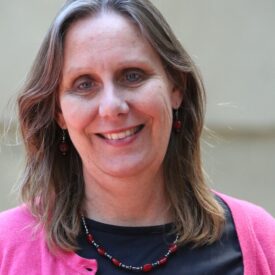
Heath Rada, moderator of the 2014 General Assembly, has begun a series of “Call to the Church” discussion sessions around the denomination – asking Presbyterians to share their suggestions for the future of the church. His plan: to include those ideas in a report to the General Assembly “The Way Forward” committee this summer, and with the Presbyterian Church (U.S.A.) more broadly.
“Folks, be bold,” Rada told a listening group gathered March 7 at Auburn Theological Seminary in New York. “Don’t be restricted by our structure. We can dream great dreams today.”
His conversations are being organized in anticipation of the discussion the 2016 General Assembly will have in Portland about possibly restructuring the PC(USA) – with overtures asking the assembly to consider a potential merger of the Office of the General Assembly and the Presbyterian Mission Agency, and with discussion expected about whether the denomination should have fewer than 16 synods.
Rada said his intention is that “we not use this as a gripe session – we’re not here to talk about what’s wrong with the church.” The focus is on “where are we going … what is the church called to be?”
He started these listening sessions with two conversations in Atlanta – in a private gathering with evangelical leaders from the Fellowship Community on March 2 and 3, and later with mostly African-American Presbyterians at an event March 4 at First Afrikan Presbyterian church in Lithonia, Georgia, organized with the help of Paul Roberts, president of Johnson C. Smith Theological Seminary.
The evangelical leaders said they don’t want to leave the PC(USA) – their message is “we want to lead, not leave,” Rada told the Auburn gathering.
He also spoke briefly about an Office of the General Assembly endeavor to gather opinions about the identity and purpose of the Presbyterian Church, the results of which are expected to be released soon and that is being described as the largest study of its kind ever done by a mainline denomination, with more than 3,000 online responses.
Rada said his personal opinion is that it would be “putting a Band-Aid on a broken bone” to wait to figure out where the church is to go until a new structure gets designed. He acknowledged others disagree – seeing reorganization as the necessary first step.
Rada contends that Presbyterians need to “give ourselves permission to make mistakes,” and that any idea for change the 2016 General Assembly adopts “can be redone or totally thrown out if it doesn’t work.”
If Presbyterians sense the Holy Spirit moving, “let’s try it,” the moderator said. “Let’s risk it.”
Rada started the Auburn gathering by asking those present to give one-minute summations of areas to which they’d like to see the PC(USA) give attention. Among their responses:
- Presbyterians are struggling with how a predominantly white denomination can be part of a multiracial future.
- How the church can respond quickly to social issues such as police brutality and gun violence – issues that sometimes dominate cultural conversations, but about which “it appears the church might be somewhat silent.”
- What does it mean to provide an evangelistic witness to people of other faiths while remaining in relationship with them?
- Presbyterians need to make a commitment to creation justice by saying not just that “Presbyterians will recycle more and use green light bulbs,” but by addressing the role that racism, poverty and colonialism play in environmental issues. “I want my grandchildren to live in a world where they can breathe,” one woman said.
- How does the PC(USA) effectively tell its story? And to what extent does that involve “some truth-telling,” not just “the stories that make us look pretty?” one woman asked. As a denomination, “I don’t necessarily think we’ve lost our way – I do think we’ve lost our voice,” another person said.
- How can the denomination empower local congregations, who sometimes feel ignored unless someone’s asking them to give money? How can the PC(USA) “support them so they want to be part of this connectional church?” a woman asked. “Right now, most of them are happy to be really isolated.”
- “Congregations really, really matter,” and the denomination will rise and fall on the health of the congregations, another participant said.
Based on the concerns participants raised, the gathering of about 30 broke up into small groups to discuss six areas: social witness, local ministry, communications, structure, evangelism and education. Some of the ideas and questions they reported back when they returned:
- For the next two years, the PC(USA) should focus on racism and dismantling white privilege – using that as a lens through which to consider all its work.
- The PC(USA) needs to move away from old structures that no longer work and figure out “what is the next structure,” better suited for a smaller church.
- How can Presbyterians become better listeners – to learn from one another and to listen for “who is being left out? Whose voices are not being heard?”
- How can the PC(USA) develop both pastoral and lay leadership, particularly for the many small congregations – with about half the denomination’s congregations having 100 members or fewer?
- How can language from the Bible be used as a tool to bring people together to talk about justice and social witness?
- What does evangelism mean to people who are concerned about race, economic issues and social justice? Part of evangelism means showing up and listening – “as opposed to saying ‘we’re going to create a program.’ ”
- What is the role of seminaries in training new leaders to work in ministry in a changing context? “Are we teaching people to be change agents?” Rada asked. Are seminaries teaching ministers what they need to know? Studies have shown pastors suffer disproportionately from stress, depression and burnout, he said, and many ministers acknowledge, “I wasn’t equipped to do many things I’m required to do.”
- What’s the importance of branding and creating a distinct identity for the PC(USA)? How can Presbyterians learn to effectively tell their stories? In addition to positive “good news” stories – which can be tools for congregations to learn from one another – “good news also arises from suffering – from shared suffering and struggle and being in the places of tension,” one participant said. “That’s part of our story” too.
Rada is planning three more listening sessions – March 10 at First Presbyterian Church in San Diego; March 12 at Collegiate Presbyterian Church in Ames, Iowa; and March 19 at Princeton Theological Seminary, with vice-moderator Larissa Kwong Abazia.