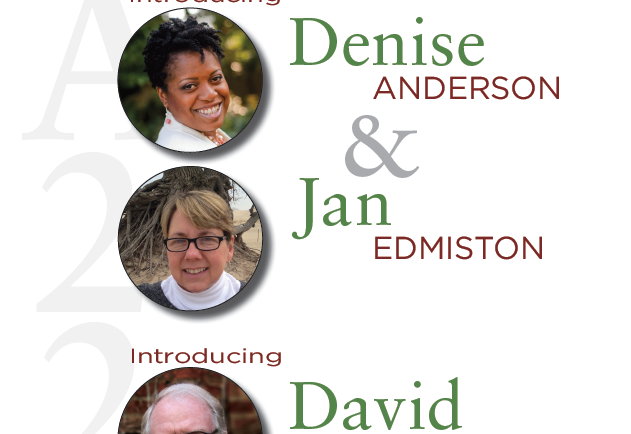
 Electing the moderator or, as is possible for the first time this year, co-moderators, is one of the most important responsibilities of commissioners to the General Assembly. As we prepare for the 222nd GA in Portland, we posed a series of questions to those standing for moderator and co-moderator of the 222nd GA. We are grateful for the candidates’ willingness to share their answers with us.
Since this piece was printed, David Parker and Adan Mairena have announced plans to stand as a co-moderator team, pending Mairena’s endorsement by the Presbytery of Philadelphia.
OUTLOOK: Why do you feel called to stand for moderator/co-moderator?
DENISE ANDERSON & JAN EDMISTON: We have been friends for quite some time and have a deep admiration for each other’s gifts and vision for ministry. We discussed and discerned for a while what it would look like to stand together for co-moderator, and in listening to each other’s hopes for the church, we began to get excited about the possibilities. Both of us agreed that while we believed in the other’s ability to stand alone as moderator, we could serve better together. We hope to model a different way of serving by sharing responsibilities as equal partners with different gifts and experiences. Together we are a team with both a cradle Presbyterian and one who became Presbyterian as a young adult in a new church development. We’re each in different stages of our career, we come from different social locations and generations, and yet we bring a common love for the PC(USA) that’s informed by those very different church experiences. We are voices that — by God’s grace — can speak to what it means to be the 21st century church for the PC(USA).
DAVID PARKER: After serving as a commissioner to the 219th General Assembly in Minneapolis in 2010 and then simultaneously serving as Salem Presbytery moderator and chair of a North Carolina state political party in 2012, I cheerfully dismissed suggestions to stand for 221st GA moderator. But when more Presbyterians whose guidance I respect suggested in 2015 that I stand for moderator of the 222nd GA, I discerned that I should “test” the call. Calvin, commenting on 1 John 4:1, counsels that we should use the “Word of God as a touchstone” for Spirit-filled sound private judgment, and then submit to the public “common consent … of the Church” derived by “honest and godly agreement” to test a call.
For several months before and for a month after Salem’s “call” and endorsement of my candidacy, I talked with my family, with my business partners and with diverse Presbyterians around the country, and prayed over the matter.
Consequently, I came to believe that with God’s help I can positively impact PC(USA) as the 222nd GA moderator. The 222nd GA will test my “private” calling by its public “honest and godly agreement” in Portland.
OUTLOOK: What is the most pressing issue facing our denomination?
DAVID PARKER: Wholeness, meaning coming together while clearly seeing our diversity: no easy task and impossible without grace. Individually, Jesus teaches us to love one another, even as he loves us. In 2005, I wrote a song for Covenant Network saying “if we only love who looks like us … thinks like us … loves like us, what good is that?” Wholeness is the starting point.
Within the PC(USA), wholeness means respectfully and simultaneously hearing the missional call of “emerging Christianity,” the angst about PC(USA) institutional adaptation and our theological differences. Do the tools and resources of an older, somewhat staid, 90 percent European-heritage membership truly complement and fulfill the diverse energy and ideas of those who are non-European or in the youngest quarter of our membership or both? For instance, at 61 and a grandfather, I am still in the younger half of the denomination! Where does the PC(USA) want to be in 20 years? The PC(USA) needs active listening, long-range planning and connection of Louisville to every-ville. Can we use our seminaries and churches in need as incubators? To increase connection, can we set two Sundays a year for church pulpit and choir exchanges to cross-pollinate PC(USA) congregations?
DENISE ANDERSON & JAN EDMISTON: There is a lack of trust in our institutions — both on the national level and in our mid councils. In spite of the faithful work of denominational workers, people in our congregations either don’t trust or don’t care about what happens beyond their congregations. We see a lack of connection between many of our congregations and the denomination, which we believe facilitates mistrust. We understand that disagreements over the direction of the national body contribute to that. We see similar trends, of course, in national politics as well.
We would all do well to remember what Jesus died for, and Jesus didn’t die for unending committee meetings or church property arguments. The PC(USA) could benefit from clarifying our unique witness and where God is calling our particular branch of Christ’s body to act. We are so appreciative of the conversations Moderator Rada and Vice Moderator Kwong Abazia have facilitated about our denominational identity. We hope that those conversations can be continued and broadened to more fully include those in the pews (and beyond), so that when someone says, “I’m Presbyterian,” there is a better understanding of what that means.
OUTLOOK: What do you see in the PC(USA) that inspires you and gives you hope?
DENISE ANDERSON & JAN EDMISTON: Because of her presbytery work, Jan worships with a different congregation almost every Sunday and she especially loves observing congregations that exude resilience and joy. They are unafraid of cultural shifts because their faith keeps them grounded. They are discerning what breaks God’s heart in their communities and then they are addressing those issues. They are the ones who have stepped out of cookie-cutter ministry. They offer authentic hospitality in the name of Jesus. They are less anxious than they are trusting that God will shepherd us into a new season of being the church. It’s her favorite thing to observe in our congregations.
Similarly, Denise has seen the prophetic witness that is alive and well in our churches through her service on National Capital Presbytery’s leadership council and her work with NEXT Church. Our churches are active in the fight for fair wages and affordable housing. Our ministers are on the front lines of the fight for racial and gender justice. Our churches are opening their doors to refugees, migrants and day laborers. The Holy Spirit is moving mightily in our midst, and we’re both excited about what will come if we stay the course.
DAVID PARKER: We are 1.6 million Presbyterians in 9,800 places of worship serving some 8 million folks both inside and outside our congregations through our mission work. The PC(USA) has vast wellsprings of creative energy in our diverse members, educators, wizened elders, young members and seminary graduates yearning to make the Word live in the hearts of all people. If we inventory and fully access the skills, gifts and mission passions of our believers, we can be a phenomenal force for good and spreading the good news!
OUTLOOK: What is your opinion on restructuring the Presbyterian Mission Agency (PMA) and the Office of the General Assembly (OGA)?
DAVID PARKER: Clearly, the moderator’s opinion can have no bearing on how she or he conducts the GA discussions on any subject. That said, having counseled numerous nonprofits and for-profits as an attorney, board member or presiding officer, I have learned that effective systemic
change requires consensual internal, facilitated mediation. Part of wholeness is accepting mediation. Although the folks in the pews may not feel it, the PC(USA) governance model needs determined internal mediation and work that I would welcome facilitating.
DENISE ANDERSON & JAN EDMISTON: We are blessed with committed leaders serving both of these entities, but we need to consider streamlining our structure in ways that serve our congregations and the wider church in the best possible way. From the 2015 Presbyterian Panel Report (“Awareness and Understanding of the Presbyter-ian Mission Agency”), it’s clear that many of our members are unaware of the ministry of the PMA. The Presbyterian Panel found that “just over half (51%) of teaching elders feel like they are familiar with the Presbyterian Mission Agency, compared to only 20% of members.” Over 10 percent of ruling elders who completed the survey and about half of the teaching elders believed that the PMA and the OGA were actually one and the same. How can we be more nimble so that when God calls us to move, we are able to respond?
As pastors, we’re also very concerned about the overall health of our dedicated staff in these days of layoffs and cutbacks. When we’re so concerned about limits and scarcity, we feel less free to move toward where the Spirit is leading us. We’re hopeful for a structure and culture that honors staff and promotes their spiritual and physical health.
OUTLOOK: What issues beyond the PC(USA) do you want Presbyterians to address in the next two years?
DENISE ANDERSON & JAN EDMISTON: Although our denomination has addressed systemic racism for decades, we have come to a point where anti-racism training must be an essential part of every congregation’s conversations. To that point, Jan speaking about these issues as a person who grew up in the dominant culture would be received differently by Denise as a person of color. We would like to talk about these things in Christian love. While our beloved PC(USA) is predominantly a white denomination in a nation that is increasingly less so, we have the extraordinary opportunity to serve side by side with people we have not partnered with before. We do this — not to keep up with demographic shifts or for institutional survival or to create quotas that make us congratulate ourselves for how open we are. We do this at the pleasure and commandments of God. And — selfishly speaking — we are a richer, more creative church when we embrace the diversity of the Body of Christ.
DAVID PARKER: First: wholeness. Wholeness means connecting every neighbor as Jesus teaches us at a deep, spiritual level. In contrast, superficial connection through various news and social media seems to actively promote schism. The arc of the moral universe does bend toward justice, but sometimes it is hard to see! In being reformed by the Holy Spirit, we connect and see our neighbors and the world through the enlightening lens of the Word (versus the dim lens of our circumstances). In a 1998 song for Presbyterian Pilgrimage, I wrote: “I am a New Creation, I am a part of the Whole.” The “Whole” includes every neighbor. The PC(USA) is situated to provide a rare sanctuary for the world to re-connect through Calvin’s “coming together and reasoning their way to an honest and godly agreement.” In our churches, we can disagree and still come together for communion, which is all too rare today. In assertively connecting the virtually armed silos of the world, the PC(USA) can deeply engage in the spiritual work of reconnecting neighbors. And, just as the PC(USA) needs to think long term, so we should ask our society: Where do we want to be in 20 years? The PC(USA) can promote a vision of wholeness for the world.
Second: seeing beyond the law. E.A. Robinson, in his poem “The Three Taverns,” has Paul say that “I did not see myself the criminal / You contemplate, for seeing beyond the Law / That which the Law saw not.” Even when the Law is being followed to the letter, injustice, cruelty and pride never take a holiday — ever. Nor can we. We must see, as Jesus taught us, and as amplified by Micah and later Paul, that God requires that we do justice, love kindness and walk humbly with our God.
We are called, as we have been called since the early 1720s in America, to make our discerned denominational voice heard. Being a sanctuary for discourse without being partisan or judgmental also means acting assertively as a whole once we have discerned the righteous path. This is a high mission call for a fractured world, but as Browning asked: If our reach does not exceed our grasp, or what’s a heaven for?