by Deborah Thompson Prince
 The church moves through Pentecost so quickly that it is difficult to do justice to the beauty and complexity of this moment of divine encounter. If we look past the cliché at the heart of many children’s sermons that Pentecost is the birthday of the church, there remain many significant avenues for theological reflection. Peter’s Pentecost speech is the first time the gospel message of the life, death and resurrection of the Lord Jesus is boldly proclaimed. We may reflect, therefore, on the power of the Holy Spirit that entered into those gathered in Jerusalem and celebrate the transformation that results when powerful preaching reaches the ears of those who need it, as seen in the 3,000 who accepted the message and were baptized (Acts 2:37-41). Or we may read the story of Pentecost and focus on how the Spirit empowers our life of discipleship through acts of healing, devotion to prayer and concern for the needs of others (Acts 2:42-47). Each of these responses to the story focuses on the power of the word and action, which is at the heart of Reformed theology.
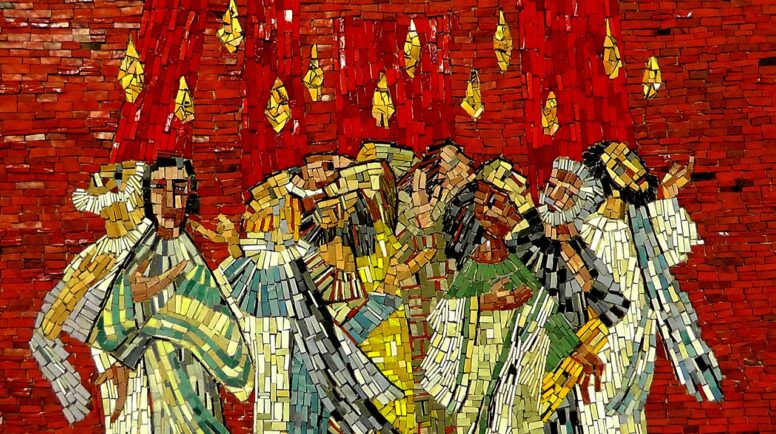
Before any word was spoken or any act taken, however, the apostles were overcome by a visionary experience. While they were gathered together in Jerusalem, they were suddenly accosted by a great sound from heaven and “divided tongues, as of fire, appeared among them, and a tongue rested on each of them” (Acts 2:3). Often Christians bypass this experience and focus on the result, whether the ecstatic speech (glossolalia) or Peter’s address to the crowd present at the event. Howard Rice, in “Reformed Spirituality: An Introduction for Believers,” recognizes that most people today “have very strong defenses that form a shield against the experience of God.” This is true for many of us raised in the Reformed tradition who have been taught to view spiritual experience (whether visionary or otherwise ecstatic in nature) with suspicion based on readings of Calvin that emphasize the intellectual and rational approach to knowing God through community and the preaching of the Word. Although Rice acknowledges that Calvin can and has been interpreted in ways that are more open to personal religious experience, there remains a discomfort for many with visionary experience in particular. It is telling that even in a volume on spirituality, only one page is specifically dedicated to visions and spiritual experience is often discussed in more general terms. It is not surprising then to find that the term “vision” is not listed in the index (although there is an entry for “dreams”). The terminology of “vision” is not fully welcome in the Reformed tradition. For many, the term indicates an experience that emanates from a person’s imagination and so is deemed unreal, or at best unreliable. Regardless of our personal discomfort, the author of Luke-Acts uses the language of vision frequently and unapologetically. And it all begins at Pentecost.
THE VISION OF PENTECOST
Biblical scholars have noted that the quotation from Joel in Peter’s Pentecost speech (Acts 2:17-21) explains the disciples’ experience as a revitalization of communication between God and God’s people. “‘In the last days it will be,’ God declares, ‘that I will pour out my Spirit upon all flesh, and your sons and your daughters shall prophesy, and your young men shall see visions, and you old men shall dream dreams.’” With the coming of the Holy Spirit, communication lines with God are open again.
But full communication with God is not only a verbal experience; it is a visual one as well. The prophets of ancient Israel frequently describe visual as well as verbal encounters with God. And the reader of Acts does not have to struggle to find many manifestations of communication with God through visions. Acts begins with an account of Jesus’ ascension, which was also narrated at the end of the Gospel of Luke. Here the apostles see Jesus taken up into heaven and immediately receive a vision of two angels (Acts 1:9-11). In the span of these three verses, there are five references to what the apostles see. The Pentecost vision follows soon after and visionary communication across the boundary between the human and the divine is evident again as soon as chapter 5, when the angel of the Lord releases the apostles from prison and tells them to “Go, stand in the temple and tell the people the whole message about this life.”
Encounters with divine figures (or visions of divine figures — it is not clear that there is a real distinction between these in Acts), whether angels or the risen Jesus, are particularly frequent in Acts chapters 7-12. In chapter 7, after a long speech recounting the history of Israel, Stephen has a vision of the heavenly court as he sees “the glory of God and Jesus standing at the right hand of God.” Soon afterward, Philip is visited by an angel of the Lord and is told to head south along the desert path where he comes across an Ethiopian eunuch, whom Philip will baptize. In chapters 9-10, four different men of various religious and cultural identities (Paul, Ananias, Cornelius and Peter) will see and hear the risen Jesus or an angel of God and together come to understand God’s open invitation to all people, Jew and Gentile, to believe in Jesus, to be baptized and to be welcomed into God’s community. Paul himself is said to experience multiple visions and dreams in Acts, and his vision on the road to Damascus is shared three times throughout the narrative.
Why are there so many visions and dreams in Acts? Words are important, as seen in the prevalence of speeches in Acts. But so too are visions. Revelation is the only New Testament book that exceeds Acts in terms of its visionary material. From the very opening of the book of Acts, it is clear that one must see before one can speak. Religious experience must precede religious thought or speech. For what have disciples to say if they have not “seen” the Lord? The claim that the apostles are themselves “witnesses” to Jesus emphasizes the first step for all who would speak and act in Jesus’ name — they must have seen the Lord. Furthermore, when a disciple must be chosen to replace Judas, it was determined that he must have been an eyewitness of Jesus’ ministry, post-resurrection appearances and ascension. Even during the Pentecost event itself, the apostles see the power of the God in the flames of the Spirit before they are gifted with ecstatic speech (2:3-4). And Paul can only speak boldly about Jesus after he first sees him on the road to Damascus (9:1-9, 27). One must first encounter the divine before it is possible to share that experience and discern its meaning. Visions are spread throughout the story of the early church because the risen Jesus continues to communicate with his followers even after his resurrection. Jesus’ ministry is carried on within the Jesus community, the church. But to persist in this mission, the church must continue to see the path that God through Christ has laid before it. The Pentecost story reveals that it is by the power of the Holy Spirit that believers are invited to see what God would show them.
How is the divine encountered in the visions in Acts? Paul sees a blinding light on the road to Damascus and hears Jesus speak to him. The extent to which Paul’s vision is perceptible by the physical senses is not completely clear. His companions are said to either see the light or hear the voice, depending on which account of the experience is read, but not both. Peter is on the roof at noon praying, his hunger growing as he awaits the meal being prepared, when he sees the heavens opened and something like a sheet being lowered down with all sorts of animals in it, both clean and unclean. This vision seems to be an imaginative experience that has no connection to what Peter can physically sense beyond the hunger that may have triggered it. Cornelius sees clearly an angel of the Lord in his vision and hears him speak, but there is no indication that the angel had a physical presence that could be seen by others. Ananias hears the voice of the Lord but sees nothing. Although each encounter is different, each one is called a “vision.” The Greek word horama is used to describe Ananias (9:10), Cornelius (10:3) and Peter’s (10:17) experience and optasia is applied to Paul’s (26:19). The diversity of the nature of perception described in these visions illustrates the wide range of experiences that the biblical text considers to be visionary. We should not imagine that visions are only about “seeing” the divine in a literal way, nor should we assume that visions are clearly either physical or imaginative experiences. There is a complex interaction between the senses engaged and their physical and imaginative qualities. In particular, it is essential to recognize the close connection between seeing and hearing in biblical visionary experiences. Although sight is often proclaimed to be the most significant of the senses for gaining understanding (this perspective is commonly found across ancient Hellenistic literature), hearing is always intricately involved in the process. However, recognizing that sight alone is insufficient and that the act of seeing is complex does not undermine the necessity of that first step toward proclamation, vision.
SEEING ANEW AT PENTECOST
Reading the Pentecost experience as visionary and highlighting the role of the Holy Spirit in the experiences of visions and dreams may feel foreign. Some are uncomfortable with the idea of mystical experience. It may sound too individualistic, unreformed or perhaps New Age. To others, who long for more personal ways to experience God’s presence, such a reading may be more than welcome. In either case, now is the time, as we celebrate the coming of the Holy Spirit, to encourage the church to explore its own spiritual life more deeply. Seeing Pentecost anew challenges Christians, as Howard Rice has written, to let go of the need “to screen out or repress our own experiences when they do not fit our rational explanations of the way the universe operates,” so that “we may be startled into new awareness of God’s nearness.”
The stories of the apostles in Acts tell us that what we see and experience is as vital to God’s revelation as what we hear declared in the Word. Moreover, the declaration of God’s Word is only possible because we have first seen the Lord. As it was for the visionaries in Acts, visions may take many forms for us today. What they have in common is an experience that offers us the opportunity to see our reality as more than we can perceive on our own. A vision brings before our eyes the divine reality that is known through Christ and that guides us on the path by which we can make Christ known in the world. Through the working of the Holy Spirit, believers are invited to see beyond the common objects of our world, which we perceive through ordinary physical senses. This may mean that the visions made possible by the pouring out of the Spirit engage the human imagination as much, if not more, than the physical senses. Christians today may be more comfortable with what our eyes see and our ears hear through our ordinary sense perception. Certainly the biblical story has shown that God works through, and is revealed through, the everyday realities around us. God’s glory is evident in the wonder of nature.
Jesus’ crucifixion is experienced again through the hatred and accusations that one group shouts toward another. We can see Jesus in the most vulnerable in society. But is it ordinary human vision that shows us reality as God would have us see it? If we look at creation with human eyes, will we not simply see natural resources at our disposal? If it is with only our physical sense of sight that we observe people who treat others with contempt, will we simply see the expression of our own anger? If we look at the vulnerable in society with human eyes, will we not simply see people who take but do not give — if we see them at all?
Perhaps it is only with a sight that breaks the boundaries of heaven and earth, if indeed there is such a clear boundary, that we can see beyond the ordinary. Augustine calls this spiritual sight. If the Holy Spirit provides us with the gift to see one thing in the face of another, that is a vision! Not all visions involve ecstatic experience, although they may. Neither is all ecstatic experience hallucinatory.
On Pentecost the power of the Holy Spirit inaugurated a new wave of spiritual sight, of vision. That same Spirit continues to flow within the Christian community today. Margaret Miles states that for Augustine “the first prerequisite to spiritual vision is faith, the faith that there is something to see and that it can be seen by human beings.” Has God indeed poured out the Spirit on all flesh, as the story of Pentecost tells us? If so, then be ready to see visions and dream dreams.
 DEBORAH THOMPSON PRINCE is assistant professor of theology at Bellarmine University in Louisville. She has worked as a Christian educator in Presbyterian churches in Indiana and Michigan and is a ruling elder at St. John Presbyterian Church in New Albany, Indiana.