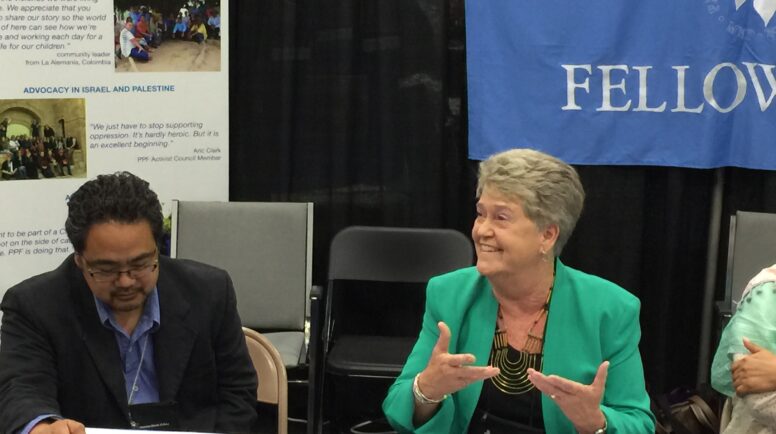
PORTLAND, Ore. – At 4 p.m. on Sunday, June 19 in the exhibit hall at the Presbyterian Church (U.S.A.) General Assembly, a press conference was held in support of an overture that proposes divestment from fossil fuel companies. The press conference was co-hosted by Presbyterian Peace Fellowship and Fossil Free PC(USA). Speaking at the press conference were Susan Andrews, moderator of the 215th General Assembly, Bruce Reyes-Chow, moderator of the 218th General Assembly, John Fife, moderator of the 204th General Assembly, and Marta Muñoz, current moderator of the Iglesia Presbiteriana de Colombia in South America.
A letter was presented signed by nine former PC(USA) moderators written to the commissioners of the 222nd General Assembly asking for them to support and approve the overture “On PC(USA) Fossil Fuel Divestment – From the Presbytery of San Francisco” (09-01). Each former moderator and Muñoz spoke passionately about their support for this overture.

Andrews started the press conference. She stated that Rick Ufford-Chase, moderator of the 216th General Assembly, wrote the letter and circulated it to all of the former moderators, inviting them to sign. Andrews said, “Climate change is a catastrophe that effects every human being on earth and the longer we wait, the more we are desecrating what God has created and given us to take care of.”
Andrews acknowledged her own centrist tendencies, but said she felt compelled to sign on to this particular letter because of the way the overture builds on previous efforts and the multi-pronged approach it takes to respond to global climate change. She highlighted the fact that the overture proposes keeping a basic amount invested in the stocks so that Presbyterians still have a voice at the table as shareholders. She also noted that the overture does not address only divestment, but also proposed “positive investment” in alternative energy. And, she said, the overture “takes seriously the fiduciary responsibility of our denomination and the fact that in many ways our stocks are in jeopardy as climate change changes the whole energy industry, so there is some stewardship prudence included in this overture.”
Reyes-Chow stated that he is an urban dweller who appreciates development and the benefits of fossil fuels, however, “There are times when we vote and act against our own self-interest, our own wealth, our own comfort and our station in life. And in this particular case, it has become clear that intellectualizing our understanding of climate change cannot be something we can just wait on. We can’t afford to wait the two years, the four years, the six years that it often takes us to make very important decisions. At some point we act because it is the thing to do now. So when we signed that letter, that was your nine former moderators saying that we believe prolonged deliberation is not the way to go. We must act at this General Assembly.”

Muñoz spoke about the direct impact global climate change and fossil fuel extraction has on the people of Colombia. She spoke of rivers being polluted by oil, animals dying and fish being poisoned, which impacts those eating the fish and the livelihood of the fishermen. She said that passing this overture would send a message of solidarity to the Colombians who are disproportionately impacted by the oil industry and their unethical practices in Colombia as well as a message of protest to the oil companies.

Fife concluded the press conference reflecting on his own experiences with protests, non-violent resistance and divestment. He stated, “Never in the history of this nation, and beyond this nation, has any meaningful social change occurred without making the move from advocacy, protest and education to active non-violent resistance strategies. What this overture does is move this church to active nonviolent resistance with our money and our investments. I pray that the Presbyterian Church understand that this is the most urgent ethical and theological issue of the 21st century and that we understand the ethical and theological imperative of not waiting; this needs to be accomplished as soon as possible. In the 1970s, I chaired MRTI and we struggled with recommendations about divestment around apartheid in South Africa. We heard again and again that we ought to delay, wait, study more, and wait for succeeding General Assemblies to take this up. We didn’t wait. All of you know that history. One thing I want to point out is that the Wall Street Journal published a full page editorial when Nelson Mandela was elected where they pointed to the religious institutions, labor unions and corporate involvement in divesting from South Africa as a major contribution to the nonviolent change that occurred in the regime in South Africa. The Wall Street Journal proclaimed that it was profoundly grateful for the leadership of all those institutions who divested in the 1970s to challenge the moral and ethical foundations of apartheid in South Africa. Now is the time when we can hopefully begin to make that history again.”