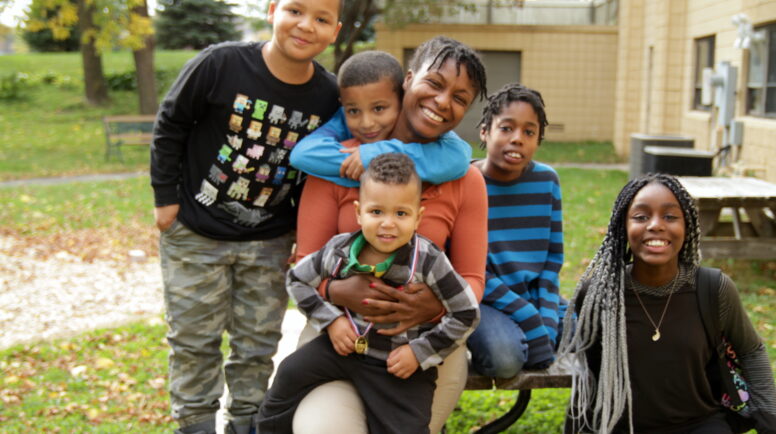
by Kris Berggren (Photos by Maria Forsythe)
In the affluent enclaves of Scott and Carver counties in suburban Minneapolis, it’s really hard to see the need for a homeless shelter.
But the need exists – an official point-in-time survey counted 17 households with children on one winter night last year as experiencing homelessness there, with a total of 72 households lacking shelter.

A group of local congregations responded by opening a Families Moving Forward shelter program in May 2014, the first family shelter program to serve Scott and Carver counties. Families Moving Forward is a program of Beacon Interfaith Housing Collaborative, a Twin Cities nonprofit dedicated to ending homelessness through housing, shelter and advocacy.
Shepherd of the Hill Presbyterian Church in Chaska, Minnesota, is among those congregations. Though small in numbers, they’re big on living their values.
“The church should not be just a building, it should be a place that serves the community,” said Dean Seal, the church’s pastor. “There are people out in the cold. Jesus said, I was a stranger and you welcomed me.”
Hidden homelessness in affluent suburbs
By urban standards, the number of families experiencing homelessness in Scott and Carver counties isn’t astronomical; just 17 families with children were homeless there according to a 2016 one-night count, compared with 44 families in 2015 (according to the Scott Carver Dakota Community Action Partnership that helps to address housing and other social service needs).
Another indicator of need is attendance at Project Community Connect, an event geared to connect those experiencing homelessness with helpful resources, which was up five percent in 2016 over the year before, said Eric Gentry, the agency’s director of housing.
The two counties are among those in Minnesota with the highest income per household. Visually, they’re a mix of quintessential main street America, rich rural countryside and suburban affluence. Carver County is home to the late musician Prince’s Paisley Park estate, and Hazeltine Golf Course, host of prestigious tournaments such as the recent Ryder Cup competition. Neighboring Scott County boasts the Mystic Lake Casino owned and operated by the Mdewakanton Sioux community and Canterbury Park horse racetrack.

Yet some people overshadowed by that affluence face homelessness or can’t afford the area’s market rate housing cost: those earning minimum or low wages as grocery clerks, gas station attendants, cleaning and service workers. For them, affordable, stable housing near where they work is a distant dream.
“When you live out in the suburbs you don’t think there are homeless people out here,” said Julie Wiese, a Shepherd of the Hill member who is active with Families Moving Forward. “It’s not like they are wearing a sign.”
It’s those “hidden in plain sight” folks that the members of Shepherd of the Hill Presbyterian Church want to serve.
Small congregation with a big heart responds to need
Early on, Wiese attended a training session about the Families Moving Forward model. Here’s how it works: Congregations take turns opening up their sites to create temporary shelter. A phalanx of volunteers mobilizes each week to set up sleeping space for each family, provide nutritious meals, plan activities for children and act as overnight staff. A former teacher, she was especially moved by the thought of young children with no homes.

“Some statistics they threw out surprised me,” she said. “The average age of a homeless person is 6 years old. That means the vast majority of homeless people are children. I’ve talked to my friends about this, about preparing the rooms and getting the cribs and toys. They say, ‘You mean babies are homeless?’”
Yet Wiese initially doubted the small congregation could pull off hosting effort that typically requires between 80 and 100 volunteers. And that’s four times a year for up to four families.
The congregation has about 50 people, most over 60, and all empty nesters, Seal said.
“I said at the beginning, ‘There is no way we can do this,’” said Wiese, now a co-coordinator for her church’s hosting weeks. About half of the congregation members participate – but that’s still only a few dozen people.
Seal saw an opportunity in that challenge to reach out to other area churches and civic groups to invite them to get involved too. He started with his good friend from seminary, now the pastor at Chaska Moravian Church, a congregation with a similar mission mindset of living Christian values through their service in the world.
Now Moravians, Lutherans, Catholics, the Lions Club and even groups of neighbors pitch in during Shepherd of the Hill’s hosting weeks.
Making faith incarnate, finding unity in mission
Seal has served the congregation for two years. He previously taught religion at Augsberg College in Minneapolis, focusing on Martin Luther King Jr. and the civil rights movement, as well as interfaith dialogue. He also founded Spirit in the House, a nonprofit that produced interfaith arts programming such as plays and storytelling events, movie showings and symposia.

Activism is in his wheelhouse, in other words. And as a pastor, Seal knows that what brings faith alive for people is the chance to do something useful that aligns with their core beliefs. Shepherd of the Hill has a tradition of engaging in social issues and exploring their root causes.
He points to a study by the Alban Institute about what church members want from their church: “Spiritual refreshment, then mission, were the top two reasons people said they were members of a congregation.”
Michael Eder, Chaska Moravian’s pastor, said the opportunity to serve the neighboring church benefits his congregation, too, because they want to be of service but can’t host because they lack space.
“I just think any collaboration between churches is always a good thing. Any time people reach across the aisle and get over whatever pittance separates us and lean into what unites us is good. That’s the way the kingdom is going to come, is by people reaching out.”
Before the Kingdom, the mortgage
The little congregation that could, Shepherd of the Hill is facing its own dwindling numbers as best it can while retaining its strong social justice underpinning Seal says is a hallmark of the Presbyterian tradition.

This year the church agreed to lease its lower level to Families Moving Forward for its program center: staff offices, showers, family lockers for personal belongings, computers for job and housing searches and homework, a kitchen, a living room. Families use the space during the day when not at work or school.
The rental income gives the aging congregation greater financial sustainability, and gave the program center the more permanent home it needed to serve that part of the metro area.
Only two members left when Families Moving Forward moved in, Seal said.
“They said it felt too corporate. They remembered when the kids [in the congregation] were down there, and they hoped they would come back if the space was there. I said let’s move on and take care of the kids who actually need us instead of letting these toys gather dust.”
 Kris Berggren is the content specialist at Beacon Interfaith Housing Collaborative and a freelance writer. She lives in Minneapolis.