Editor’s note: Three articles represent three perspectives on communities working together in the city of Baltimore. Those involved come from a wide variety of faiths and backgrounds. They are well aware of the problems of violence, division, mistrust, poverty and more in their city. However, they are committed to finding common ground and working to make their community better.
By Deborah McEachran
A black pastor friend in the inner city calls our church “suburban.” We are on the western edge of Baltimore. We have a parking lot, trees along the back of the building and enough green grass to host our Community Strawberry Festival. Most city churches do not have those luxuries. We look kind of suburban on the outside.

On the inside, we are made up of people born in Ghana, Kenya, Cameroon, Haiti and the Dominican Republic; black and white Baltimoreans; and a good number of transplants of all skin tones. A majority of our congregation lives outside of the city limits.
When we started taking a stand for peace in our violent city on what has now been named The Peaceable Corner (1.5 miles down the street), only four brave souls committed to be the hands and feet of Christ on that corner every Friday afternoon. Other church members either thought we were crazy or were very proud of the ministry of our church in the city (or a mixture of both). One husband would not permit his wife and daughters to participate out of fear of the neighborhood’s reputation.
As the months went by, we began to develop relationships with residents on the streets of the neighborhood. We strengthened connections with leaders of neighborhood churches, grass-roots ministries and community associations. Together we planned and implemented activities beyond The Peaceable Corner, using various locations around the neighborhood. This required attentive listening, lots of patience and a commitment to many meetings and conversations.

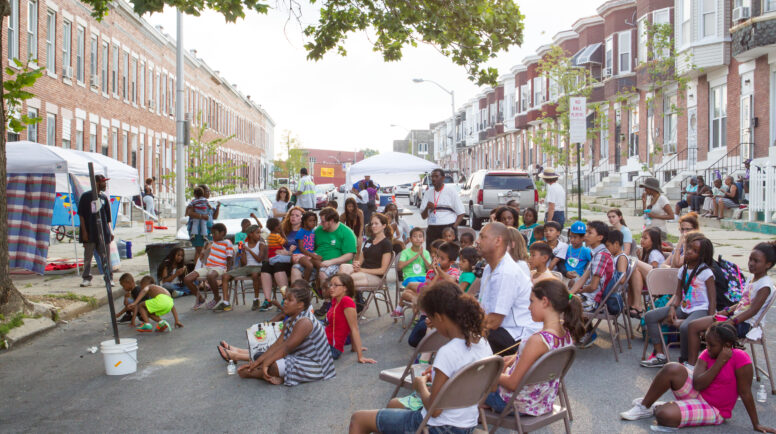
One by one, family by family, other members of our “suburban” church joined us for a trip to a nature center, as leaders and participants at our outdoor Bible Camp on the street, as preparers and servers of food, as “craft ladies” for a Halloween activity at the local school, as servants of Christ willing to share resources like children’s story books, music, dance, time, attention, craft materials and more. After three years, 51 members and friends of our congregation have participated in one way or another (our worship attendance averages 70). This includes the family of the reluctant husband. At the encouragement of his wife, he also offered his presence one evening.
Two brothers and a sister have attended the summer Bible Camp for two years. Their father said: “My children attend a public charter school where most students are from middle and upper-middle class families. By participating in the Bible Camp, they were exposed to a very different part of the city and to the children who live there. It is valuable for them to play and eat with children from a variety of backgrounds and cultures. They looked forward to going back to camp each evening!”
One retired woman has been inspired to start a weekly reading group for early elementary aged children in the neighborhood, using the facility of one of the local ministries.
Instead of saying, “Pastor, we are glad you all are down on the corner!” – now people can say, “We are living as Christ’s disciples with our neighbors in the city we share.”
 Deborah McEachran is pastor of Hunting Ridge Presbyterian Church in west Baltimore. She strives to be a follower of Jesus outside of the church building: on the streets of the city, in the schools, in Cuba and elsewhere.