SAN JUAN, Puerto Rico (Outlook) – On the morning of March 23, the eight ministerial teams that the Presbyterian Mission Agency Board created last fall held separate meetings – some of them going out into the community to meet in local churches.
Two of them met at Seminario Evangélico de Puerto Rico (the Evangelical Seminary of Puerto Rico), where seminary president Doris García Rivera greeted them graciously and explained the seminary’s history and ecumenical role.
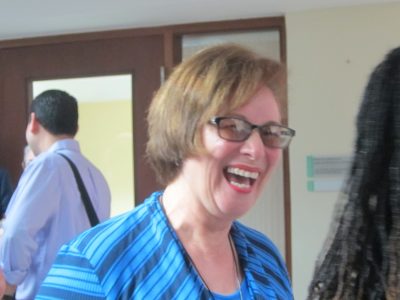
García Rivera, who has been president of the seminary for about two and a half years, said the seminary was founded nearly a century ago in 1919, through the efforts of six denominations. One of those involved was the Presbyterian mission worker James A. McAllister, for whom the seminary’s chapel is named.
García Rivera described the school as an ecumenical, Protestant and Reformed seminary with about 225 students – “very diverse,” with the students making lifelong cross-denominational friendships.
The seminary is beginning to do work to educate lay leaders through certificate programs, as well as being the only seminary in Puerto Rico with a degree program accredited by the Association for Theological Schools.
Bringing greetings later in the day to the full board, García Rivera said that “in the seminary, we have a little piece of the kingdom.” At a time of crisis, “when the souls of our people are being fragmented, the church needs to say ‘we are here.’ ” It is also called “to step up and say ‘Lord,we are here to serve you. We are heare to accompany your saints.’ ”
Those two ministerial teams meeting at the seminary – one on implementing the Belhar Confession from South Africa, and the other on addressing power and privilege – also heard from Francisco Javier Goitía Padilla, who is the seminary’s dean and a professor of systematic theology and homiletics, speaking on what power and privilege look like in the Puerto Rican context.
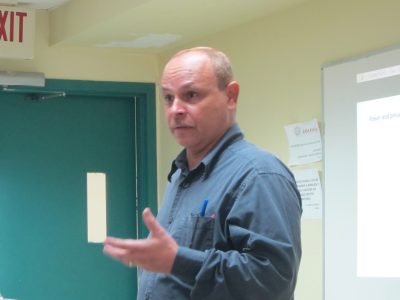
Goitía Padilla started with definitions: that power involves the ability to act and control outcomes (“you can get what you want”) and privilege “the option to decide how you want to act.”
For Christians, understandings of that are shaped by theology, he said – that how we think about power and privilege is framed by how we think about God and ourselves. And “we are talking about the structures of society that are tinged with sin” – sin that’s structural as well as personal.
With structural inequity, “some people have something they do not deserve, and some people are kept in the same place for the benefit of others,” Goitía Padilla said.
The Reformed theologian John Calvin wrote of the continuing desire that becomes an obsession to use things – such as people, money, power. “People, societies, communities, churches are affected by this desire, this longing to accumulate,” Goitía Padilla said.
Puerto Rico is now facing a political and economic crisis, with $72 billion in debt and an employment rate of only around 42 percent – both indicators that “people are using power and privilege for their own benefit,” Goitía Padilla said.
Some would say “we are not a colony,” but he thinks otherwise, that essentially “we are an economic colony.”

Patsy Smith, a board member from Oklahoma, said, “We have always been taught that Puerto Rico is a territory.”
Goitía Padilla responded that there are issues of power, that “keep us in a position not to decide what is good for us” – for example, the requirement that “we have to use American ships” to import food to the island.
That imbalance of power “makes us understand ourselves as less human,” he said.
“People in Puerto Rico do not want to end their relationship with the United States, but I would also say we need some political power,” Goitía Padilla said. “We cannot keep living as we live.”
He spoke of some of the realities – police corruption, people living without health insurance, unemployment, an outflow of Puerto Rican natives leaving for jobs in the United States. He quoted Pedro Pietri’s poem “Puerto Rican Obituary,” about all the broken dreams, including this haunting line: “They were born dead and they died dead.”
He also traced the role that churches and religion have played in the equation. The Roman Catholic Church came with the Spanish in the 1500s, blessing the colonization process. “The Protestant church came with the Americans,” dividing Puerto Rico up into six zones for the different denominations.
“Puerto Rico was divided by lines as Africa was divided by lines. The Middle East was divided by lines.”
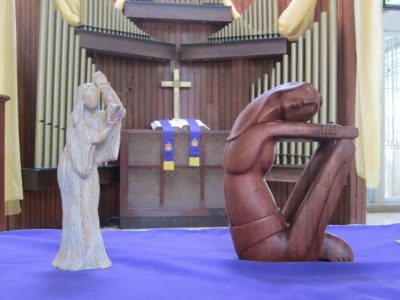
Goitía Padilla said churches can play a role in calling people to responsibility and providing a corporate witness.
The church has been very timid in addressing structural and political matters,” although “there are spots of hope,” he said, where Christians are working “to create spaces of grace.”
The board meeting continues with plenary sessions March 23, and the meeting ends midday on March 24. See the agenda here: H.100 Board Agenda