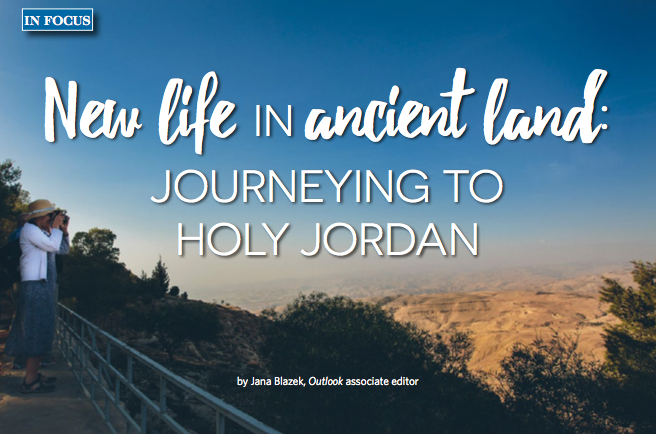
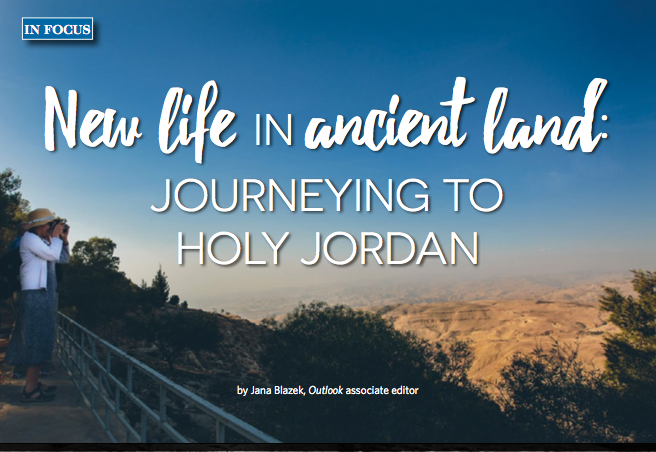
Jordan seems to be clinging to our consciousness in the news cycles of late. The mother hen to thousands of refugees. A key U.S. ally in the Middle East, now rethinking border security in the face of the ISIS threat. It’s speculated that Jordanian King Abdullah II may have influenced President Donald Trump’s perspective on peace in the region after they met at the February Prayer Breakfast in Washington.
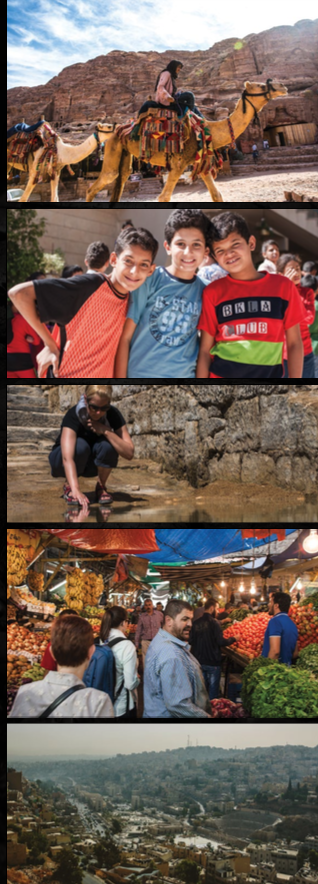
An ancient land, now home to refugees in the midst of chaos. That was my basic perception of Jordan. That is, until I was invited to take part in a press tour of religion bloggers in Jordan in the fall of 2016. Our travels illuminated my understanding with the lands of biblical narratives come to life, camel rides through the desert, beautiful mosaic artwork, and good food – so many exquisite meals served with the warmest hospitality.
We spent a number of days in Amman, Jordan’s capitol city. A predominantly “westernized” city, Amman blends old and new, connecting the country’s longstanding Arabic culture with modernity. We ventured to Umm Qais and Jerash, bearing witness to the remains of civilizations thousands of years old – ancient whispers of cultures that built trade routes, accentuated the arts and formed the civilizations we read about in our Bibles.
Biblical sites
Jordan is the land of more biblical geography than I previously realized, and home to some of Christianity’s earliest churches. It’s the land of the Old Testament Ammonites and of the region of the Decapolis, where Jesus taught and performed miracles.
From the ruins of Umm Qais (an ancient city of the Decapolis), we looked out to see the region of the Garasenes on the western shores of the Sea of Galilee. The Gospels tell of Jesus casting demons out a man into a herd of pigs (Mark 5); it likely happened on that very steep bank.
Here are a few more biblical sites we visited:
Baptism of Jesus. “When all the people were being baptized, Jesus was baptized too.” Today, many archaeologists believe the biblical and historical evidence points to Jordan as the site of Christ’s baptism and of John the Baptist’s grotto. Nearby, we visited a baptismal pool constructed by early converts to Christianity (with evidence dating back to the fifth century A.D.) that marked the spot where they believed Jesus’ baptism took place. The pool is built into the shape of a cross. We slowly walked down the steps, breathing in the air, soaking in the sun and walking on the dust that Jesus’ sandals had kicked up so long ago in the land of Bethany-beyond-the-Jordan.
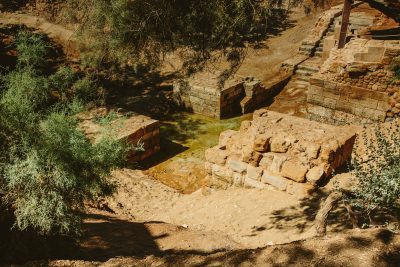
Near the baptism site is Elijah’s hill, where Elijah ascended to heaven in a whirlwind. Malachi suggests that Elijah will return to herald God’s presence in the Messiah, so when John the Baptist began baptizing people on that same land, I can only imagine the stir it must have created for those waiting the coming Messiah. John said, “I am a voice crying out in the wilderness, prepare the way for the Lord!” And today, that area remains wilderness, appearing much the same way it must have 2,000 years ago. It wasn’t hard to imagine John dwelling in one of the caves near Elijah’s hill or foraging for his locust supper in the nearby wilds.
Jabbok River. It seems likely that Abraham followed the Jabbok River as he traveled from Haran to Shechem (though the Bible does not convey his path), and later Jacob would travel this route. From the fords of the Jabbok River, Jacob sent gifts to placate his brother Esau (Genesis 32), then spent a long night along the river, wrestling with God until daybreak. We stood at this spot and remembered Jacob’s words, “It is because I saw God face to face, and yet my life is spared.”
Mount Nebo. From atop Mount Nebo, an important site in many Christian pilgrimages, we looked out upon Moses’ vista, where he saw the land he would never actually enter after the Exodus.
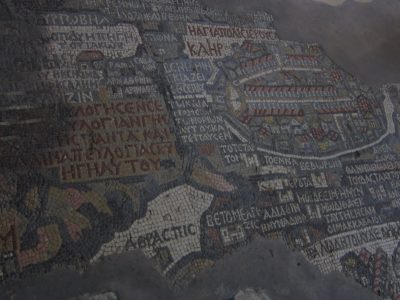
Mosaic map. We stopped at Madaba, known as the “City of Mosaics.” On the floor of the Greek Orthodox Church of St. George lies the famed Madaba Map. This is the oldest surviving mosaic map of the Holy Land, dated to the middle of the sixth century. The map originally contained about 150 captions in Greek of the major biblical sites encompassing Jordan, Israel (including a detailed map of Jerusalem), Lebanon and Egypt. Thought to be the most exact map of the Holy Land crafted prior to modern cartography, the Madaba Map shows the site of Jesus’ baptism, the allotments of the 12 tribes of Israel, and the walls and streets of the Holy City of Jerusalem. Was it crafted to aid early pilgrims making their way from one holy place to another? Did the artisans hope to represent Moses’ vision of the Promised Land gleaned from Mount Nebo? Or was it designed to aid the spiritual experience of those early Christian worshippers?
Herod’s castle. The columns still stand at Mukawir, Herod Antipas’ hilltop fortress where John the Baptist was imprisoned and where Salome danced and sealed John’s fate, by asking as her reward John’s head upon a platter. We even ventured into an old cavern that may have been John’s cell.
Middle East Council of Churches
The Middle East Council of Churches (MECC) has offices in Cairo, Egypt, and Amman, Jordan. MECC is a fellowship of churches in the Middle East, with 27 member churches (denominations) in 12 countries and representing 14 million Christians. Member churches include the Presbyterian Church of South Sudan and Sudan, Evangelical Presbyterian Church of Egypt Synod of the Nile, and Evangelical Presbyterian Church of Iran.
During times of division and conflict in the Middle East, the MECC has worked to be a sign of hope for Christians in the region. The churches have used their alliance in the MECC to build spiritual renewal, unity and a common witness. Together, they have worked for justice and peace in the Middle East.
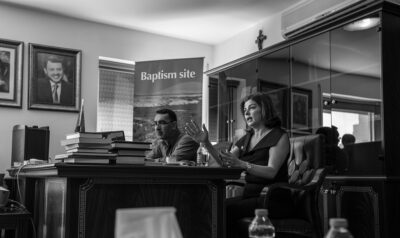
During our time in Jordan, we had a chance to visit with Wafa Goussous, director of MECC, at her office in Amman and to talk with her about the council’s work in the region, especially as it relates to Jordan’s role in the refugee crisis.
“Jordan is playing a very important and serious role” as the region deals with the influx of Syrian refugees. In the Holy Land, a Christian presence is important, Goussous stressed, adding, “we are present” as Jordan attempts to rise to the challenge.
The Za’atari camp is at full capacity with 80,000 “refugee guests.” MECC is working to build relationships with local communities and groups. The hope is for refugees to be able to return home when the time is right and it is safe, but for now, Goussous believes it is critical to tend to not only the refugees’ physical requirements, but their mental and emotional needs as well.
Goussous believes God is really leading the MECC and “we reach everywhere.” She said: “We are keeping the symbol of the cross among all the people,” but the council doesn’t serve only Christians. She emphasized that the council’s work is about strengthening the Christian presence and witness in the region.
The intangibles
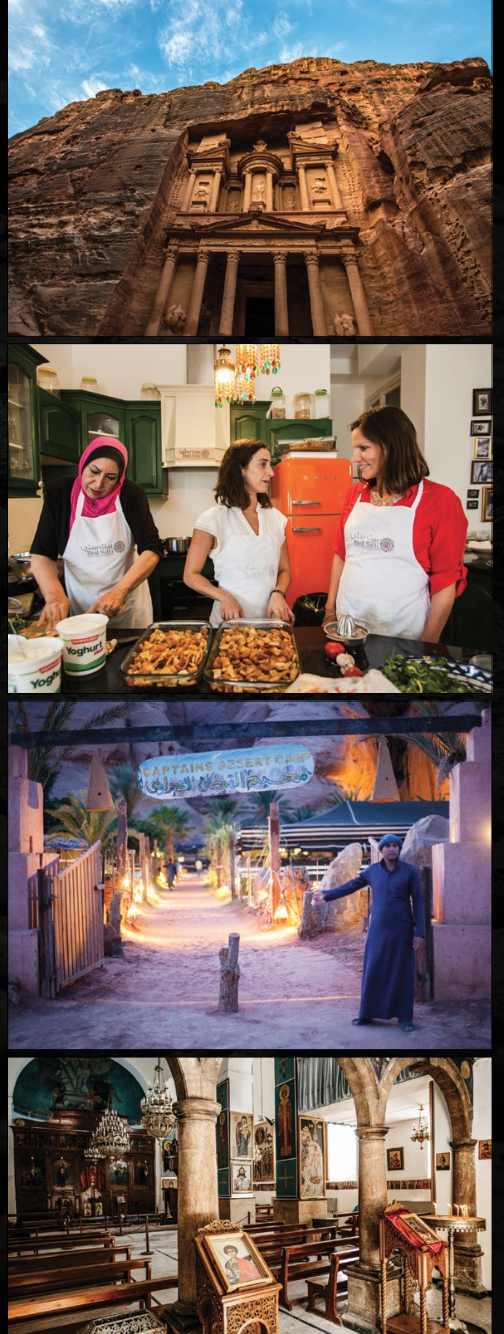
Beit Sitti cooking school in Amman, Jordan (Photo credit: Greg Tarczynski); Bedouin camp in Wadi Rum (Photo credit: Greg Tarczynski);
Greek Orthodox Church of St. George in Madaba, Jordan (Photo credit: Matthew Paul Turner)
There was so much more to experiencing Jordan beyond what we learned intellectually – beyond understanding the mechanics and challenges of refugee aid and being biblical tourists visiting ancient, holy sites.
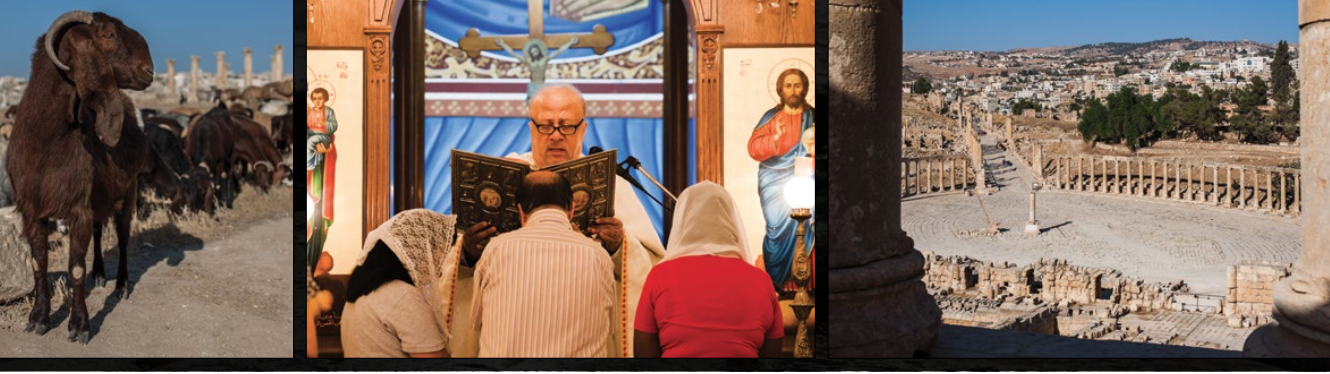
Our group floated in the Dead Sea and was blessed with a breathtaking sunset. We road camels through the desert, then spent a night receiving Bedouin hospitality in a camp in Wadi Rum.
We rose before sunrise and hiked Petra, taking in brilliant skies, pondering the ancient civilization, watching goats scamper in their natural habitat, and possibly reliving a little Indiana Jones. A Jordanian woman prepared lunch for us at her cooking school where she teaches others the same lovely approach to food that she learned from her grandmother. Old cultures came to life at Jerash, where the circular floor and columns of the agora still stand.
And, on a Sunday morning we joined a Christian congregation in Amman for worship in Arabic. We shared the miraculous story, which the faithful all over the world repeat week after week. These ancient lands continue to bring the shimmering, timeless Christian story to life.