ST. PAUL (Outlook) – The Governance Task Force of the Presbyterian Mission Agency Board has released a revised series of recommendations – continuing to suggest that the board become smaller, more nimble and responsive (decreasing over time from 40 voting members to 16), but changing the proposal so that representatives of three advocacy and advisory groups could remain on the board as corresponding members.
That revision would keep on the board as corresponding members representatives of three groups – the Advocacy Committee for Racial Ethnic Concerns, the Advocacy Committee for Women’s Concerns, and the Advisory Committee for Social Witness Policy. Corresponding members have voice on the board and can vote in committee, but not in plenary.

An earlier recommendation – which the task force released in January in a white paper – would have removed representatives from those groups as corresponding members, assigning them instead to a new “liaison committee.” That idea did not seem to resonate with the Presbyterian Church (U.S.A.), said Ken Godshall, a pastor from Kentucky who’s chair of the board.
So “we are reversing course and reinstating each of these committees as corresponding members … so they will continue to have a seat at the table,” Godshall said, speaking July 17 at the retreat of the board’s executive committee, being held at Central Presbyterian Church in St. Paul, Minnesota.
The plan is for the full board to consider parts of the Governance Task Force recommendations when it meets Sept. 21-23 in Louisville, and other parts at the meeting February 7-9, 2018 (also in Louisville), said Melinda Sanders, chair of the task force. That would give the task force a chance to see what recommendations the Way Forward Commission and All Agency Review Committee might be bringing to the 2018 General Assembly. Those groups have until Feb. 16, 2018 to decide what to recommend. The task force is being deliberate about staying in step with those groups, “so we’re not wasting anyone’s time,” Sanders said.
“The fire in our belly is not bean counting or the balance sheet,” said Gregory Chan, a task force member from California. “It’s about our mission and ministry.”
The changes the task force is considering include these:

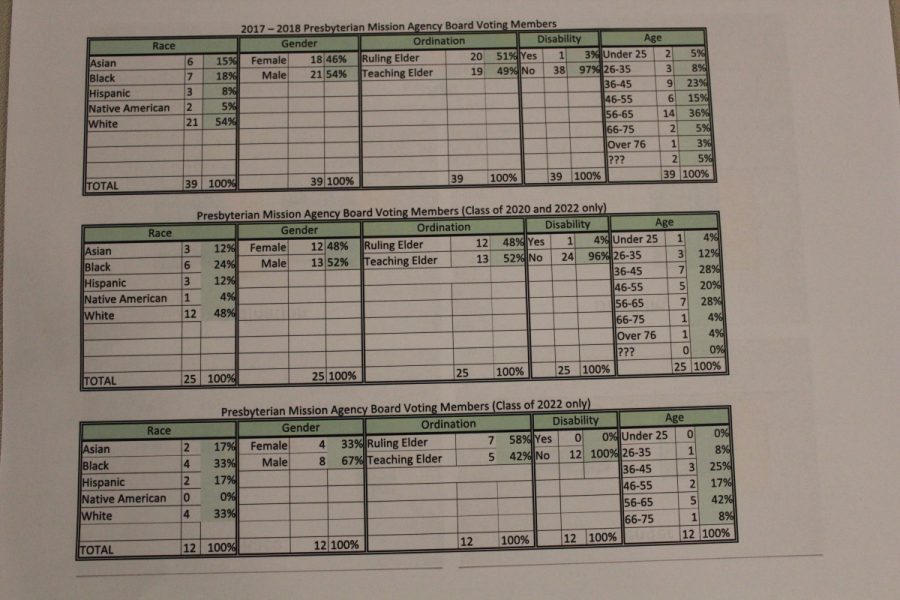
Smaller board. The size of the board would be reduced via attrition – with board members not being replaced as they rotate off. While the proposal is to end up with a board of 16 voting members, that number could shift. Attrition alone would reduce the board to 12 by 2022 – so to reach 16 more people would need to be added.
A smaller board would make it easier for the board to discuss and debate significant issues – something that’s hard to do with 40 people, said Conrad Rocha, a task force member from New Mexico.
Currently, “there are a lot of people who sort of shut down and don’t participate,” said Molly Baskin, a task force member from Chicago. “With 16, you can’t hide.”

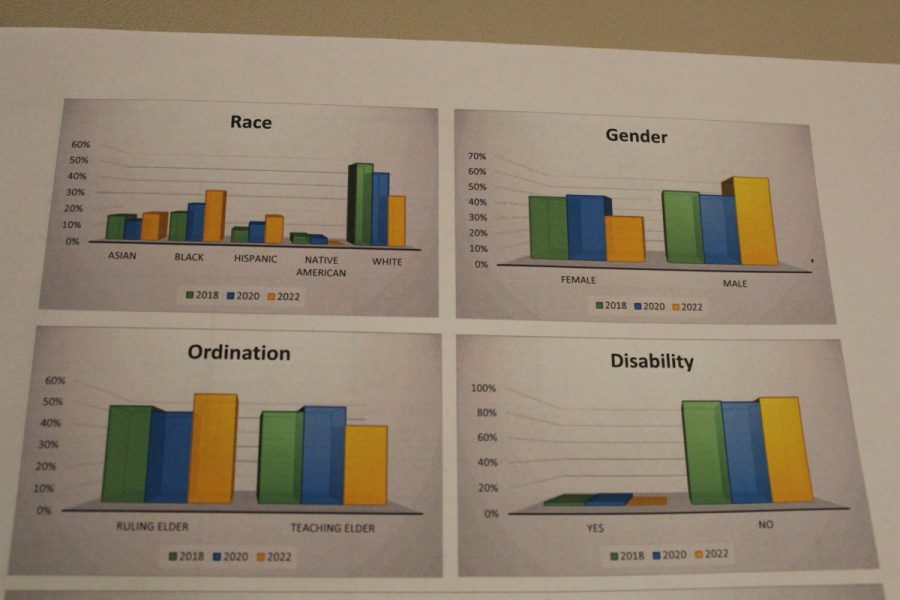
Diversity. A smaller board actually would be more diverse – with the class of 2022 being only 33 percent white, compared with the current board that’s 54 percent white, Rocha said. “We need to keep the richness of our diversity at the forefront,” he said – while also reminding the General Assembly Nominating Committee of the importance of considering both skill sets and demographics for those being considered for nomination.
“It was mentioned that if we reduced the number of members of the board that we would not be able to get the right skill sets” while making sure the board is diverse, “which I find offensive, disgusting and racist,” Rocha said. “Looking at skill sets is not going to mess up diversity. In fact it will make us richer.”
Term lengths. Under the proposal, board members would serve a four-year term (terms are currently six years), with a possibility of renewing for a second term. Shorter terms
“will make it easier to recruit people,” Baskin said.
Committee structure. The board would have three program committees (in addition to administrative committees and short-term strategic task forces). The proposal is that they would be:
- Nurture the Body – focused on congregations and mid councils;
- Resource Allocation – to ensure effective stewardship;
- Outreach to the World – focused on ministry outside the walls of congregations.
The Governance Task Force is still working on its proposals. “Send us your feedback,” Sanders said. “We aren’t so wedded to anything that it isn’t worth telling us what you think about it.”
The executive committee did vote to recommend that the full board extend the task force’s term of service – from September 2017, when it’s currently scheduled to end, through the conclusion of the General Assembly in 2018. The full board is expected to vote on that in September.
The executive committee’s meeting continues through mid-day July 19.
It will include a conversation July 18 with Gilo Agwa Gora, a part-time pastor with Foundation of Life Community, a new worshipping community serving the Anuak refugee and immigrant community in the Twin Cities, and a visit to Westminster Presbyterian Church in Minneapolis.