It is the morning of 9/11 in 2017. The sun is up but the height of the Norris Cotton Federal Building, home of the regional office of the U.S. Immigration and Customs Enforcement (ICE), blocks the sunlight from reaching its Chestnut Street entrance. In the shade a steady breeze makes the 57-degree temperature feel especially chilly.
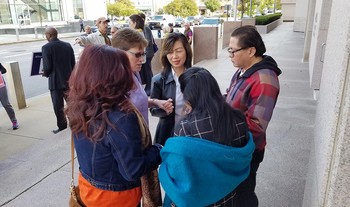
Yet, small groups of people have dutifully gathered again, uniting for an 8:30 a.m. vigil and “Jericho Walk” in the largest city of this state famous for its motto “Live Free or Die.”
Among the interfaith clergy who regularly lead the seven-lap “Jericho Walk” is the Rev. Cindy Kohlmann, the Resource Presbyter for the presbyteries of Boston and Northern New England. She has been deeply involved in the vigil project begun by Arnie Alpert, Co-Director of American Friends Service Committee.
“On a day when we remember how America came together,” she says, “we’re here because people are being separated from America.”
While others across America assemble this day for vigils remembering the victims of 9/11 16 years ago, perhaps including a prayer, here on the steps of the Cotton Building the morning’s concurrent vigil is another in a series that includes prayers for those some consider to be the indirect victims of the 9/11 attacks: America’s undocumented immigrants.
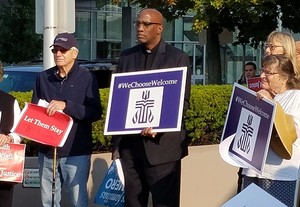
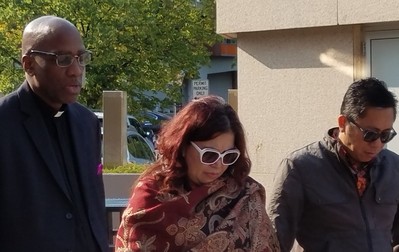
A week after the Rev. Dr. J. Herbert Nelson II, General Assembly Stated Clerk of the Presbyterian Church (U.S.A.), decried President’s Trump’s recent action rescinding DACA, he has, typically, put his faith in action. Joining in solidarity with the marchers, including the Rev. Amaury Tañón-Santos from the Synod of the Northeast, Nelson’s presence helped bump the number of marchers to around 60 – up from what Alpert said was the summer average of around 50 participants.
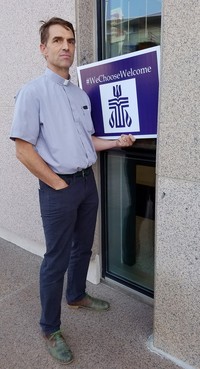
In one spot on the sidewalk, the Rev Carl Hilton Van Osdall, moderator of the Presbytery of Northern New England, and a group of walkers stand with signs in hand, silent witnesses for justice: for immigrants in general and particularly for two local Indonesian immigrant congregations — the Rev. Sandra Pontoh and Maranatha Indonesian United Church of Christ, and the Rev. Jelty Ochton and Marturia Presbyterian Church.
In the wake of 9/11 16 years ago, the U.S. Government placed all undocumented immigrants — a population that includes those who overstayed their visas, who were once “boat people” who never had any paperwork, and those who arrived claiming political or refugee status but somehow never got around to properly registering — under a magnifying glass.
When it came to the plight of the several thousand Indonesian immigrants in New Hampshire, in 2009 Senator Jeanne Shaheen (D-NH), worked with ICE and the religious community on an agreement she reiterated in an Op-Ed in the 9/11/17 edition of the New Hampshire Union Leader. In brief, what became known as an “Order of Supervision” required the undocumented to learn English, get jobs and agree to frequent check-ins with ICE at the Cotton Building. Sometimes they occurred every three to four months or further apart. Then as now, an Order can be revoked if the undocumented person breaks any law, even a traffic violation. However, on the heels of a Trump Administration Executive Order issued in late January, the frequency of the check-ins became monthly. The number of deportations increased from a handful to dozens during the first eight months of 2017.
Sometime around 9:30 a.m. it was time for Sam Wodall, here since 2001, to go to his appointment. While checking-in at the Manchester, NH, office four weeks ago, Sam found himself in a situation similar to one many among his fellow undocumented now find themselves: being told by ICE agents to return to their second-floor office one month hence “…and bring along a plane ticket.”
As Kohlmann puts it, the plane ticket, “shows ICE that the undocumented person is ready to return ‘voluntarily.’” Additionally, directing the undocumented to purchase their own ticket saves the U.S. Government money.
Now, on this 9/11 morning, after waiting with his anxious Indonesian wife, their two small American-born children and a bevy of supporters, Wodall was embraced and collectively prayed over. With handshakes and good wishes, he entered the Cotton Building, accompanied through the airport-style security by Nelson. Ochton served as Wodall’s interpreter during the hearing itself.
About an hour before Sam came down, Niko (“just Niko,” he said) emerged, clear plastic envelope in hand holding the paperwork telling the 36-year old father of a days-old newborn that he was soon to fly to Jakarta.
“They were very polite,” Niko added.
It was the same comment Sam Wodall made when he rejoined everyone in front of the building. He calmly stated he was to return on October 10th and to “bring along a plane ticket.
“They told me to report on the day before I’m to fly out,” he said, his wife standing at his side, wringing her hands, the look on her face screaming of heartbreak.
Upbeat, Sam and his attorney, Bill Hahn, said they will continue to fight Wodall’s scheduled deportation, a struggle some among those on the steps privately see as a steep uphill climb.
“I love these people. I’ve really gotten to know them,” said Hahn. Based in Boston, he has travelled up Route 3A many times to stand up with several among these working class, law-abiding, yet undocumented Indonesians.
“This is not about the money,” Hahn said. “This is about justice.”
As the crowd formed a circle to enable the Nelson to lead a concluding prayer, the Stated Clerk advised that he would be teaming with fellow Presbyterian leadership in the church’s Office of Public Witness in Washington, D.C., on Wednesday, September 13th. There, Nelson said, “we will be working the halls of Congress,” bringing the Indonesians’ situation, along with other justice issues related to the Federal budget, to the attention of members of Congress.
by Jim Nedelka, Presbyterian News Service