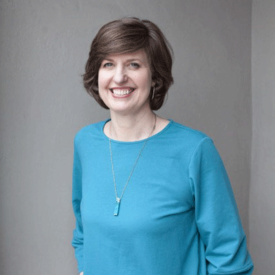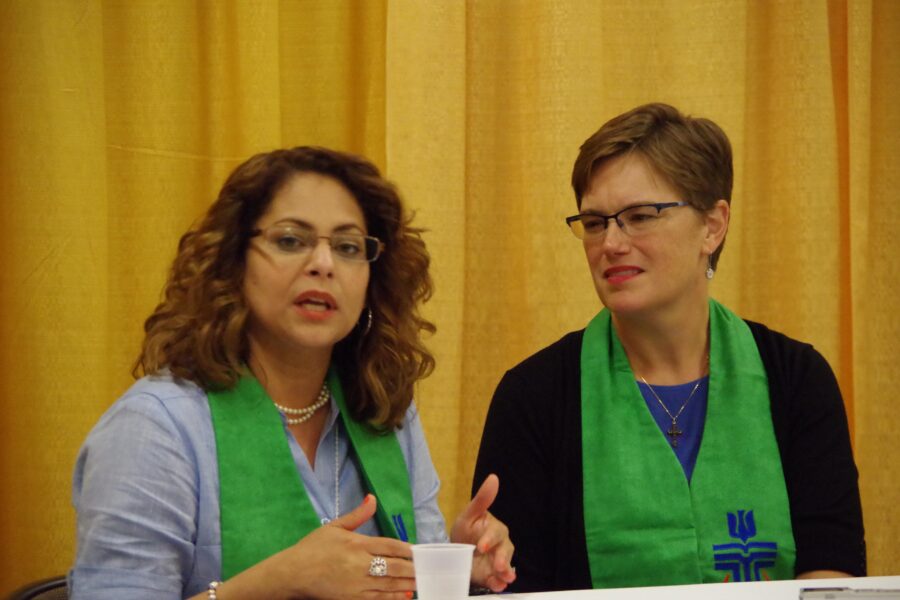
ST. LOUIS – When asked how they felt about the “amazing honor” of being elected as co-moderators of the 223rd General Assembly Cindy Kohlmann answered with one word: Humbled. Vilmarie Cintrón-Olivieri added, “Overjoyed by the opportunity to serve.”
Shortly after the election on June 16, the co-moderators were asked how they felt about the votes, knowing that it took four rounds of voting for a majority to be declared. Cintrón-Olivieri responded, “This was not a political race at all, this was the body of Christ seeking the will of God.” She noted that it was a Spirit-led process. Both Kohlmann and Cintrón-Olivieri expressed gratitude for the other candidates who stood for the office. Kohlmann said, “Bertram and Eliana have been amazing to get to know.” And, “It was a joy to get to know Chantal and Ken.” Cintrón-Olivieri remarked on the real collegiality within the group of six saying that between the three teams, “there was love and hope.”
During the question-and-answer session before the election, many answers reflected a theme of the church needing to leave the building, to which Kohlmann added: “There are churches that use their buildings to bless the community in deep ways. It is not about leaving the building behind.” Rather is it making sure the building is “not the first priority, but a means we use to do the mission of the church,” she said.
Cintrón-Olivieri concurred saying churches need “to think about how the building can become the center of community. It can become a place of safe space.”
 Several questions at the evening’s press conference reflected the comments of the co-moderators from the parity of ruling elders and teaching elders to celebrating the diversity in the church. Cintrón-Olivieri articulated the Presbyterian understanding that both ruling elders and teaching elders are called to ministry. While Kohlmann said she imagined they will be surprised by how those roles emerge as they serve as co-moderators and as they “do things as we feel called.”
Celebrating diversity was central to the pair’s platform and they intend to do so, in part, through music and worship. Kohlmann noted that worshipping in immigrant congregations in the Presbytery of Boston can be both diverse and uniting. In song, “it doesn’t matter if I don’t understand the words, I can sing with them, I can hum … and usually ‘alleluia’ is the same.”
Cintrón-Olivieri believes “there is a way to do worship multilingually … we can preach or pray in another language.” She encouraged: “Be open to possibilities to celebrate diversity.”
The last question of the night was simple and challenging: Are you ready?
Cintrón-Olivieri said, “I think we are.” Kohlmann added, “with God’s grace.”