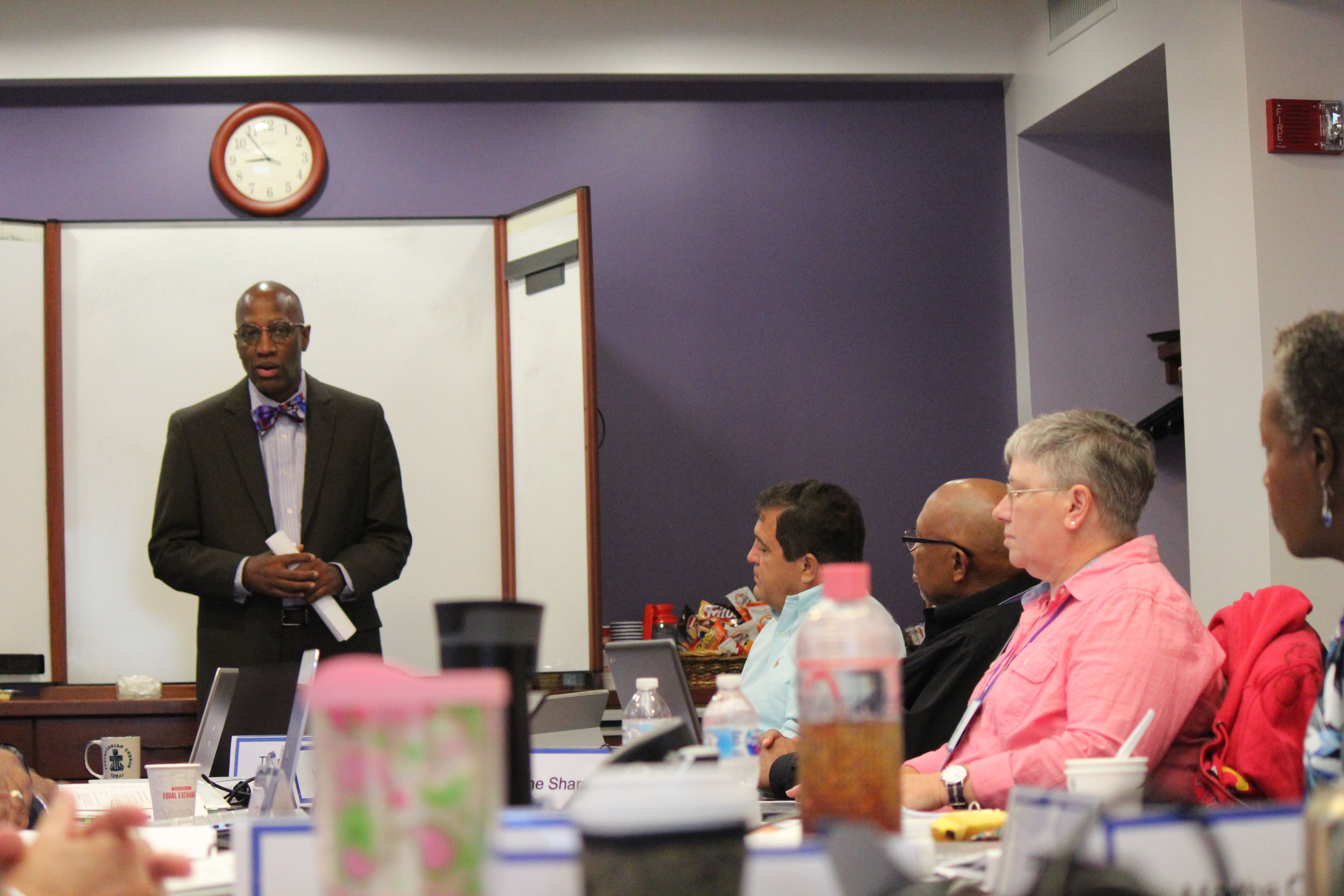
LOUISVILLE – In a conversation Sept. 5, top denominational leaders laid out their hopes and dreams for the reconfigured board of the Presbyterian Church (U.S.A.), A Corporation – describing a church that is rich in both faith and potential resources; that needs to demonstrate collaboration, courage and risk-taking; and whose leaders need to follow the Holy Spirit, and be willing to make change.
J. Herbert Nelson, the denomination’s stated clerk, said the PC(USA) has all the resources it needs to be a turnaround denomination. “We are not a poor denomination,” Nelson said. “We can do all things if Christ is with us.”

Nelson also said Presbyterians need not to feel ashamed to share their personal faith stories – to tell how God is working in their lives and motivating their choices.
“We are going to have to begin to talk about Jesus, and not hide our faith under a bushel,” the stated clerk said. He encouraged Presbyterians to share their faith stories of God’s goodness and grace – and to figure out how to bring the kind of commitment to justice that the 2018 General Assembly demonstrated with its cash bailout demonstration in St. Louis to their local communities.
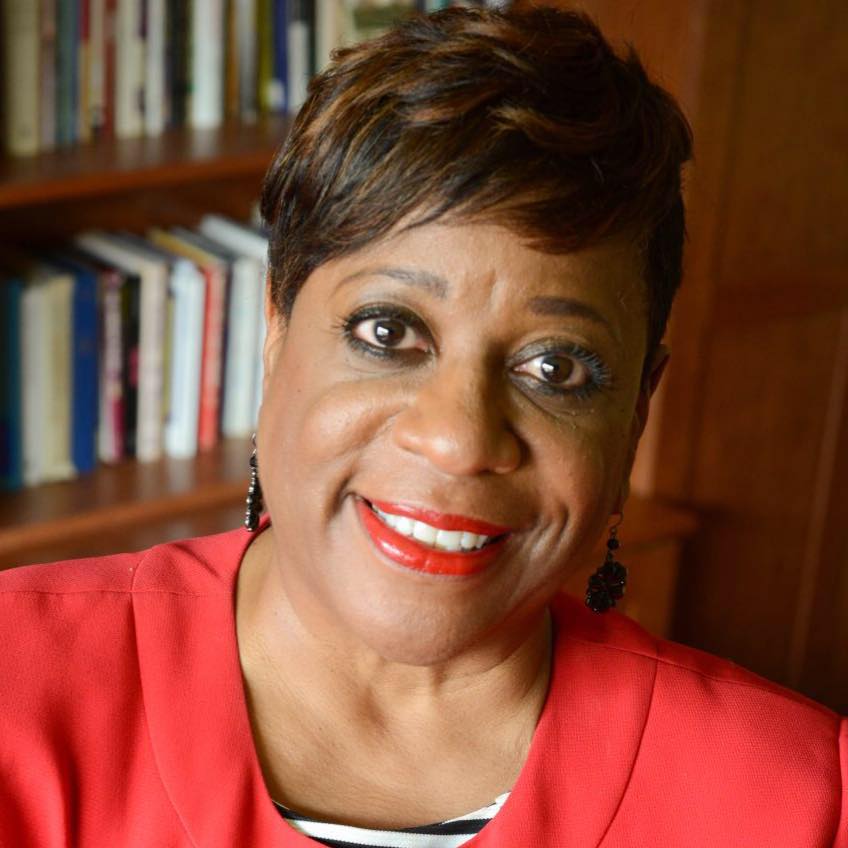
Diane Moffett, president and executive director of the Presbyterian Mission Agency (PMA) called into the meeting from an out-of-town trip, describing herself as “the new kid on the block” – she just began work at the agency in June.
Moffett offered words of encouragement – saying it’s a “critical time” for a denomination that is “radically inclusive,” that invites people to “come as you are. It doesn’t matter what your orientation may be, your color. … The task is to live it out.”
She spent some time introducing herself, as the board members had done with each other the previous day – telling her own faith story of being influenced by the healing, vibrant faith of her grandmother; of her three decades serving in parish ministry; her decision to run for mayor of Greensboro, North Carolina in 2017. While she did not win that election, her candidacy demonstrated her belief that sometimes “you have to get inside to advocate for policy changes” as well as to protest.
Moffett encouraged the board to think of three Rs: relevance, relationships and pushing the reset button. “I hope you will dream and plan for what can be, not simply what is,” she told the board.
But she also described the work of moving shared administrative services from PMA to the A Corporation as “delicate surgery,” and urged the board to proceed carefully and take its time.
“No one likes to be changed but a wet baby,” Moffett said.
So she encouraged the board to take risks, but also to build relationships and understand the possible ramifications for the PMA staff of realigning shared services, and consider how the changes will affect PMA ministry. Moffett said PMA board members have told her that the structural change that’s been made, giving responsibility for the A Corporation to a smaller and more representative board, rather than having the PMA board members responsible for the A Corporation, will give PMA more freedom to focus on mission.
Moffett said she’s grateful for that, but recognizes that administration and ministry “are so closely aligned. I hope you will introduce the least-disruptive change first. Look before you leap. … This is delicate work and complex work. It can be done.”
She also encouraged the board to develop a culture focusing on servant-leaders or customer service, and to develop creative ways to manage systems already in place. Coming to PMA, she heard “there were a lot of issues with getting information and reports that people needed for ministry. I am not here to judge one way or another. … We are serving one another. We are one team. It’s important that we ask how, and not necessarily say no all the time.”
Moffett said her expectation is that “this change is going to be beneficial to this church. That is our hope.”
The board elected as its co-chairs for the next two years Bridget-Anne Hampden, a retired banking executive from North Carolina, and lawyer Chris Mason of New York – both of them ruling elders. Hampden assured Moffett that “we have a solid commitment to be inclusive as we go forward,” keeping the lines of communication open, and “we will be respectful of your team. We are quite clear on the delicacy of this issue, and will handle it with the utmost care and deliberateness.”
The board also heard, also via conference call, from the co-moderators of the 2018 General Assembly, Vilmarie Cintrón-Olivieri and Cindy Kohlmann.
While the new A Corporation board will make important and difficult decisions – acting as the corporate entity for PMA and the Office of the General Assembly – Cintrón-Olivieri encouraged board members to think of relationships and not just the work. “We are not called to be corporate,” she said. “It is a church. There are some styles of work that are suitable for other enterprises, but not necessarily for the church of Christ.”

Cintrón-Olivieri thanked the 11 board members for their ministry and willingness to serve.
“I see your heart for mission and your love for this church,” she said. She emphasized “putting people first. Understanding what it means to be church together. And taking the time to know each other, to cultivate relationships, to know each other’s gifts” and to build trust.
As the board continues with its work, “you will see the best of our church,” Cintrón-Olivieri said. “You will also see when we are not at our best.” She encouraged board members to build spiritual and emotional strength, to rely on each other.
The new A Corporation board is small, and “it is sort of like a prayer group,” she said.
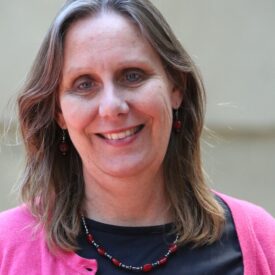
Cindy Kohlmann, the assembly’s other co-moderator, said others have spoken of the importance of courage, creativity and taking risks. So “I’ll be the technical person for a minute.”
Kohlmann said she began her presbytery work in a system that wasn’t particularly healthy, but discovered that “the system was going to try to retain its equilibrium. It wasn’t healthy equilibrium, it wasn’t functioning well,” there was a lack of trust. So “the system was in balance” – even though it was unhealthy, it had equilibrium.
After several months in the job, she discovered “I was feeling a need to protect power and authority I didn’t actually have,” to challenge people in ways “that weren’t honest to myself. I realized they were honest to the system, to the dysfunctional system I was a leader in.” Resisting that was hard, but Kohlmann said as she tried to be true to herself and rely on the Holy Spirit, she became a linchpin as the system began to work toward health.
Kohlmann told the A Corporation board members that “you are being called to do something new” in a struggling system. And she has learned that “amazing people in a system where the health isn’t good end up being pulled into unhealthy systems unless we’re aware.” Pay attention to the internal dynamics, she counseled. “There’s going to be a lot of weird pressure for you to fit into the equilibrium of the system that is already in place.”
With this new configuration, “you have an opportunity to be a linchpin of change,” she told the board members. This is a chance for the church “to shift, to turn around, to reset to use those words. But there will be a lot of pressure to be molded into what already is.”
The system already in place “will do everything in its power to form you as part of the existing system. If you can resist, if you can ask those questions,” if you can assess where anxiety exists or where people “feel like we need to protect and preserve, and get to the root of those things, then you will have an opportunity to help our family system that is the Presbyterian Church be stronger and healthier. I am really hopeful and very, very excited.”
That part of the morning session ended with prayer – with the co-moderators praying, in Spanish and English, for God’s grace and leading in the challenges ahead.
The board’s meeting continues through mid-afternoon Sept. 5.