LOUISVILLE – The new board of the Presbyterian Church (U.S.A.), A Corporation has begun to set its course – electing its leadership, hearing from denominational leaders on everything from investments to evangelism, and acting on some specific items of business.
This new board, approved by the 2018 General Assembly, is both smaller and more broadly representative than the previous one. Formerly, the voting members of the Presbyterian Mission Agency Board served as the A Corporation Board.
The new board includes representatives from five of the six PC(USA) agencies, along with representatives of Presbyterian Women, the Racial Equity Advocacy Committee, the Advocacy Committee for Women’s Concerns and three at-large members, two of whom are currently drawn from the All Agency Review Committee and the Way Forward Commission.
The shift has been controversial and much-debated at top levels of the denomination, but there is hope it can lead to greater efficiency, transparency and collaboration. And now, with the reconfigured board’s first meeting, held Sept. 4-5 in Louisville, the work has begun.
Part of this meeting involved gathering information from a variety of Presbyterian agencies and departments. For example, how often are performance evaluations conducted? Which auditing firms are used and why? What efficiencies might be found? How could the A Corporation board help you in your work?
Angela Duffy, general counsel of the Presbyterian Foundation, said the Foundation has had its own culture shift in recent years. “We say all the time we are one church,” Duffy said. “That feels like that is where this is headed.”
The board heard from top denominational leaders – the co-moderators of the 2018 General Assembly, Vilmarie Cintrón-Olivieri and Cindy Kohlmann; Diane Moffett, president and executive director of the Presbyterian Mission Agency, and stated clerk J. Herbert Nelson – about their hopes for the reconfigured board. The leaders urged the board to be led by the Holy Spirit; to act like the church, not just a corporation; and to take some risks.
“There’s going be a lot of weird pressure for you to fit into the equilibrium of the system that is already in place,” Kohlmann said. But “you have an opportunity to be a linchpin of change.”
And, the board took some votes of its own.
Leadership. The board opted to go with a shared-leadership model.
“Why are we looking at the traditional form of leadership?” asked JoAnne Sharp, who represents the Advocacy Committee for Women’s Concerns on the board. “We have the opportunity to say to our beloved denomination ‘we’re trying something new because that’s what we’ve been called to do.’ … Let’s be open to something that’s not always how it’s been done.”

The board voted to elect as its chair and vice-chair Chris Mason, a ruling elder and lawyer from New York, and Bridget-Anne Hampden, a retired banking executive and ruling elder from Charlotte, North Carolina. For bylaw purposes, they will both serve in both roles, and will refer themselves publicly as co-chairs.
The co-chairs will serve two-year terms, although the board would have the option to re-elect them.
Committees. The board created three committees:
- Audit, Legal and Risk Management.
- Operations, Budget and Finance.
- Nominating, Governance and Personnel.
Each committee will have four or five members, with some serving on more than one committee.
Nelson, the stated clerk, urged board members to think of themselves as stewards of the work they’ll undertake. “We can turn this into a heavy-duty, fiduciary kind of responsibility,” he said, but “it’s not all about the numbers, although the numbers are important. But it has a lot to do with faith, and the spirit that we bring.”
Schedule. The board hopes to meet once more in person in 2018 and probably four times in 2019, although dates and places haven’t been selected. The question of how to pay for the 2018 meetings remains under discussion, as the General Assembly did not provide specific funding for that.
Board member Cynthia Campbell, a pastor from Louisville, suggested that since the Presbyterian Mission Agency Board is getting smaller (transitioning over time from 40 voting members down to 20) “its meetings in theory got less expensive,” and money could possibly be found in those savings.
Later, Moffett, the Presbyterian Mission Agency leader, spoke to the board via phone during an out-of-town trip.
While the Presbyterian Mission Agency Board is now down to 31 voting members, it has made a commitment to meet quarterly instead of three times a year, Moffett said – so the savings of a smaller board may be offset by more frequent meetings.
Stewardship. Rosemary Mitchell, senior director of mission engagement and support for the Presbyterian Mission Agency, told of changes in approach since she took that position in 2016. The department was previously called “funds development,” which is a “purely secular term” and one that “embarrassed all of us,” Mitchell said. She had been told that “our job was to get money in the door.”
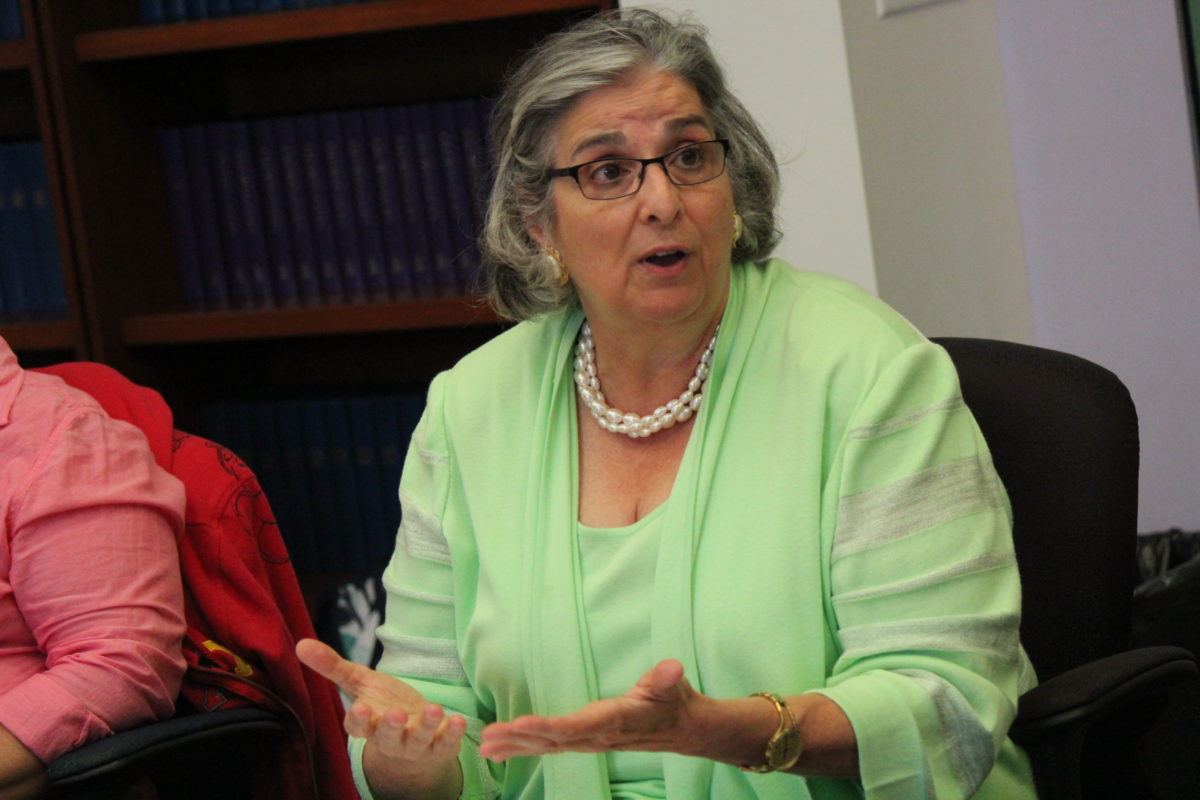
But in the church world, “money follows mission,” Mitchell said. The problem with church giving wasn’t that Presbyterians didn’t have money to give, “but the church stopped giving people a reason to give.”
She’s trying to change that, with a team that tries to work with congregations to find out what those churches are engaged with – “tell us what you care about” – and then looks for ways to support that work. “We’re going to stop worrying about all those churches that have left the denomination,” Mitchell said. “We’re going to focus on the people who stayed.”
Church Loan Program. The board voted to approve the transfer of the Church Loan Program from the Presbyterian Mission Agency to the Presbyterian Investment and Loan Program (PILP), with certain provisions. That’s the next step in a transfer that the Presbyterian Mission Agency Board voted last April to approve. James Rissler, president and chief executive officer of PILP, said the change is intended to bring savings in both time and cost, and greater efficiencies that could benefit congregations.