LOUISVILLE – The Presbyterian Mission Agency plans to kick off its Matthew 25 initiative on April 1 with a full media campaign and a new website – part of a broader effort to build support among Presbyterians around the mission goals of congregational vitality, combatting structural racism and ending poverty.
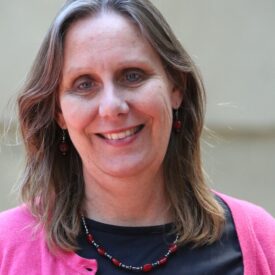
The Matthew 25 campaign – based on the calling in the 25th chapter of Matthew’s Gospel to give food and drink to the hungry and thirsty, welcome the stranger and visit the prisoner – “is getting a lot of traction, a lot of enthusiasm,” said Rosemary Mitchell, senior director for mission engagement and support for PMA. Congregations will be invited to formally commit to becoming Matthew 25 churches – and to share with others the impact that making that commitment brings.
“People give to the mission, they don’t give to budgets,” Mitchell told the coordinating committee of the Presbyterian Mission Agency Board, which met a few hours before the start of the board’s March 27-29 meeting in Louisville. When there’s recognition in the Presbyterian Church (U.S.A.) of a biblically-grounded focus on mission, “generosity increases and questions disappear.” The members of the coordinating committee include the leaders of the board’s administrative and ministerial committees, and it helps coordinate the work of the full board.
Budget process
There was also discussion in the coordinating committee of how to build support among mid councils for mission priorities that will be built into PMA’s proposed budget for 2021-2022.
The coordinating committee is recommending that the board suspend a section of the Manual of Operations (D.103 Suspend the Budget Development process described in the Manual Of Operations-2) that governs the budget development process of the Presbyterian Mission Agency. The purpose is to give time for leaders from PMA, the Office of the General Assembly and the Administrative Services Group to work together on a new process to be submitted for approval at the board’s September meeting.
Part of the thinking:
- Actions of the 2018 General Assembly involving restructuring resulted in two conflicting budgeting processes being left in place — but no process for setting a budget for the PC(USA), A Corporation, which is the corporate identity in which many administrative functions are now housed.
- The new approach could be more collaborative and could give a chance to build more support across the church for the budget by consulting with synod leaders and representatives from two of the smallest and two of the largest presbyteries.
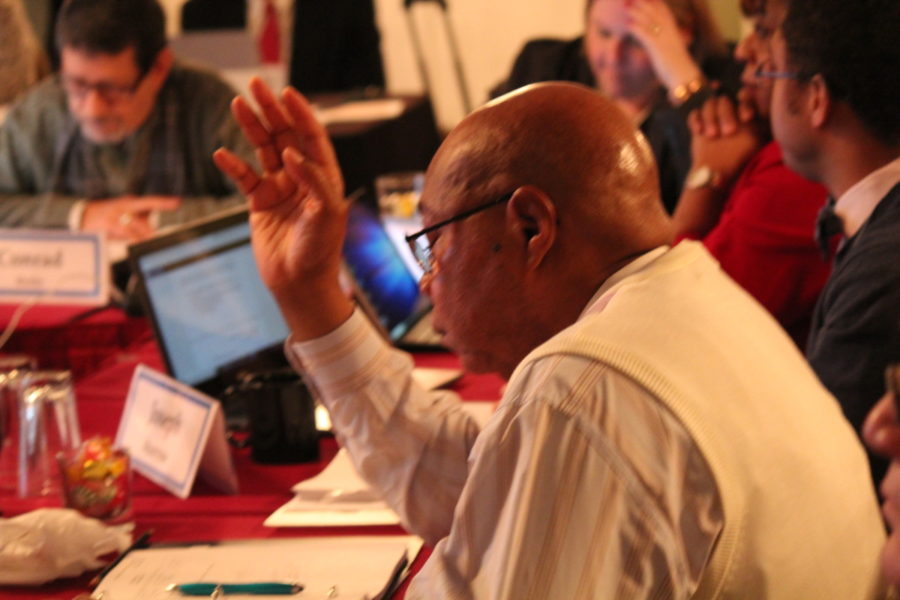
There also was considerable discussion about whether the board needs to hold a consultation this summer with mid council leaders to discuss mission priorities. The original proposal called for that consultation to be part of the board’s September meeting – but Conrad Rocha, a board member from New Mexico who serves as synod executive and stated clerk of the Synod of the Southwest, said a discussion with mid council leaders needs to come earlier – before the board intends to vote on the priorities, even if holding another meeting adds expense.

Rocha said he wants time for a “true consultation” with mid council leaders. Otherwise, “it’s effectively saying ‘Come and bless what we’ve come up with.’ ”
There’s been some history, Rocha said, where “we have consultations with mid councils that are not really consultations. … They’re dog and pony shows. This is what we’re going to do, don’t you think that’s great?”
Shannan Vance-Ocampo, a board member who’s general presbyter of the Presbytery of Southern New England, said “it’s good to consult with mid councils, because I am getting increasing pressure from my congregations to explain things about what the larger church does” – to understand what it means to be part of a connectional church.
If board members and mid council leaders can “wrestle with this together,” that would be “a new day for us, a new emphasis for us, but at the same time it can be very exciting,” said Melinda Sanders, a board member from Tennessee.
The coordinating committee voted to amend the original proposal, to recommend that the consultation with mid council leaders take place this summer, with the exact dates and place likely to be determined later this week.
Stony Point
The board will be asked to consider making decisions about the financial future of Stony Point Center outside New York – including hiring a consultant for about $38,000 (plus $3,200 in travel costs) to help develop a vision plan for Stony Point. The idea: to make the financial investment needed to develop Stony Point as a mission arm of the PMA. More information on the proposal can be found here.
Financial reports
The board is being asked to consider adjusted mission budgets (A.102 Revised 2019-2020 PMA Budget Action (2)) for 2019 and 2020 – with an increase of net expenses of about $310,000 in 2019 and $749,000 in 2020, and resulting in a mission budget of $71.7 million in 2019 and $71.4 million in 2020.
For 2018, total receipts were down more than $15.5 million from 2017 and expenses up by more than $1.3 million, according to an unaudited management report (A.202 Management Report). Among the factors:
- Emergency and disaster relief donations – giving in response to natural disasters –dropped by more than $7.3 million.
- Gifts and bequests were about $6 million less in 2018 than 2017. In 2017, the PC(USA) received two particularly large bequests.
- Giving to the PC(USA)’s Special Offerings were up by about $1 million.
At the end of 2018, PMA’s unrestricted, undesignated reserves totaled about $11.2 million, said Denise Hampton, controller for the PC(USA).

Consultant
Following a recommendation from board’s Power and Privilege Task Force, the coordinating committee is asking that the board approve spending about $12,000 to hire a consultant, Marian R. Vasser, to track power and privilege dynamics among board members at meetings. That observation would take place at meetings over the course of a year, said Michelle Hwang, a PMA board member who also is a member of the Racial Equity Advocacy Committee.
“One observation would not be enough; we would all be on our best behavior,” Hwang said. By hiring a consultant, objective observations can come from someone who’s outside of the PC(USA) system.
Communications
Kathy Francis, communications director for PMA, told the coordinating committee of a Matthew 25 marketing campaign that will kick off April 1. The idea is “to plaster the church with this initiative and invite participation,” said Warren Lesane, vice chair of the PMA board.
Francis also described work on developing the PC(USA)’s strategic communications plan, which would include combining the websites of PMA and the Office of the General Assembly into a single PC(USA) website that will be easier to search – focused on users, not denominational insiders, she said. The communications team plans to do a survey through Research Services in late April to find out “what the church most wants and needs from us,” Francis said.
Here’s the agenda for the PMA board meeting March 27-29: P.100 – Agenda
The board of the PC(USA), A Corporation also is meeting March 28-29. That agenda is here: P.100 Agenda March 2019 031319