LOUISVILLE – Presbyterian leaders concluded a week of policy-making meetings in Kentucky, with the boards of the Presbyterian Mission Agency and the Presbyterian Church (U.S.A.), A Corporation – meeting in different rooms at the same hotel – considering everything from financial matters to use of the denomination’s national offices in Louisville. Here’s some of what happened March 29.

Translation services
The board of the A Corporation – which is the corporate entity of the Office of the General Assembly (OGA) and the Presbyterian Mission Agency (PMA) – voted to create a new position of manager of global language services for the PC(USA), and to begin the process of creating a job description.
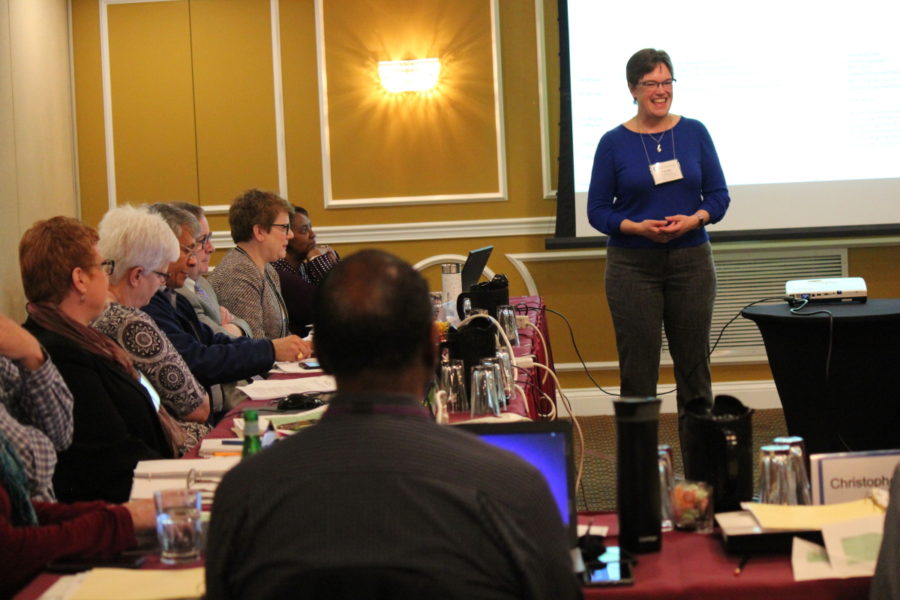
What has been referred to as Translation Services will be known as Global Language Services, “hoping to be more accurately descriptive and expansive,” said Julie Cox, a mid council executive and A Corporation board member who leads the board’s Translation Services Task Force.
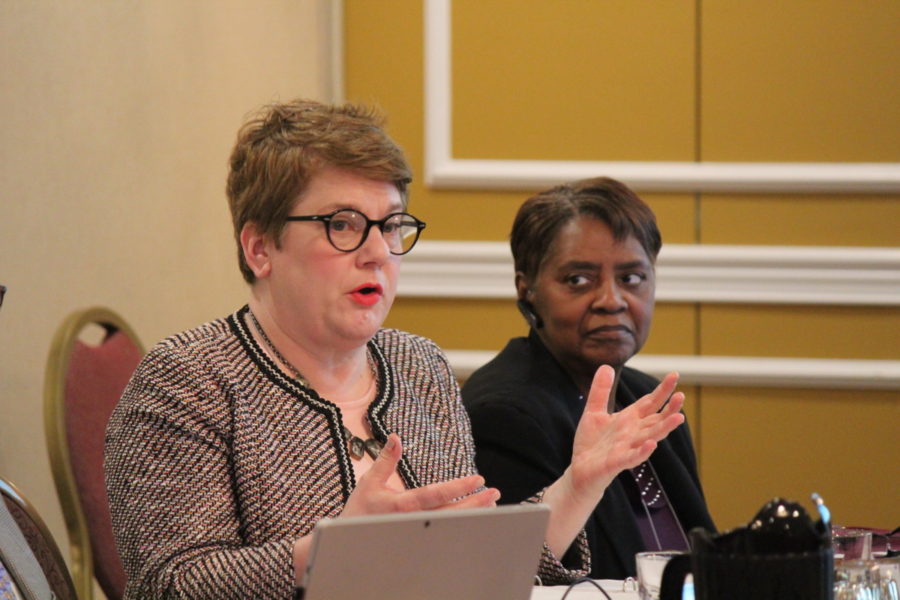
Translation of written materials is one part of the work; simultaneous interpretation from English into other languages at PC(USA) events is another.
This task force grows out of the work of the Way Forward Commission, which advanced the idea that “being able to communicate around the world our religious hopes and dreams … was essential,” said Sam Bonner, who served on that commission and now is on the A Corporation board. Translation is important to Presbyterians who speak Spanish, Korean and other languages, and “to bring our message around the world,” Bonner said.
Another aspect: “We want to be able to press into and receive the gifts of other cultures,” said Debra Avery, a minister from California who serves on the Moving Forward Implementation Commission and has been involved with the Translation Services Task Force. Part of the work will involve translating theological work from other languages into English, and making sure that Presbyterians for whom English is not their first language are able to fully participate at church events.
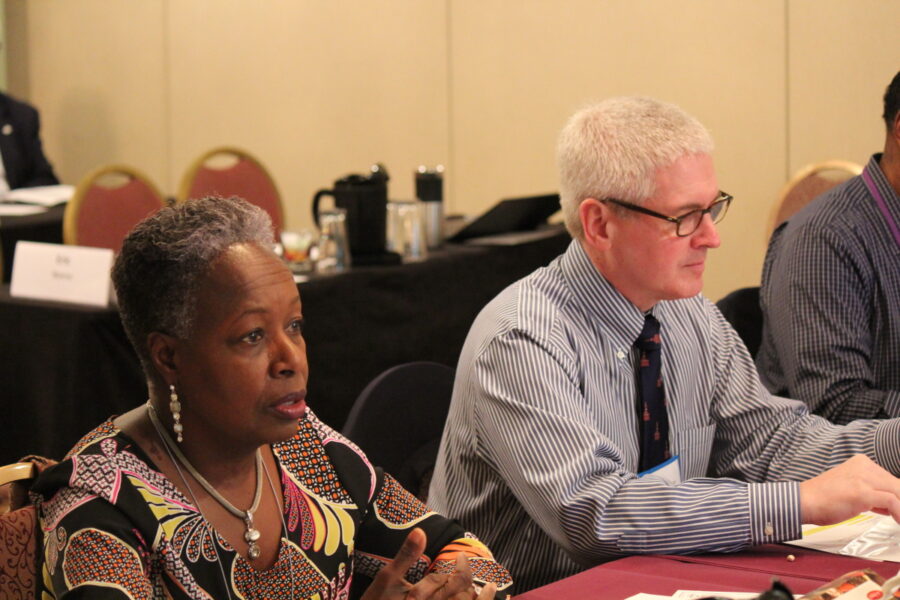
In developing the recommendation for a Global Language Services manager, task force members looked at how other denominations handle these issues, said A Corporation board co-chair Chris Mason. To have a manager “is not only a good idea, but it’s an idea that’s been tested in the marketplace,” Mason said — and is important because currently the need for translation services in the PC(USA) “vastly exceeds our ability to provide the services.”
The General Assembly authorized $460,000 for additional translation service staff for 2019 and $394,000 for 2020, said Kerry Rice, deputy stated clerk of the PC(USA) and acting head of the Administrative Services Group.
A Corporation board member Carol Winkler asked: Does the idea of interpretation include services for those who are hearing impaired or visually impaired?
There are ongoing conversations about scope and scale of services, including exactly what’s included and for what languages translation is needed, Cox responded. “It’s immense,” she said. “How can we better live into and embrace that immensity?”
Stony Point
The Presbyterian Mission Agency Board voted to hire Run River Enterprises as a consultant to consider the financial sustainability of Stony Point Center and the vision for the ministry done there, and they voted to extend the timeline for discussing those issues until September when Run River will report back to the board. It’s expected the consultant will cost about $38,000, plus $3,200 in travel costs.
For years now, the board has been discussing what to do about Stony Point, a conference center about an hour outside New York City that is home to a multifaith community and emphasizes hospitality and sustainable living. Stony Point faces significant costs for deferred capital repairs and in 2018 ran a deficit of more than $317,000. Diane Moffett, president and executive director of the Presbyterian Mission Agency, is proposing an investment so that Stony Point can be developed as a mission arm of PMA.
Online leader training
Tim Cargal, manager of Preparation for Ministry and Examinations, described for the A Corporation board a new online training platform that the Office of the General Assembly plans to roll out this spring – part of a push by PC(USA) stated clerk J. Herbert Nelson for leader development in the denomination.
These online training resources will be available at a new website: equip.pcusa.org, probably around June 1.
Once launched, the website will allow users to self-enroll to access resources in English, Spanish and Korean including training resources for ruling elders and other resources “to equip the saints for the work of ministry,” Cargal said.
Some resources will be material that’s already available on PC(USA) websites; others will be presentations that have been made at conferences or other events, or materials to help seminarians study for ordination exams, Cargal said.
PC(USA) national office building
Nelson described for the A Corporation Board his dream of using the denomination’s national office building in downtown Louisville to make an impact on the city.
Louisville “will never be New York,” but has a chance to rival medium-sized cities in the region such as Cincinnati, Indianapolis and Columbus, Nelson said. “We are basically in a shell of a building right now,” with part of the building rented out and other areas empty.
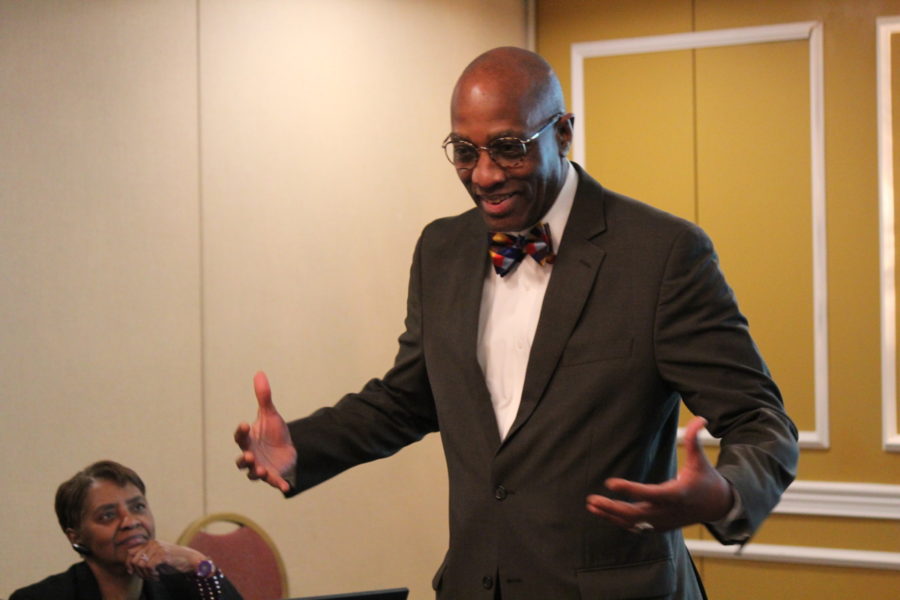
Nelson said he’s in conversation with Louisville leaders, hoping that “we will be a major player in the life of the city on a moral and ethical front” on issues such as homelessness or ending cash bail. “What possibilities exist for us to be a ministry in the middle of the city?” Nelson asked – including such things as starting a day care in the building or renting out meeting space or creating a new worshipping community in the chapel.
Bridget-Anne Hampden, co-chair of the A Corporation Board, pressed Nelson to get more specific, saying, “We are ready to support you on this,” and urging him to convene a task force with Presbyterian and city representation to come up with a plan. “You have lots of ideas,” Mason said, and Hampden urged Nelson and Rice to “think about who the partners might be in moving this along.”
Administrative Services Group
The A Corporation Board approved a business plan for the work of the Administrative Services Group. That may not sound thrilling, but it’s an important next step in figuring out how the A Corporation will function.
The Administrative Services Group is a group of about 80 employees in areas such as legal, risk services and finance who moved to the A Corporation in January – part of a reconfiguration set into action when the 2018 General Assembly voted to broaden representation on the A Corporation Board.
The business plan the A Corporation Board approved describes some of the difficulties, realities and hopes for that transition.
“While it may seem clear to the Board, assimilating to the new structure is very difficult for some and we will have to live into it for some time until a comfort level can begin to be achieved,” the plan states. The questions include how the Administrative Services Group will interact with PMA and how to grow the client base for services provided, because reimbursement for those services is a primary source of funding. The plan states that the leader of the Administrative Services group “must become part salesperson, constantly gauging the satisfaction of our customers,” including OGA and PMA and other PC(USA) agencies that use the services (such as legal services, finance and human resources) that the administrative services group provides.
The Administrative Services Group also is working on making its fee structure for providing services simple and clear – boiling down to one worksheet “what was once a very complicated Excel spreadsheet replete with formulas, spreadsheet logic, and endless formulas,” the report states. “In addition, the ‘old way’ was based on assumptions that could be seen as subjective and created without the input of all partners.”
The new method will be put in place to build budgets starting in 2021, as the General Assembly already has approved the PMA and OGA budgets for the next two years.
Leadership
Following the unexpected death of Mike Miller, who had been acting chief financial officer for the Administrative Services Group, Rice has taken over leadership of that group for a period of transition. The A Corporation Board voted at this meeting to move forward with hiring an interim chief financial officer.
Hampden described the next steps in the process of hiring an A Corporation president. A search is underway, and Hampden said the search committee will use the next six weeks to “cast the net as wide as possible.”
By mid-May, the committee hopes to bring six finalists to Louisville for interviews, then the final three for another round of interviews. The hope is to identify a finalist and extend a job offer by June, she said.
“It is a very aggressive timeline, but I think it’s a doable one,” Hampden told the A Corporation board. “We want to keep a sense of urgency.”
Gratitude
Cindy Kohlmann, co-moderator of the 2018 General Assembly with Vilmarie Cintrón-Olivieribrought greetings to the A Corporation Board on behalf of both co-moderators, as Cintrón-Olivieri was not able to attend because of illness. Kohlmann thanked the A Corporation Board members for their service to the church, saying that the work, while technical, “is about building up the body of Christ.”
Worship
During opening worship at the Presbyterian Mission Agency Board, Bong Bringas, a board member and commissioned ruling elder from southern California, told of work he’s involved with called the Guardian Angels – a group of Presbyterians and Lutherans who monitor court proceedings in immigration court for families and children who are asylum seekers.
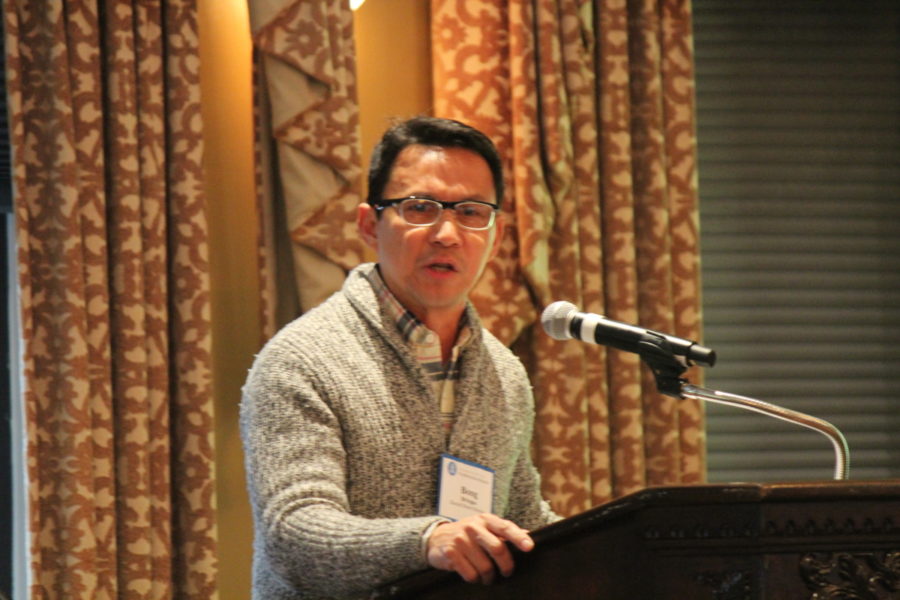
“We call ourselves guardian angels, because we feel the work we do protects tens of thousands fleeing violence,” Bringas said. Many children facing deportation do not have attorneys and don’t understand their legal rights. Bringas said he was moved to help by statements in volunteer recruitment materials saying “you become a witness in a very important way” – showing immigration judges that people are watching – and “you get to move the kingdom forward.”
He saw a 5-year-old child who barely spoke English come before a judge alone. He saw families who had traveled for thousands of miles, “running from terrible danger, encountering horrors along the way,” and becoming so discouraged by their experience with immigration authorities that they told a judge, “We just want to go back.”
Tens of thousands of cases are still being processed, Bringas said. He feels responsibility to tell the migrants’ stories, to advocate for the children, to stand with them as they come to court, to join a broader humanitarian response.
As people of faith hear stories of refugees from around the world – people who long for a better and safe life, Bringas said – “I pray that we remember that we are the only hands that God has.”