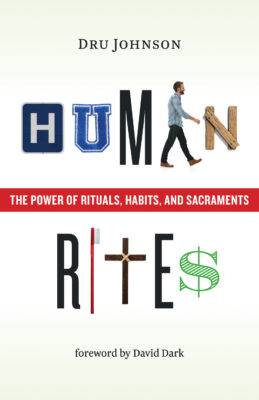
 Dru Johnson
Eerdmans, 176 pages
Reviewed by Thomas G. Long
The great scholar of ritual Catherine Bell once commented on how dramatically ritual has come back into fashion in contemporary society. Rituals, often rejected by industrial society as “primitive, tribal and nonrational,” or attacked by Protestant Reformers as superstitious and unbiblical, are, she said, now increasingly reclaimed, romanticized and viewed as “good for you.” Ritual practices, which in the past were scorned as mindless submission to authority, are now, to the contrary, seen as acts of healthy resistance against the technologizing and secularizing of society. Indeed, if my Scottish Presbyterian forebears should suddenly appear through time travel and catch me in an alb imposing oil and ashes on the foreheads of Lenten worshippers, they would be scandalized. They would surely miss what I understand to be the worshipful power of those actions and could do nothing but assume that I had been captured and deprogrammed by a war party from the Vatican.
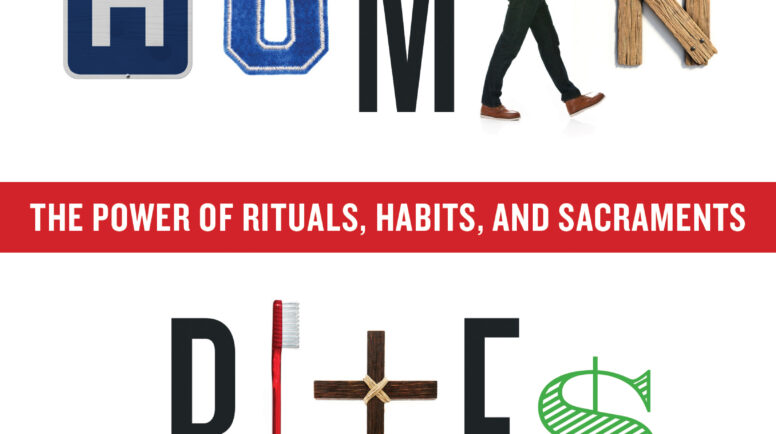
Ritual, mostly in the good sense, is the theme of this entertainingly written book by Dru Johnson, who teaches Bible and theology at The King’s College in New York City. His main point seems to be that, whether we know it or not, whether we like it or not, rituals saturate our everyday existence. “Our entire world,” he writes, “our faith traditions, professions, cultures, and embodied lives — is shot through with ritual.” Indeed, it is impossible to read this book without becoming aware of ritual-like patterns everywhere, from driving to work, to family meals, to preparing for bed.
Given the power of rituals to shape our moral outlook, Johnson invites us to scrutinize our ritual life and to ask sharp questions about the rituals we practice. Where do they come from? What authorities commanded them? Should we abandon or change them? Rituals, Johnson argues, can nourish life and sharpen moral vision, but they can also “go dark” (become addictive) or “go flimsy” (become trivial).
As engaged as I was by Johnson’s prose, I have two serious reservations about this book. First, Johnson’s implied definition of ritual is so broad it finally loses the capacity for nuance. The Lord’s Supper and baptism are rituals, but so are walking to church, clothes shopping, playing “Candy Crush” and doing laundry. At one point, Johnson even suggests to the readers that the fact they are reading his book is ritual activity. Ritual is so pervasive and universal it becomes the water in the aquarium and, thus, lacks any real descriptive value.
Second, and more troubling, is the tacit view of Scripture and theology in this book. For Johnson, rituals spring from three basic sources: everyday living; authority figures (“parents, teachers, churches, coaches, and others who prescribe traditions for us to follow”); and “from God and his Son.” He says, “God prescribed a thick ritualed world for Israel, and Jesus strategically re-tooled those rites for his followers.” The notion of an independent divine stream of ritual, the idea that God and Jesus somehow authored and mandated rituals like Passover or the Eucharist apart from interactions with history, human agency, intercultural borrowings and the like, strikes me as naïve. Just as we listen faithfully for God’s Word in the words of a Bible that contains a mixture of genres and bears the marks of human fingerprints, so we encounter the risen Christ in our sacred rituals, which also arise in history and culture and bear the imprint of human hands.
 Thomas G. Long is the Bandy Professor Emeritus of Preaching at Candler School of Theology in Atlanta.