 Jonathan P. Walton
IVP Books, 224 pages
Reviewed by Jeff Charis-Carlson
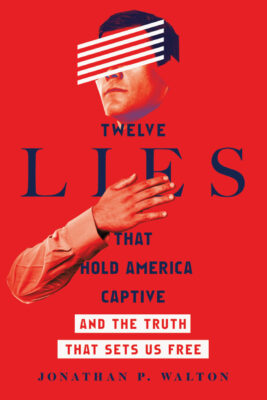
Readers can take encouragement just from skimming through the blurbs accompanying Jonathan Walton’s new book, “Twelve Lies That Hold America Captive.” It’s inspiring to know so many American Christians are already engaged in the import work of decoupling the core of their faith from the rhetoric and iconography of their national identity.
And Walton’s attempt to speak truth to power lives up to such genre-busting descriptors as “prophetically pugilistic.” In every chapter, he challenges his readers to pause and consider the passages where they disagree with him — sometimes to the point of wanting to walk away from the book.
“To claim that the white American church does not embody and enforce the ethnic, social, and political division and call it ‘Christian’ is to live in denial,” Walton writes. “And to stop reading here because you disagree is cowardice.”
Walton, however, doesn’t want any of his readers to go through this journey on their own. A former director of the New York City Urban Project, he encourages people to read the book within an accountability relationship with someone unlike themselves. The lists of questions ending each chapter are not meant for mere quiet contemplation; they are meant to allow readers to hear what their thoughts on race and social justice sound like when said aloud.
As Walton explains how the U.S. and the Kingdom of God are “antithetical” to one another, he provides his own loose sociological study of what he calls White American Folk Religion, or WAFR.
Given the ubiquity of WAFR — aka American civil religion — few readers will make it through the book without flinching at least once as Walton negatively reframes the sentiments at the heart of the Declaration of Independence, the Constitution, the Pledge of Allegiance, the National Anthem and the American dream.
Walton unpacks the underside of slogans like “We are all immigrants” and “We are a melting pot.” The first, while often intended as means for voicing solidarity with today’s immigrants, becomes an ill-fitting narrative frame for describing the complex array of reasons that brought people — especially non-Europeans — to the Americas.
The slogan “All men are created equal” likewise becomes debilitating because it “implies that if I am behind, no one is to blame except me.” And the notion that America is a “great democracy” — rather than a republic set up to protect the rich and powerful — is designed to keep people ”running the race for life, liberty, and happiness.”
Walton is upfront about his own implication in the ideology of WAFR. As an artist and InterVarsity employee, for example, he often experiences a tension between his gratitude toward the successful rich people who sponsor him and his denunciation of the social forces that maintain income inequality. And he offers a hard look at his own past failings as a model for how readers can lament, confess, repent and reconcile.
But woe to anyone who finds themselves agreeing with Walton’s jeremiad for political reasons rather than spiritual ones. The history lessons provided in “Twelve Lies” are very much in line with recent secular works, such as Robin DiAngelo’s “White Fragility,” yet many of Walton’s would-be allies may be surprised to find themselves cut to the quick by his rebuke.
Jeff Charis-Carlson is a freelance journalist and an elder at St. Andrew Presbyterian Church in Iowa City, Iowa.