CINCINNATI – Miguel A. De La Torre calls himself a scholar-activist, and – as might be expected from the author of books with titles including “Burying White Privilege: Resurrecting a Badass Christianity” and “Embracing Hopelessness” – he really doesn’t care if a roomful of white Presbyterians are thrilled with what he has to say.
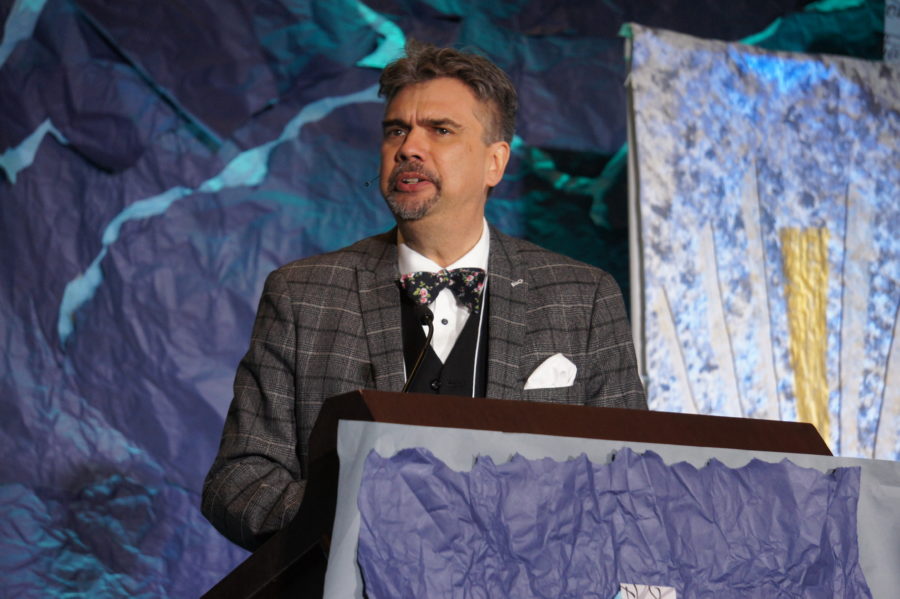
Speaking March 2 at the NEXT Church national gathering, De La Torre – a Cuban immigrant and professor of social ethics and Latinx studies at Iliff School of Theology in Denver – said his message during this keynote address was not intended for white Christians but “for the few faces of color in the audience,” and, he said later, for “those who are on the margins of the margins.”
His message is intentionally provocative. As he said in response to a question: “I guess I’m preaching chaos and disorder.”
“Christianity the way it is done in this country is really only for white people,” De La Torre said. It’s built on a foundation of “salvation history,” a systemic undervaluing or ignoring of the philosophical and theological contributions of those who were colonized by whites “and relegated to the underside of history.” As a child at Blessed Sacrament school in Queens, the students recited the Pledge of Allegiance daily. When they came to the line of “liberty and justice for all. … Even as a child I knew that didn’t apply to me.”
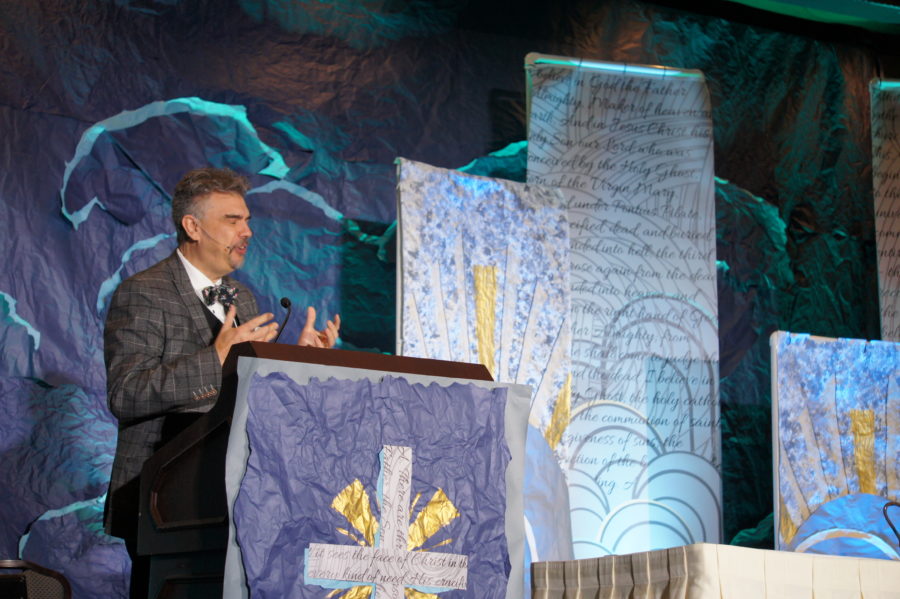
Those who are oppressed become complicit in their oppression. “I have to deal with how much my mind has been colonized,” De La Torre said.
When he was about 20, with “hair down to here,” he drove his car – a red car that he envisioned as a Ferrari but was in reality a Capri – one weekend from Miami to New York. A police officer stopped him in New Jersey for going barely over the speed limit, and asked to search his car. “I said yeah, sure, go ahead. I never argue with people who have guns.” And it wasn’t “the first time I was stopped for driving while being under the influence of being Latino.”
When De La Torre asked why he was pulled over, the police officer explained they suspected young Latino men from Miami driving red cars north were trafficking cocaine. The officer found no drugs, but when he pulled away, De La Torres realized he wasn’t angry – he was mentally congratulating the cop for doing a good job, and had become complicit in his own oppression. “The idea of salvation history is part of our DNA.”
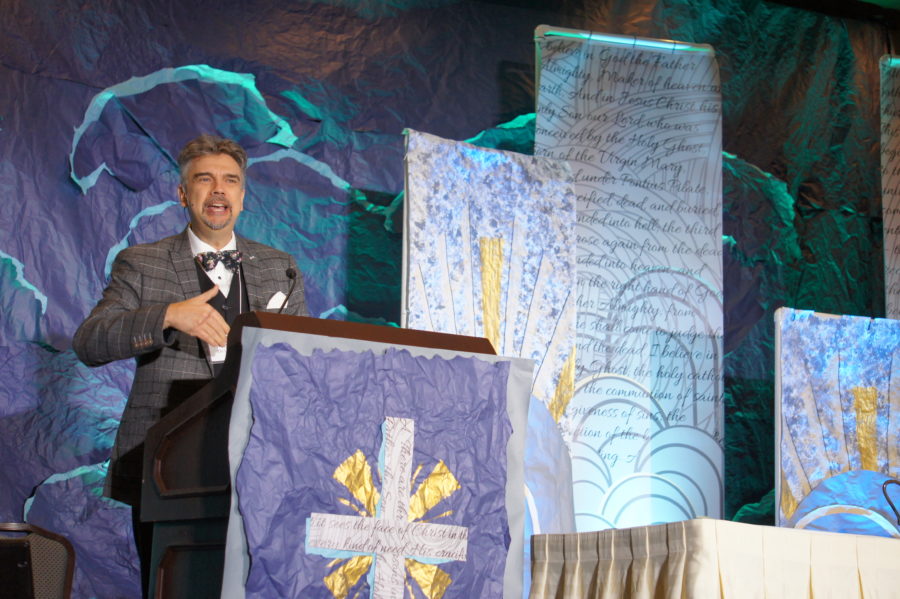
Reject hope. Hope is not a valid response to oppression that intense, De La Torre contends.
While Martin Luther King Jr. stated that “the arc of the moral universe is long, but it bends towards justice,” De La Torre disagrees. “The arc of the universe could care less which way it bends” – maybe it’s towards justice, maybe towards injustice. “We’re the ones who have to do the bending.”
In the face of unrelenting oppression, “hope becomes a form of domestication,” De La Torre said. “Hope works very well when you are among the conquerors,” but for those facing genocide, it’s a problem. To believe in the riches of the hereafter while ignoring the oppression of the here-and-now means “I embrace my own oppression, and it makes God vomit.”

Make wine from your own cultural symbols. De La Torre rejects the Eurocentric cultural views of the academy – that pantheon of white male theologians – and says people of color must “learn how we can make our own wine out of our own cultural symbols,” studying the voices of the marginalized and speaking for themselves.
Coming from Cuba, “we will make our wine out of plantains. … It doesn’t matter if it tastes bad, because it’s mine. Because it’s mine, it has worth and it has meaning.”

Privilege obstructs action. De La Torre took a group of students to Mexico to visit the squatter villages, to learn from people who live in poverty and know marginalization. One student said, “I just saw the misery of the people. But when I looked in the eyes of the little girl, I saw the hope in her eye.”
What he saw instead was “the middle class privilege that excuses her from doing anything about the poverty of this little girl.”
Living in Holy Saturday. In Spanish, the word for hope – “esperanza” – comes from the same root as the word for “to wait” – “esperar,” De La Torre said.
“We’re not always sure what we’re waiting for, and we’re not always sure if the wait is for something good or something bad,” he said. The German theologian Jürgen Moltmann says that “we can trust God, because God keeps God’s promises. … Tell that to Primo Levi,” the Auschwitz survivor who said, “there is Auschwitz, and so there cannot be God.”
Moltmann argues that at the end of history, “we will look back and everything will make sense,” De La Torre said. “No matter how I look back, the Holocaust will not make sense. Slavery will never make sense. Gunboat diplomacy will never make sense. … I have chosen to stand with the oppressed of the world who live in Holy Saturday,” in a moment of anxiety, not knowing if there will be a resurrection. “That’s who my audience is: those who understand the hopelessness,” not those who say “that it’s all going to work out, that all things work for good.”
An absent God. Sometimes hope can be a way of controlling people, De La Torre said. “Hope keeps me quiet and docile. But when I have no hope, when I realize I have nothing to lose, that’s when I am the most dangerous. That’s where I’m trying to get my people to – to realize that by embracing hope, nothing will change, because they are afraid of losing the little crumbs they have. So I have to ask where is God in all of this? If I read the biblical texts clearly, sometimes God is absent. My God, why have you forsaken me?”
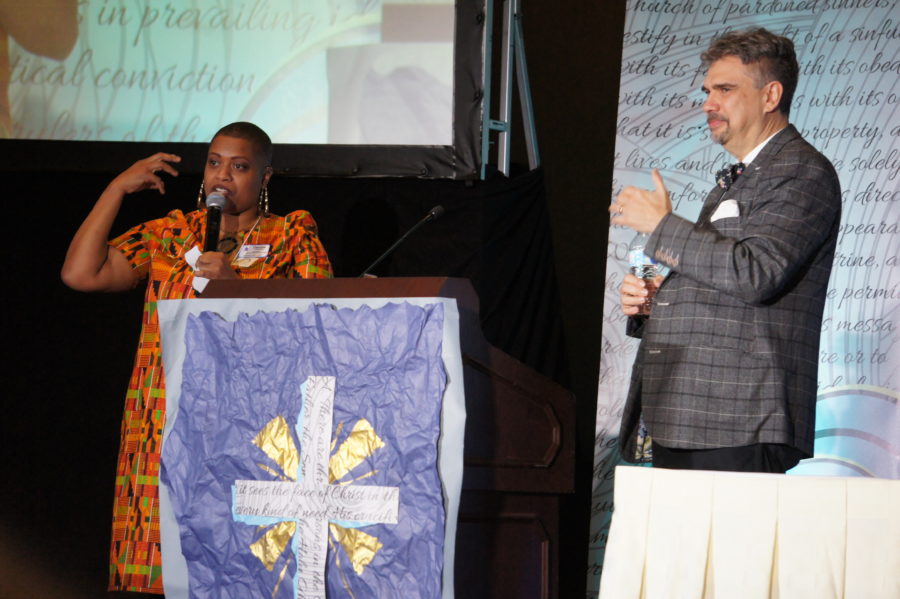
Desperation and action. That leads him to praxis: the idea of creating a “badass Christianity,” which rejects hope and leads to the question of “how then do we act,” knowing that there are no easy fixes and “racism, xenophobia, sexism, homophobia are with us for a long, long time.”
The question that matters to him is not who or what God is – “that’s totally unimportant” – but if there is a God he believes in, “how do I live my life accordingly?”
He asks his students: “Do you fight for justice because you think you are going to win?” Or do they fight “even when they know the battle is already lost, even though you know there is no way in hell you are going to win,” because “it defines their humanity and it defines their faith, regardless of the consequences.”
De La Torre defines the opposite of hope not as despair, but desperation, “because desperation propels me towards action” – in the same way that desperate migrants risk their lives crossing the Sonoran desert.
The questions that intrigue him: How to ethically cheat so those in poverty get their equal share? How to ethically steal so people can eat? How to deceive to reveal truth? How to ethically “screw with the systems of power and privilege and whiteness so we can move a step closer to liberation?”
He also contends that the ethical response means “I refuse to follow the rules because the rules were designed by the dominant culture. … Not following the rules might lead us to something just,” like Jesus turning over the tables in the temple.
“If some of you are not offended by everything I’m saying, then I’m doing something wrong. Because if everyone agrees with us, we’re not doing Christianity. We’re basically having a nice social club. … This message of Christ is truly radical.”
During a question-and-answer session, De La Torre was asked about the Presbyterian bent towards doing things “decently and in order.”
His response: “Yeah, lose that. If you want to change the world and turn it upside down, it doesn’t happen in a five-year plan.”
What about the passage from 1 Corinthians stating that “faith, hope and love abide”?
“I think Paul might have gotten something wrong,” as he did with telling women to obey their husbands and telling slaves to obey their masters. I’m saying for the vast majority of us, we don’t have hope.”
What’s his word for white Christians?
“You have to reject white Christianity. You have to reject this white Jesus. Not only is it oppressive to communities of color, it also oppresses you. … I’m asking you to crucify your whiteness so you can be born again and be a new creature in Christ.” Crucify all that oppresses – including racism, sexism, homophobia. In short, “you really need to get saved.”
And “number two, don’t cry,” white people. “It’s not about you.”