So what does an online summer camp look like?
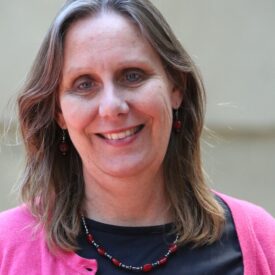
That’s what Kellie von Borstel, camp director of Montlure Camp in Arizona, is spending long, anxious, creative hours trying to figure out. She’s set aside much of the hard work she had done over the past nine months or so to plan the 2020 camp season — in search of something completely new.
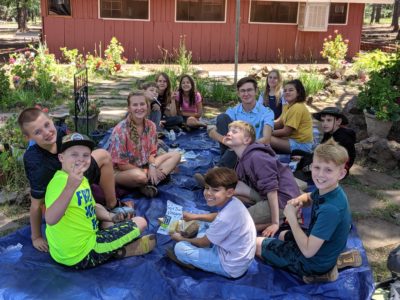
Camp Montlure has begun taking registrations for its online “Camp Reimagined,” a work in progress. “It’s very fluid, and it’s still changing,” von Borstel said.
At the heart is her new motto: “Connection over content,” with an emphasis on the Sabbath practices of hospitality, prayer, retreat, storytelling and service. While von Borstel and her small staff are working on curriculum and ideas for activities, her main focus is on sustaining the relationships Camp Montlure has built with its campers — and providing space for these young people to connect with their counselors and one another.
Typically, Montlure operates a traveling day camp for elementary age children that takes its programming to congregations around the state, and an overnight camp for older students near in White Mountains near Greer, Arizona.
As it stands now, Camp Reimagined will have week-long sessions grouped by age, with the format mixed up through the day, including large-group time, private devotional time, self-guided activities campers can do “completely detached from the computer,” and small group bunk or cabin sessions — places for conversation about the impact COVID-19 is having on campers’ lives and their faith.
“We’re unplugged traditionally. We don’t allow cell phones,” von Borstel said. “It’s a very interesting dynamic that now we’re being forced to plug in.”
In planning virtual camp, the Montlure staff also is having to deal with changing realities — not knowing, for example, whether campers will have to stay mostly inside (because of shelter-in-place orders or Arizona’s steaming summer temperatures) or whether campers could, for example, take a nature scavenger hunt in their neighborhood.
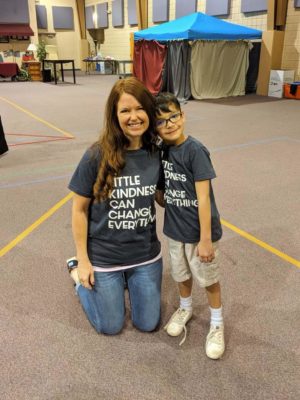
Montlure is planning to send out camp boxes or bags in advance of each session – with a camp T-shirt, a prayer journal and pen, any needed supplies for art or other activities, and printouts of activities so campers can walk away from the computer to participate.
Von Borstel said parents have had mixed reactions to the idea of virtual camp. “At the beginning, it was ‘No way!’ ” she said. “That was my reaction initially too. Going virtual is really the antithesis of what camp is, of kids getting the experience of being outdoors 24 hours a day, away from their parents. … More and more parents, just as I have had to go through the grief motions, are kind of in the acceptance phase. None of us would choose to do this over being in person with each other.”
But Montlure is going virtual “because we don’t want to go a whole year without seeing our kids,” von Borstel said.
Recognizing that some families that are socially isolating are eating dinner together every night and spending time together in the evenings, von Borstel also is hoping to make some camp programming intergenerational — so parents and campers can have table talk involving some activities, and families can gather together for a virtual camp fire at night.
Montlure has some experience navigating the unexpected. In 2011, a blaze known as the Wallow Fire swept through the region — and Montlure has been unable to return to its original site since then, holding residential camp during the interim in other rented facilities. “Even the year of the fire when the kids were evacuated, we held camp at another site the following week,” von Borstel said. “I feel we are well-equipped to weather the storm” of this new challenge.
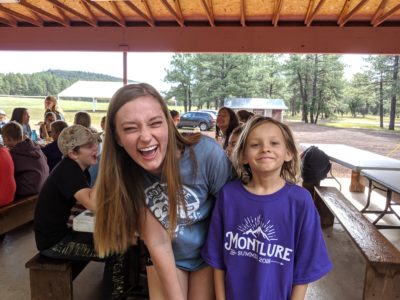
While she tries to stay positive, she also admits that “I’m on a little bit of a roller coaster,” with moments both of optimism and grief. Von Borstel is committed to creating a virtual camp “because I really care about each and every camper, and I care that they have a place to connect. Camp is such an anchor for the lives of so many kids. For us not to even try to give them something, that to me is more heartbreaking than ‘Let’s just give it a try, and recognize that some things are not going to work.’ ”
Von Borstel also thinks the COVID-19 pandemic will bring some long-lasting changes to how church summer camps operate.
“I’m trying to be really open to what God is doing,” she said. “I do feel confident that new things are going to be birthed through the process. I think we’re going to be stronger because of it,” with some of what matters most only visible in hindsight. “Let’s see.”