
The post on my public Facebook page from the man I did not know started out innocently enough. George said that his daughter had told him he was a racist, and he didn’t think he was. He looked for a book to find out, so that if he was a racist, he could change. He found my book, “Good White Racist: Confronting Your Role in Racial Injustice.” He thought it might be just what he needed.
Let’s just say the book was not his forever favorite.
He bemoaned the $12 and the time he’d spent reading it. Things seemed to escalate when he blamed himself for not doing his research on me and called me a “white woman libber communist Never-Trumper.” His rant ended in mock concern that I might “off myself” in November. (Though his words said he hoped I didn’t kill myself come election season, the implication was that was exactly what he hoped for.)
These types of attacks are not new to me, nor are they unexpected, given the fact that I work in anti-racist spaces. In fact, a Lifeway study showed that among some Christians at least, 22% agree (at least a little or a lot) that civility in conversations with people who disagree is not productive, and about a quarter believe it’s perfectly fine for their political candidate to lob personal insults at their opponent. At least George’s post was an entertaining read — it had narrative and a little bit of humanity to it. Mostly the comments I get are unimaginative and ill-conceived, like one reader who went to all the trouble to seek out my personal email address just to tell me to “Go back to Africa.” (I’m white and of Irish heritage, so this one was particularly amusing). Though George did indicate a desire for my untimely death, it wasn’t the same as the direct threat I received on Twitter, which claimed I would soon find my end in the loop of a noose. (It took three appeals, by the way, for Twitter to finally determine that tweet was hateful and have it removed.)
I coach white pastors and organizational leaders through their own racial awakenings, and I’m the sort who loves to talk about race, politics and religion in polite company, which means I might not make the perfect guest for your next cocktail party. It also means I collect online trolls like some people collect Smurf mugs or baseball cards. They come to my social feeds with their circular logic and their polarizing sound bites, unwilling and unable to consider pesky things like paradox and generous thinking. I confess it’s difficult sometimes to not respond with a similar sense of vitriol, but seriously, who has the energy for that? It takes a whole lot of effort to be meaningfully mean. I’d rather be kind yet firm, or at least take the higher road and ignore that nonsense altogether.
Still, there are some things I simply will not tolerate. Hateful commentary toward marginalized communities like people of color and members of the LGBTQIA community –
which make up the multitude of my online friends – will be rebuked and removed tout de suite, because I insist that my online space be safe for my friends and loved ones. I engage with people who hold different views, and I am clear about where I stand and will confront what I consider to be illogical opinions while doing my best to respect the person who holds them.
But occasionally, a troll will stop by with a big fat helping of hate. And sometimes, I confess, I take a bite.
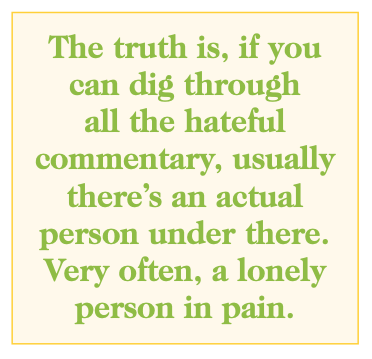 Friends often caution me: Don’t feed the trolls. It’s probably good advice, because the truth is, I probably won’t change a single brain cell in the mind of someone who disagrees with me so vehemently as to desire my death, even if just in their imaginations. I don’t feed the trolls to assuage their hunger for angry debate. I do it for the people who are watching.
In some cases, that’s people from marginalized communities who need to finally see that someone from the dominant identity has their back. After all, racism and homophobia are exhausting and ubiquitous and totally the responsibility of white, straight people, so it’s up to me as a white, straight person to do the work of managing racism and homophobia when it appears on the shores of my Facebook page. I know that when misogynists loom, I’m always grateful to the men who call out that bad behavior so I don’t have to. This isn’t about being rescued. It’s about dominant identities taking responsibility and holding each other accountable.
Take George, for instance.
In the end, George wasn’t all that bad.
Look, I’m human. Like anyone would, I had a reaction when George suggested I off myself, and it’s possible it contained a few chosen curse words that I uttered under my breath. (I am, after all, from New Jersey, where cursing is our mother tongue.) But what I muttered in my kitchen and what I typed onto my Facebook feed were two very different things. I only took one breath before I wrote: “Wow! What a fun-filled and loving message! God bless!” I intended to leave my sarcasm as a snack and ignore any other bait George threw my way. He responded with, “Kinda like your book.”
I proceeded to fix my after-dinner treat, leaving my phone decidedly on the counter. But then I thought a little more about George. I thought it was pretty cool that George cared so much about his daughter’s opinion. And the fact that he was willing to buy a book to find out if he was a racist or not demonstrates a real willingness to learn. It’s not surprising that my book made him uncomfortable (that’s sort of the book’s point, and I say so right at the start), and I can relate to the fact that feeling uncomfortable isn’t fun. I started to realize that even though it’s obvious that my humanity wasn’t all that apparent to George – I was, after all, just a “white women libber communist Never-Trumper,” a conglomerate of labels to which he was opposed – George’s humanity was apparent to me. He was a dad who loved his daughter. He was a man who didn’t want to be a bad person. He was a guy who got uncomfortable and offended when he was presented with an opinion different than his own. He was being deeply human, underneath all that dehumanizing he was doing.
I must have been having a good day. God and the angels must have been in charge of my words and my fingers in that moment, because I did not respond the way I wanted to. Instead, I did something that surprised even me. I went back online. I told George I was sorry he didn’t like the book, and if he wanted to send me his address, I’d send him a personal check for $12 and some suggestions for other books he might like better. (I mentioned James Baldwin and Ta-Nehisi Coates, which may have been excellent suggestions and also a little snarky at the same time, which you’ll understand if you’ve read Baldwin or Coates, and if you knew George like I know George).
At the same time, some of my friends joined in the conversation, too. One of them told me that hate mail is validating, which seemed to surprise George. “I didn’t mean my post to be hate mail,” he said. “I was just expressing my opinion about the book.” He responded to my offer and admitted that since he had learned some things from my book, it wasn’t a total loss, so he did not need a refund. Someone else said at least it seemed like George had a sense of humor and that perhaps we should grab a beer together. George replied, “I do like beer.”
Soon enough, we were all having a conversation. George had recently broken his wrist, so he had extra time for reading. I asked him if we could still be friends even though I prefer wine over beer; he confirmed he had just poured himself a nice pinot. We talked about how hard it is to type when you have a cast on your arm, and he lamented that I had let the election determine whether I would stay in my previous church (a personal tidbit he’d picked up from the book). I assured him that I was finishing up seminary and that Jesus and I were still just fine, a comment which he liked with the thumbs up sign, and I would like to think he liked emphatically. Eventually, he told me that he’s sure I’m a better person than my book revealed me to be, and he hoped that I knew he was a better person than his post revealed him to be.
And this is the crux of the matter.
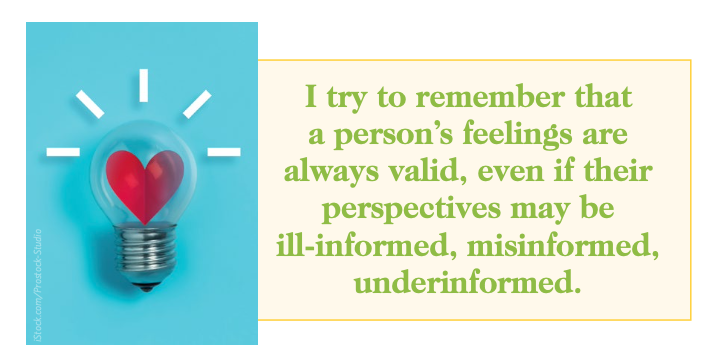
We would all do well to remember that none of us are our social media feeds. Behind our screens, we are whole people, with lives and loves, with broken bones, with fears and pain and actual emotions. I try to remember this, and I often fail. Social media conversations can devolve into a swirling mess of incomplete thoughts, misunderstood implications and sound bite battles that do nothing to achieve anything resembling mutual comprehension, much less grace or mercy. I try to remember that a person’s feelings are always valid, even if their perspectives may be ill-informed, misinformed, underinformed. When I do engage, I try to stick to interrogating beliefs rather than attacking people. When I do this well, I find a certain softening of edges and soon enough, the tender spots of woundedness that all of us carry around begin to emerge. When that happens, it gets less important to be right, and more important to listen for the pain underneath. I am often changed by this process for the better. I’d like to think that they are, too.
George’s response is not unusual or hard to understand, either. There is one very real and brutal truth about white people engaging in the internal work of anti-racism: it must lead to a deep midnight of the soul, the place where the scary things come out to haunt us, where shadow-play becomes the realm we must explore. This is no comfortable or easy thing, and it takes a brave and willing soul to sojourn through that oceanic type of depth. It is the depth of grief and lament, and there is no detour, no easier way, no simple bypass we can take that will get us to where we want to go. But the journey, if we are willing to take it, is worth it. If we are willing to walk through the depth of our lament, we can arise on the other side in the dawning light of reparation and redemption. And then, finally, perhaps justice can reign in the land.
For you, for me, for our Black and brown siblings, and yes, even for George, a father who cares what his daughter thinks.
 KERRY CONNELLY is a certified coach, speaker and the author of “Good White Racist? Confronting Your Role in Racial Injustice.” She lives in New Jersey with her family.