Who are the 140 million Americans living in poverty, or in spitting distance to it?
What are their lives like? What policies and systems contribute to their suffering?
And what responsibility do Christians have to do something about it?
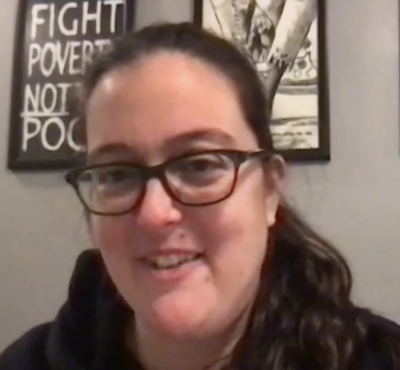
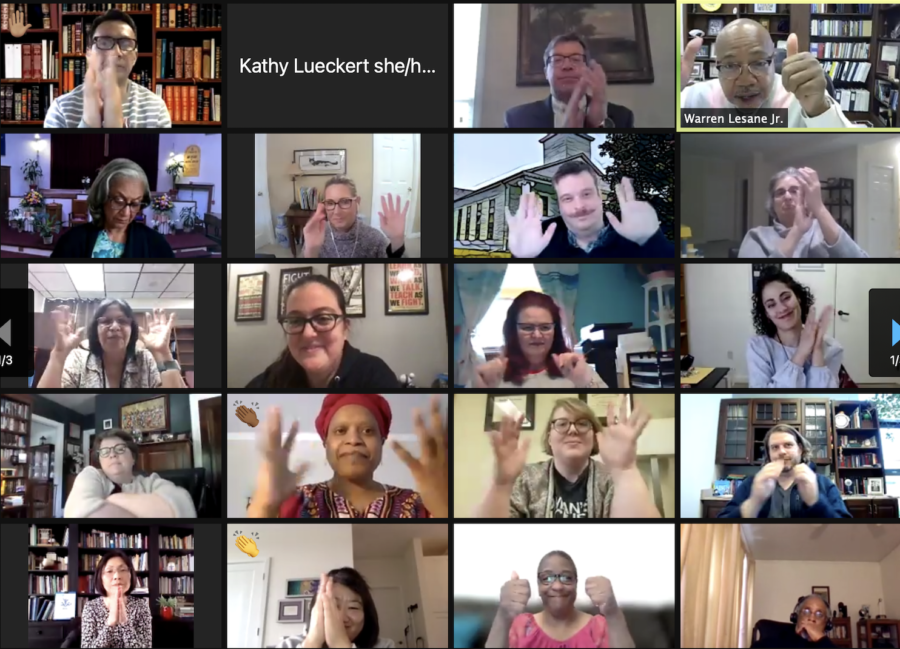
Those are some of the questions that Liz Theoharis – a Presbyterian Church (U.S.A.) minister and co-chair with William J. Barber of the Poor People’s Campaign: A National Call for Moral Revival – presented in a discussion April 22 with the Presbyterian Mission Agency Board. The board is focusing at its April 22-23 Zoom meeting on eradicating poverty — one of three emphases of the Presbyterian Mission Agency’s Matthew 25 initiative, along with dismantling structural racism and building congregational vitality.
Theoharis said many of the 140 million Americans living in or close to poverty are one health crisis, one job loss, one bad storm away from “absolute economic ruin.” And they live in a country in which there is “no scarcity, except for our scarcity of political will” to make changes.
She began by showing a video (see below) in which people living in poverty told their own stories: of working full time at a minimum wage job and not being able to pay the bills; of knowing farmers in Kansas who killed themselves because they were “in debt up to their eyeballs”; of losing health insurance just before being diagnosed with stage 4 kidney disease; of realizing that with the factory closed and the jobs gone, poverty may not be a temporary condition – a season or something to rise out of – but permanent, the way life always will be.
Members of the board had their own stories to tell.
Ken Godshall said he recently got a call from the church he previously served in western Kentucky, reporting that congregation’s first death from COVID-19. The man who died was 54 and was hospitalized for three weeks. Two months before that, the man lost his manufacturing job, and with it his family’s health insurance. His 24-year-old daughter, also with no health insurance, has been in the hospital too. The family has no way to pay what are sure to be huge medical bills.
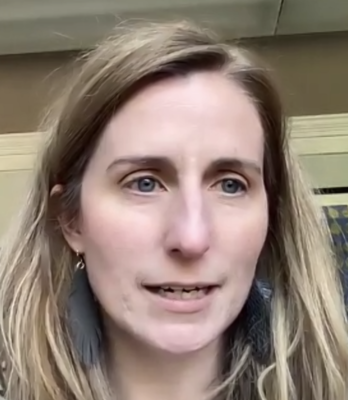
Kate Murphy, a pastor from Charlotte, North Carolina, told of people from her congregation who can’t afford asthma medication or insulin for diabetes, so they skip the medicine or space out the doses. “These are people who are working,” Murphy said. “So many of our faith communities are so segregated economically as well as racially” that many Presbyterians don’t understand this kind of financial stress. They don’t have relationships with people “who can tell them, ‘This is really how it is in America right now.’ ”

Jeromey Howard, pastor of First Presbyterian Church in Montgomery, New York, and a new board member, does. He grew up in poverty, and “all of my friends and my siblings still exist there,” he said with tears in his eyes.
“Yet we as a nation and a world could end poverty tomorrow if we wanted to,” Theoharis said. “Everybody could be out of it” if Americans were willing to address the systemic causes. “It’s structured into the very core of our society.”
Michelle Hwang, a pastor from Illinois, said that when her family arrived in the United States as immigrants, they were poor, and “the shame that comes with that is deep. And the expectation that as immigrants, you’re kind of expected to be poor, and you work yourself out of it.”
Her family did that, “but at what cost?” Hwang asked. “My parents worked two jobs each. We [children] were left alone, because we had to be. It’s such a complicated issue. You see the intersection of race, and how that plays into how people treat you as a person in poverty.”
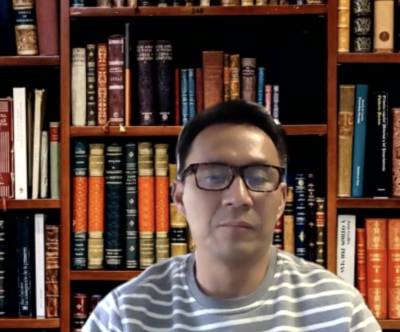
Board members also acknowledged that, as Bong Bringas of California put it, often the church “has not been a factor in the resolution of this problem.”
The church has played a role, Theoharis said — but not in eradicating poverty and racism, or “saving the earth and everyone who is living in it.” Martin Luther King Jr., in his 1967 “The Other America” speech, spoke of something that was true in the 1960s and is still true today: that there are “literally two Americas,” with huge disparities, and that “you cannot separate problems of systemic racism from problems of systemic poverty.”
The federal poverty line guidelines used today are outdated, Theoharis said — a single person earning $13,000 a year is not considered officially poor, nor is a family of four with an annual income of $27,000. Those guidelines don’t take into account the current costs for transportation, housing, utilities, food, healthcare and more, she said.
And poverty disproportionately affects people of color — with more than 60% of Blacks, 65% of Latinos and 65% of Native Americans and Indigenous people living in poverty or close to it, she said. More than half of the 140 million in or near poverty are women and girls.
“About half of the kids in this country at some point live in food-insecure homes,” Theoharis said. “But we throw out more food in this country” than it would take to feed the whole world. Fifteen million families can’t afford water “to wash their hands in a public health crisis.” She’s met families in Alabama with raw sewage in their yards because their communities can’t get sewer service.
Today is Earth Day, she said. “Who is hurt first and foremost by ecological devastation” and climate change? “Our poor communities. Our communities of color. Our marginalized communities.”
What are some of the systemic factors that contribute? Theoharis ticked off a few: Racism. Militarization. Voter suppression. Mass incarceration. Mistreatment of immigrants. A system of unfair taxation. There are more — she calls them interlocking problems.
One of the biggest factors she sees is “a false moral narrative. A moral narrative of Christian nationalism. A narrative that blames poor people, blames immigrants, blames queer people, blames black people for all of society’s problems” and “feeds us a lie, a lie of scarcity, a lie that this is as good as it gets, that we can’t do any better,” that the poor will always be with us, “and often backs up that narrative with the Bible, with Christianity.”
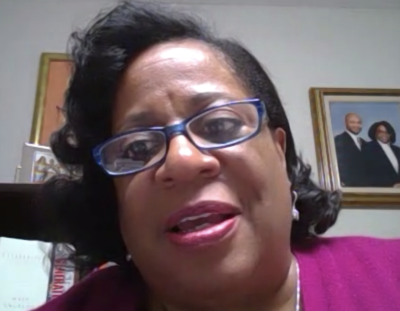
Diane Moffett, president and executive director of the Presbyterian Mission Agency, said churches need to change their own narrative of what it means to be a disciple of Jesus Christ — to follow Jesus, not capitalism. “We don’t think of picking up the cross,” Moffett said. “We don’t have a sense of the love of humanity and how to make things better. … What is this world we’re trying to create? It’s here, it’s right now,” not “the by and by.”
The PC(USA) is predominantly white and wealthy, and “we need to recover our own gift of being able to have enough in Christ,” said Murphy, the pastor from North Carolina. “The culture would like to teach us that we’re poor if we drive an old car” — and “the culture’s narrative is that poverty is a moral problem of the poor,” rather than “poverty is a moral problem of the wealthy.”
Theoharis called for a moral movement for a justice-seeking church. “As long as poverty exists, it means we are being disobedient to God.”
Liz Theoharis showed the Presbyterian Mission Agency Board this video so they could hear some of the voices and stories of Americans living in poverty. As she watched, she wiped away a tear.