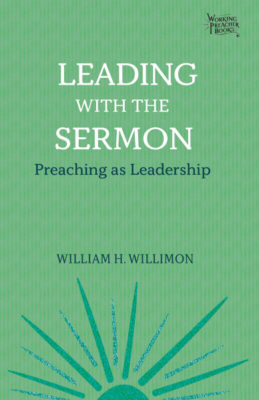
 William H. Willimon
Fortress Press, 192 pages
William Willimon has a way of expressing himself that provokes his readers first to laugh and then to view things in a different way. In this volume from the Working Preacher series, Willimon challenges preachers to see themselves as leaders, understanding how preaching can both aid and shape their leadership approach — and how leadership “provides the context, purposes, and test” of preaching. His first example of a preaching leader is none other than Jesus Christ. Why? Because “we know the truth about God only because of the proclamation of the one true preacher, Jesus.”
Willimon, a bishop in the United Methodist Church as well as a professor at Duke University, believes that sermons must do more than communicate important religious ideas. It’s “not enough for the sermon to ask and answer, ‘Who is God and what is God up to in the world?’” he writes. The sermon must also include an explicit invitation: “’Don’t you want to hitch on to what God is doing?’ At some point in sermons, God’s people must hear the summons ‘Let’s go!’”
Willimon challenges milquetoast preaching, citing Luke’s account of the reaction to Jesus’ first sermon. He affirms that transformative leadership comes with conflict. Just as the sick need a doctor more than the well, he observes that “leadership is not needed to guide people in a direction they are already headed.” Willimon says that leaders must use their words to “influence, organize, orchestrate and motivate people to face their problems.” Those problems may even include the preacher’s shortcomings; “poorly run meetings, lax financial oversight, absence of accountability, sorry supervision of staff, and poor time management are frequent complaints from laity about pastors.” Clearly there’s more to pastoring than Sunday morning preaching.
By their nature, institutions “crave the placidity of the status quo, and reward those who keep them comfortable.” Anyone who has read Willimon or heard him preach knows he does not feel called to that timid posture. He calls for courageous preachers to connect congregations to their pain: “Ye shall know the truth, and it will hurt.” Preachers should help churches envision possibilities, challenge congregants to lay aside self-defeating attitudes, guide the organization through the chaos inherent in real change and support the reframing and learning transformation requires.
Willimon says sermon-listening skills are acquired, not natively inherant. Congregants have to learn, and a wise preacher will find ways to help. He warns, “Listening to sermons would be a harmless activity were it not for Christians’ well-founded anticipation that God might use a sermon to call our names.” He observes that Jesus wasn’t likely to ask, “Do you agree?” so much as to command, “Follow me!” Faithful listening has risks, and so does faithful preaching:“Pastors must stir up in themselves a more passionate desire to be truthful than their typical pastoral longing to be popular.”
This book made me think more about preaching than leading. What’s missing is treatment of pastoral leadership challenges, such as when the flock doesn’t want to go where their shepherd is leading — or when some in the flock want to be the dominant leaders.
Since retiring as the psychologist for North Carolina’s Services for the Blind, Paul Rowland Jr. has served as commissioned pastor of Berea Presbyterian Church of Four Oaks, North Carolina.