Editor’s note: The Outlook has received word that shortly after this article was published, Roy M. Nageak Sr. died at Mat-Su Regional Medical Center after becoming ill with COVID-19. Our deepest sympathy to his wife, Flossie; his children, grandchildren and extended family; and his many friends.
The crying never stopped.
The first night that Roy M. Nageak Sr.’s sister spent at Wrangell Institute in Alaska, she lay on her cot, exhausted from the long journey, but could not sleep. Wrangell was a school that brought Native American children from all over the state, and lying there she could hear “all the crying of the younger kids,” Nageak said. “Some were really young. She couldn’t get that out of her mind for many years.”
Nageak heard stories growing up of teachers hitting Native children. “People were injured permanently, sometimes to where they limped all of their lives,” he said.
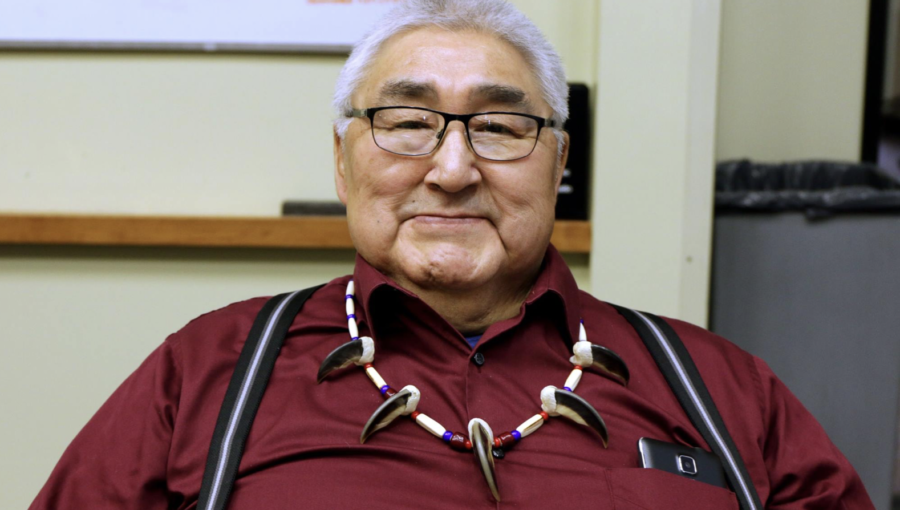
Nageak, born in 1951, is from the Iñupiaq people and serves a commissioned co-pastor of Utqiaġvik Presbyterian Church in Utqiaġvik, Alaska, founded in 1898.
In his large family, nearly all the children went away to boarding schools – in part because there was no high school then in Barrow, Alaska, now known by its Indigenous name of Utqiaġvik, and because an uncle who had a steady job helped to pay for it. “It wasn’t much of a choice,” Nageak said. “My parents, especially my father, believed in further education” — his father never had the opportunity for much schooling.
As one of the youngest, Nageak had seen his older siblings go off to boarding school and then return. “Usually, they came home cooler than we were, more hip, they learned more dances,” Nageak said, laughing. “They’d come home freezing. They had to get back into the high Arctic.”
He was also accustomed to his community’s ways: to hours spent in church; to learning to hunt at the whaling camp; to caring for the dog team and using the sled as transport to help raise money for his family.
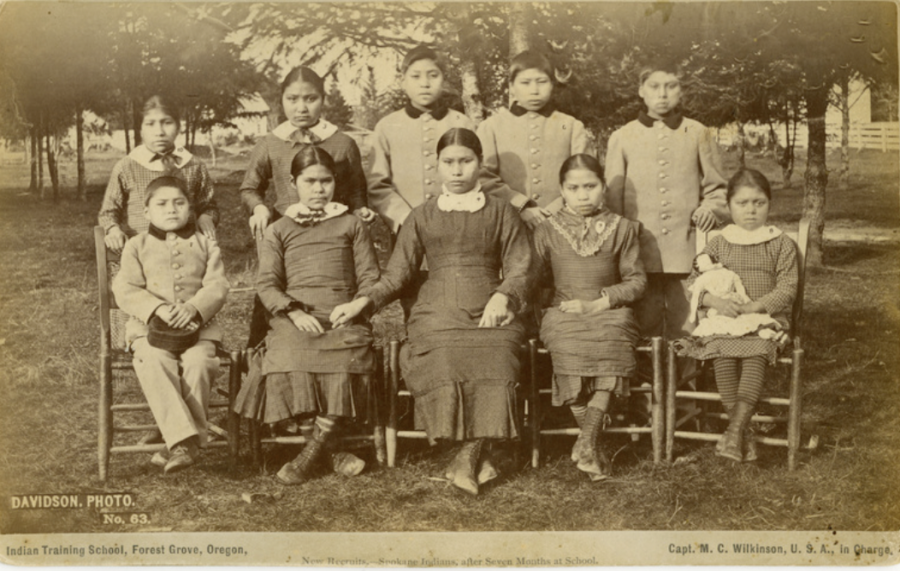
When his turn came to leave, Nageak was sent to Chemawa Indian School, a boarding school near Salem, Oregon — traveling by plane from near the Arctic Circle to Fairbanks; then a chartered flight filled with Indigenous teenagers from all over the interior of Alaska down to Seattle; then a Greyhound bus to Oregon. “When we got off the bus, it was like 90 degrees, green grass, warm.”
He has dozens of stories from his time at Chemawa — many of them about sports and leadership. His trips running on foot from the whaling camp to home to fetch supplies for his father made him a natural for the cross-country team. He became captain of the football and basketball teams and made life-long friends with whom he later served on the Alaska Board of Education and in other community roles.
But while Nageak did not experience physical abuse at Chemawa, the distance from his culture and his community created hardship. “I always tell people they wanted me to become a white man,” he said. “But all I got assimilated to was the national sports — football, basketball, track and field.”
He felt viscerally the separation from his Inuit community. When he returned home after the first year, he learned his father had bought a snowmobile and had given away the family’s dog team because he had no one left at home to help with the dogs — that had been his son’s job.
“I loved the dogs because I was always with them,” Nageak said. “I knew every one of them.” He walked to the house where the dogs now lived, and found that of a 15-dog team, only a half dozen were left and those were skinny. “Each one of them, I petted. I took the ice off their faces. Talked to each one of them. Then I walked away. That was a transition to a modern world. I could hear them hollering and crying. And never looked back. Never looked back.”
Nageak grew up in the Presbyterian Church, and steeped in the teachings of his people — learning as a child of “the spiritual connection we have with God’s creation,” with the animals and the earth. “We were created in the image of God,” he said. Before Christian missionaries came, “instinctively, even without knowing the Word of God (from the Bible), the living word of God was already amongst us.”
When the PC(USA) formally apologized in 2017 for its role in subjugating Native American people, “I had already heard about the Doctrine of Discovery,” with its insistence that “because the savages didn’t have Christianity, they didn’t know God. … The savages were not Christians. Then they could be killed and their lands taken over.”
But Nageak grew up absorbing the reverence of his people for the animals and nature and their lived commitment to spirituality, to sharing and giving to one another.
At Chemawa, those cultural connections – to the land, to family, to creation – were missing.
At home, Nageak had often taken care of one of his older sister’s children — a baby girl, for whom he formed deep affection. One day at school, he got a phone call from a cousin, who informed him his cherished niece had taken sick and died.
“That was devastating to me,” Nageak said. “So I took a walk,” away from the campus, heading into the trees, seeking solace in creation. After a while, in a clearing, “I started seeing headstones” — gravestones from the 1880s, 1890s, 1901, 1905, 1923. The graves of Chemawa students — buried far from their families. Since then, “I’ve always wondered why” — wondered who each of these children were and how they died.
Marsha Small, a Montana State University doctoral student and member of the Northern Cheyenne tribe, has been trying to find that out too, using a ground-penetrating radar device to search for graves at Chemawa, documenting 222 so far, trying to learn their names and their stories. The title of her master’s thesis: “A Voice for the Children of Chemawa Cemetery.”
That day, as he grieved his niece and walked the Chemawa graveyard, Nageak felt the presence of these children. Like the crying of the children his sister heard her first night at Wrangell, their presence has not left him.
He was not surprised when he heard of the discovery of unmarked graves at Native American boarding schools in Canada. He will not be surprised if more are discovered on the grounds of schools in the United States.
For all these years, the crying has never stopped.