 The Office of the General Assembly has presented a preliminary list – subject to revision – of the committees of the 2022 General Assembly, as well as a schedule of which committees are likely to meet when.
Committee list
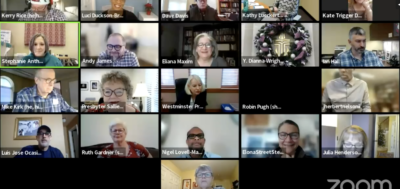
The Committee on the Office of the General Assembly (COGA) received the list at its Dec. 16 Zoom meeting — but won’t act to approve it until probably in January, so some things may change as committee members offer feedback. But here’s the preliminary list (with more information at the link about business items that maybe assigned to particular committees).
- Assembly Committee on Business Referrals (ACBR)
- Bills and Overtures (B+O)
- General Assembly Entity Policies and Procedures (GA-PAP) — This committee will focus its work on administrative and internal issues related to the PC(USA) A Corporation and Administrative Services Group (ASG), the Presbyterian Mission Agency (PMA) and the Office of the General Assembly (OGA).
- General Assembly Ministry Coordination (GA-MC) — This committee addresses outward-facing actions tied to A Corporation/ASG, PMA, and OGA operations. These include caucus and advocacy committee structures and awards.
- Standing Rules of the General Assembly (STAN) — All proposed changes to the Standing Rules.
- Financial Resources (FIN) — All financial and budget-related items from entities of the General Assembly. (Includes the Presbyterian Foundation and Investment and Loan Program.)
- Moving Forward and Vision 2020 (MOV) — The Moving Forward Implementation Special Committee recommendations (except for those related to the Organization for Mission and budget, which will be addressed by the appropriate committees above) and the Vision 2020 report.
- Mid Councils (MC) — Items of business directly related to the operations of presbyteries and synods.
- Polity (POL) — Amendments to the Book of Order section G.
- Rules of Discipline (ROD) — Amendments to the Book of Order section D.
- Ecumenical and Interfaith Engagement (ECU) — Items related to relationships with other denominations and faiths.
- Environmental Justice (ENV) — Items related to divestment, environmental policy, and a green future.
- Race and Gender Justice (RGJ) — Items related to justice issues surrounding racism, gender identity, and their intersection.
- Health, Safety, and Benefits (HSB) — Items related to health, safe spaces, and benefits. (Includes Board of Pensions.)
- International Engagement (INT) — Items related to policies and actions that include international partners.
- Immigration (IMM) — Items related to policies and actions related to immigration.
- Addressing Violence in the United States of America (VIOL) — Items related to gun violence, bullying, domestic violence, and violent language.
- Theology, Worship, and Education (TWE) — Amendments to the Book of Order section W, items related to theological and higher education, and items related to published materials. (Includes Presbyterian Publishing Corporation.)
Committee meeting schedule
This list is also preliminary until COGA approves it. The plan now is for all General Assembly committees to meet in person at the PC(USA)’s national office building in downtown Louisville — although OGA leaders are carefully monitoring the permutations of the COVID-19 pandemic.
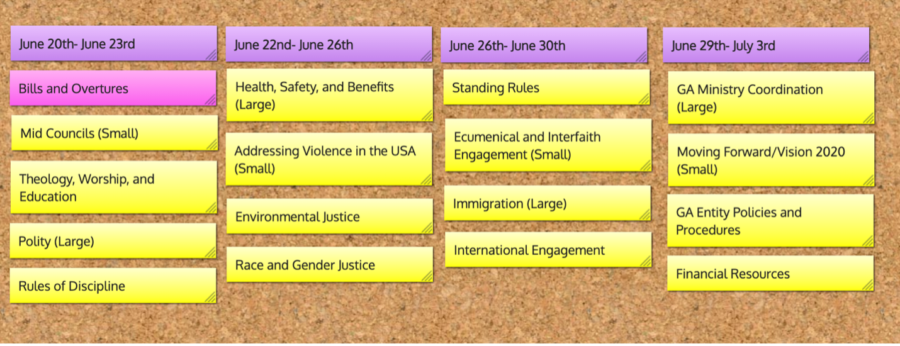
June 20-23
- Bills and Overtures (Meets June 19th)
- Mid Councils
- Theology, Worship, and Education
- Polity
- Rules of Discipline
June 22-26
- Health, Safety, and Benefits
- Addressing Violence in the United States of America
- Environmental Justice
- Race and Gender Justice
June 26-30
- Standing Rules
- Ecumenical and Interfaith Engagement
- Immigration
- International Engagement
June 29-July 3
- General Assembly Ministry Coordination
- Moving Forward and Vision 2020
- General Assembly Entity Policies and Procedures
- Financial Resources
Deputy Stated Clerk Kerry Rice said OGA leaders tried to think of the committees in some different ways for this assembly than has typically been done in the past. For example, committees working on budget issues are scheduled to meet during the last block — recognizing that some work of other committees might have financial implications.
Herbert Nelson, the PC(USA)’s stated clerk, asked for prayer for the church, “for the ability to be flexible and to be innovative in this period” of change in the church and the world.
Choice points and equity primes
How can the General Assembly be more intentional about considering equity and inclusion as it makes decisions?
How can commissioners and advisory delegates hold themselves accountable for being equitable? And how should they respond in situations where they sense that’s not happening – for example, where someone isn’t being treated with respect or are given a chance to speak?
Is there a way to ask the assembly to take a pause before voting to consider whether equity and inclusion have been properly considered?
COGA continued its discussion of finding ways to ask the assembly to do that – using techniques known as “choice points and equity primes” – with the plan that COGA will begin modeling some new techniques at its Jan. 20 meeting and will provide training for assembly commissioners and advisory delegates.
Jihyun Oh, director of mid council ministries, described equity primes as prompts or a way of “priming the brain” during a discussion to consider other ways of acting — to “remind the brain of other choices that exist beyond the automatic decisions people are making” because that’s what’s most familiar. “Remind folks there are other choices available.”
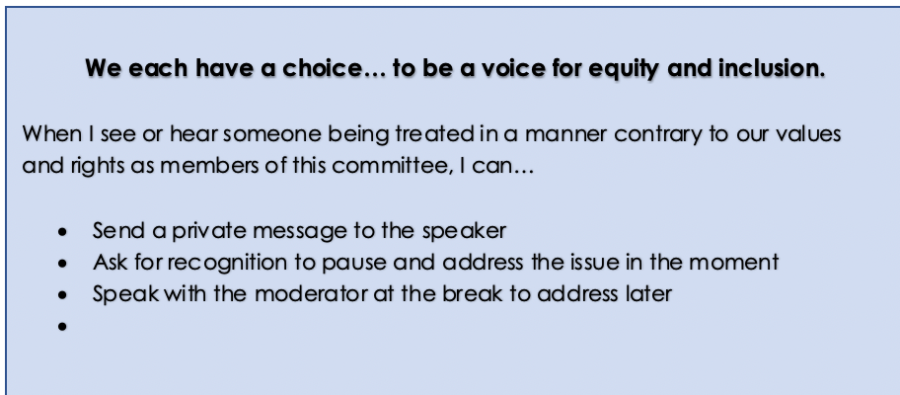
COGA’s Coordination Work Group for the 2022 General Assembly is considering making cards that would be given to commissioners and advisory delegates that would focus on individual responsibility and say something like this:
And there might be a PowerPoint slide that could be displayed before key votes were taken, with questions such as these:
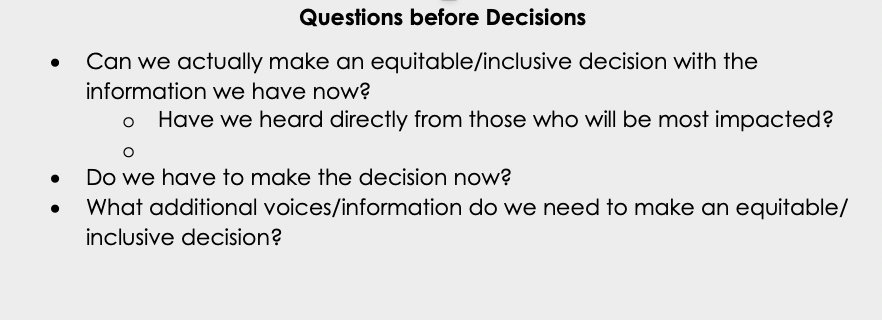
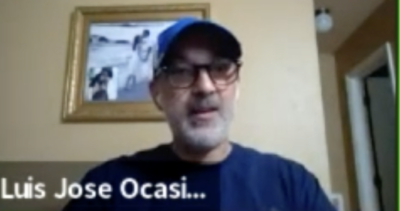
COGA member Luis Jose Ocasio Torres suggested adding language from the PC(USA) ordination vows, something like: “Have we, in making this decision, lived into our commitments to serve with energy, intelligence, imagination and love?”
Elona Street-Stewart, co-moderator of the 2020 General Assembly, spoke of the importance of having explanations of these approaches translated into Spanish and Korean in a way that provides not just a literal translation — but an understanding of the ideas behind the approaches.
COGA also discussed whether to implement this approach comprehensively at the 2022 General Assembly — or in more limited ways.
“It’s going to be very new for a lot of people,” Nelson said, arguing that perhaps the approach should be tried first in “designated spaces,” so it “allows people to kind of lean into this. … I do support it and we need to engage it. It’s just a question of the pace. We’re so used to the Book of Order. We’re so used to Robert’s Rules of Order.”
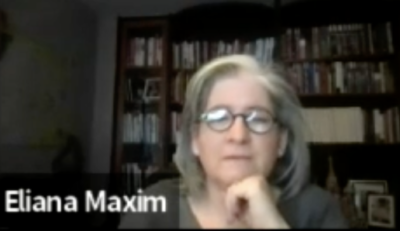
But Eliana Maxim, COGA’s vice-moderator, said: “I’m going to respectfully disagree with you,” if the PC(USA) wants to use equity and inclusion as its lens and framework. “We can’t decide to be a little bit pregnant. We either are or we aren’t.”
If COGA decides “this is who we are and this is a process we use in everything” at the assembly, “it’s a muscle we will start to develop and exercise,” Maxim said, and “it will become more quickly embedded in our identity and our work.” If the decision is made to only use the approach selectively, “the system will always revert to the path of least resistance.”
To really hear and value the voices of all, the PC(USA) needs to change, Ocasio Torres said. “If we are going to be a church, not an empire, we need to do things differently.”
COGA member Dave Davis also spoke of the possibility that those who hold power – the “folks who always use polity or Robert’s Rules to get what they want” – will find ways to use this new approach for their own advantage as well.
Oh suggested the individual responsibility cards might include language about noticing when the process itself is being abused. As COGA member Lynn Hargrove suggested: “Am I using the meeting tools (such as Robert’s Rules) to hold onto my power?”
COGA also talked about the rights of each participant. Among their answers:
- The right to be recognized and speak — so no one person or small group dominates the discussion.
- The right to disagree.
- The right not to be interrupted.
“You have a right to speak with an accent,” Ocasio Torres said. Or to use a translator.
“A right to feel as equal as another person at the table.”