Bad Bunny’s resistance
Music has been an important part of every culture’s identity. It is a way to express oneself, whether it is through the fiddler playing in a crowded pub, the salsa dancer listening to the gods speak through the congas or the raw imagination heard in jazz. The experiences of people come alive in music, which speaks to their joys and sorrows. In our scriptures, we see Psalms/songs as ways to communicate our theology, our experiences and our critiques. Songs can offer space to lament, to hope and to persevere; they call us to resist the ills and oppressions of our world. Yes, we can find these songs of resistance in our Presbyterian hymnal, but what if we were to lend an ear to the songs of resistance produced today?
Latin music has a long history of expressing la resistencia. Ask any salsa dancer and they will tell you they have danced to the classic song “La Rebelión” by Joe Arroyo. Behind the intoxicating beat, the lyrics tell the story of a protagonist who resists the horrors of slavery. When I shared with a friend what this song is about, I remember the shock on his face as he surveyed the room of joyful dancers.
It would be a gross oversight, then, to overlook the Puerto Rican reggaeton star Benito Antonio Martínez Ocasio – known better as Bad Bunny – and write him off as just another artist pursuing fame and glory. Granted, Benito is a two-time most-streamed artist of the year and the recipient of 26 awards, including four Latin Grammys. He has now gone international. Bad Bunny has received two American Grammys and recently made history as the first non-English-speaking performer ever to win the VMAs’ most coveted “Artist of the Year” award. While my wife and I watched his live performance and acceptance speech from Yankee Stadium, we were shocked to witness him deliver his speech fully in Español, and it reminded me how far Latin@ music has come in the last couple of years and how it has gone mainstream in the (U.S.A.).
I contend Bad Bunny has stepped into the longstanding history – especially within the Latin history of reggaeton – of expressing la resistencia through his music; he weaves in themes of political activism, social critique, spirituality and joy as an act of resistance. Allow me to convince you: If you listen to Bad Bunny, you may just find yourself resolved to resist. I exegete Bad Bunny in three arenas: social, political and spiritual.
Social arena
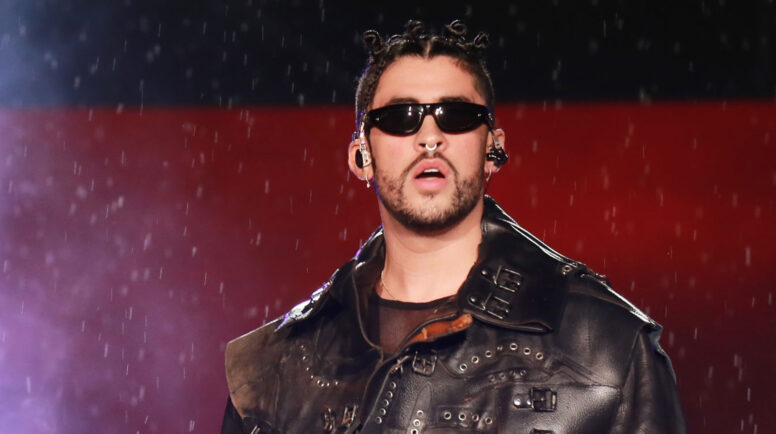
In a genre often critiqued for its toxic masculinity and homophobia, Bad Bunny consistently uses his platform to speak against exaggerated male virility, promote queer inclusivity and fight for racial equality. If you do a quick Google search for pictures of Bad Bunny, you will find an eccentric, unashamedly authentic artist, while also witnessing his audacious resistance to gender norms and machismo culture. While his appearance challenges gender norms, he also explicitly speaks out against violence towards women and trans people.
In a genre often critiqued for its toxic masculinity and homophobia, Bad Bunny consistently uses his platform to speak against exaggerated male virility, promote queer inclusivity and fight for racial equality.
Songs like “Yo Perreo Sola” serve as a blunt message against the harassment of women, clearly stating to leave women alone if they decline to dance with you. Mind you, the song is a “bop,” yet intertwined in the music are lyrics of resistance towards machismo and toxic masculinity, which we can clearly see in the lyrics of “I Dance Alone.” Furthermore, Bad Bunny brought attention to the ongoing rise of violence toward trans people when he performed on the “Tonight Show with Jimmy Fallon.” Resisting gender norms, he wore a skirt and a shirt that condemned the violence and transphobia committed against Alexa, a transgender woman who was killed in Puerto Rico.
It was not surprising, then, when Benito released a song in support of the Black Lives Matter movement called “Compositor del Año.” Translated, “Composer of the Year,” an award and title he received at the 2020 ASCAP Latin Music Awards. Here, he sings about how he earned this award for composition “but not for what matters” as he turns his eye toward resisting the ills of racism and calling Christians to action. He raps, “It’s 2020 and racism is worse than COVID/ A Black man with a gun/ that’s a criminal/ but if he’s White, they say that’s a hobby.” During a time in which the church and the world were confronting the endemic of White supremacy while battling the pandemic of COVID-19, this song expressed for me the inner frustrations I encountered while giving me permission to listen along as I continue my own acts of resistance and my own fight for justice in my local church context. I invite you to look up this song, as he also speaks to the ongoing issues of immigration and voting rights.
While I share with you a quick glimpse of Bad Bunny’s impact on the social context, I’d be disappointed if I didn’t share with you the online Bad Bunny 101 course. Bad Bunny’s social impact is so palpable that his music is used to empower undocumented youth on social and political issues. It brought me joy when I read how “since its start, Bad Bunny 101 has addressed issues such as toxic masculinity, the history of reggaeton linked to the African roots of the genre, queer visibility and political activism.” Let us now turn to the topic we all are told to avoid at the dinner table.
Political arena
From all I have shared so far, if you are wondering whether Bad Bunny was critical of President Trump’s administration, then your inclination is correct. As an active supporter of voting rights, Bad Bunny lent his voice to President Biden’s campaign by playing his songs in political ads which targeted Latinx communities in battleground states during the 2020 presidential election.
While this speaks to how his music has been used to rally votes in the United States, Bad Bunny is also heavily involved in political activism in Puerto Rico. There were mass uprisings in Puerto Rico in 2019 when Governor Ricardo Rosselló was embroiled in a corruption scandal. Bad Bunny took to Instagram and Twitter with many other Puerto Rican celebrities to resist the corrupt governor, using the hashtag “#RickyRenuncia.” Bad Bunny’s activism was quickly paired with a new song of resistance. A few days into the protests, he released a scathing critique of Governor Rosselló with his song, “Afilando los Cuchillos,” with Residente, fellow reggaeton artist. In this new song, Bad Bunny vocalized the need to resist corruption in Puerto Rico, and his new anthem led to the protests increasing in numbers.
But what happens when one governor leaves and the situation doesn’t get any better? Hurricane Maria was five years ago, yet Puerto Rico continues to struggle with ongoing blackouts, a disaster further strained by the privatization of the electric grid. [Editor’s note: This article was written before, but published after, Hurricane Fiona hit Puerto Rico, resulting in an island-wide power outage and further infrastructure damage.] The Puerto Rican government has now granted tax breaks – which Puerto Ricans cannot benefit from – to incentivize outsiders to invest in the island, leading to rampant gentrification. You should now expect my next sentence will describe how Bad Bunny wrote a song of resistance in response to this political upheaval. He did; it’s called “El Apagón” (the Blackout).
To start his tour last month, Bad Bunny threw the “Party of the Year” for Puerto Ricans. This is because joy is an act of resistance and it’s spreading like wildfire throughout the whole island in these party-protests. Bad Bunny performed his songs of resistance in front of thousands of fans, including the many who watched on tv via Telemundo PR — we were so mad we could not watch from our U.S. home. I was struck with joy when I read Izzie Ramirez’s reporting of these party protests, she comments: “As Bad Bunny’s celebrity exponentially grows, these shows were a refreshing reminder of what – and who – reggaeton is for. Bad Bunny didn’t leave Puerto Rico behind as he ascended the charts. He brought it with him.” Bad Bunny not only provided a space where his songs could express collective grief, sorrow, anger and love for Puerto Rico amid social ills, he provided anthems of resistance that empowered Borinqueños to act for change.
Bad Bunny didn’t leave Puerto Rico behind as he ascended the charts. He brought it with him.
Spiritual arena
Bad Bunny fans may wonder how in the world he offers songs of resistance in the spiritual arena. Bad Bunny grew up Catholic and sang in the choir. Yet his music isn’t explicitly “Christian.” Indeed, songs like “RLDNT” from his most recent album, “Verano Sin Ti (Summer Without You)”, show his inner struggles about whether he should turn to God or to astrology or if he may simply be lost, not knowing who he is. This may resonate for younger generations and, as many Christians no longer identify with mainline denominations, Bad Bunny could serve as, according to America Magazine, “a spiritual guide for our postmodern culture.”
Personally, I have already mentioned how his music brings me joy as an act of resistance, which is also a spiritual act. Didn’t biblical characters sing with joy as an act of resistance and a proclamation of God’s liberation — Miriam’s Song, Mary’s Song, anyone? Nonetheless, Bad Bunny’s latest album, “Verano Sin Ti,” convinced me even more that his music can be experienced as a spiritual act of resistance.
Out of all the wisdom in literature, Ecclesiastes has always stood out to me. My dad would quote it, saying, “There is a time for everything.” As I got older, I was able to identify my experiences within the array of what life offers: deep valleys and high mountaintops. When I explored Ecclesiastes further in Federico Roth’s class Wisdom Literature, it brought up questions in me such as: can I enjoy experiencing joy while injustice exists and what’s the point of fighting for what is right if “all is vanity”? I remember being conflicted in asking these questions because I believed my faith would always give the right answers, and it would give me a way to have an easy life. Of course, much has changed since then for me. Thanks to my Presbyterian seminary education, my favorite verse is now Ecclesiastes 3:7 — “I know that there is nothing better for them than to be happy and enjoy themselves as long as they live.” We know that even when this joy comes to a close – when night dawns – our God brings salvation in the morning. It’s because of my faith that I’m able to resist resigning from the good fight as I’m able to hold in tension the ups and downs of life.
It’s because of my faith that I’m able to resist resigning from the good fight as I’m able to hold in tension the ups and downs of life.
I mention my experience with Ecclesiastes because this is how I encountered Bad Bunny’s latest album. It’s filled with traditional Latin sounds, such as merengue, which immediately prompted the question from my mother-in-law, “who is this?!” Upon the album’s release, and after we gave it a proper listen, my wife and I said, “This is going to be our album of the summer,” the album we would play as we drive with our car windows down.
Yet, while enjoying this music, as I listened more closely, I noticed how Bad Bunny was tackling serious issues such as femicide and social violence in the song “Andrea,” to disaster relief in the aforementioned song, “El Apagón.” Even “Ojitos Lindos” spoke for the longing of relationship, which tugged at my heartstrings and my gut, resulting in a full-bodied and spiritual reaction — one of my hopes for my church is that we are bonded more closely together.
Every time I head into summer I have high expectations, yet summer doesn’t always deliver. If it does, it eventually comes to an end. Summer 2020 is a prime example: it was anticipated as the first summer after the “lockdown” only for all of us to experience a rise in COVID levels and social uprisings.
That’s when I realized this “album of the summer” is titled “A Summer Without You.” Throughout the album, you experience the joy of life and feel the heaviness of tackling injustice, to hold in tension the ups and downs of life. The title gives away how this summer album will hold this paradox in tension in an Ecclesiastes-esque way. For me, the album became a medium to practice the wisdom that comes from our faith and spirituality. Ultimately, it became a way to resist despair, experience joy and trust in our God.
Ultimately, it became a way to resist despair, experience joy and trust in our God.
I wonder: will you lend your ear? You may just find these songs of resistance giving rise to the perseverance that calls you to resist the ills and oppressions of our world.