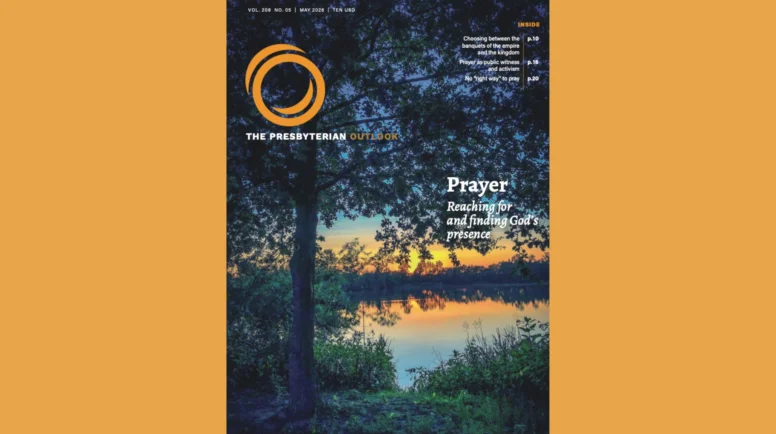
“Choosing between the banquets of the empire and the kingdom” by Quincy Worthington
Questions:
- The author begins the article by describing a personal experience of encountering “empire” values and acts in Broadview, Illinois. What is your main takeaway from his account of that experience? Have you had, or are you aware of a friend who has had a similar experience? If so, how does that experience compare with the author’s?
- Two key concepts presented in this article have to do with the differences between “empire” and “kingdom.” How relevant are the descriptions to your perceptions or experiences?
- The author contrasted “Herod’s banquet” with the “banquet in the field.” To what extent do you agree or disagree with how the two “banquets” are described?
- What are some thoughts you have regarding the way the two banquets are characterized in today’s reality of “empire” versus “kingdom?”
- The next time you pray the Lord’s Prayer, what will be some images or thoughts you have when you pray, “Thy kingdom come, thy will be done on earth as it is in heaven?”
“Beyond the altar: Prayer as devotion, discipline and public witness” by Winterbourne Harrison-Jones
Questions:
- Throughout the article, the author describes what prayer means to him. What is your response to those descriptions? What would you add? What question would you like to ask the author?
- Reread the author’s quotations from the writings of James Cone, Katie Cannon, Karl Barth, Frederick Douglass and Dietrich Bonhoeffer. Which of the several quotes sparks in you an “Amen?” Which prompts you to think deeper, to want to know more?
- What is one sentence or paragraph in the article that you would highlight to remember or return to spend time reflecting on its meaning?
- After reading this article, how would you complete a sentence that begins, “For me, prayer is … ”
- In the closing charge, reread the section that begins, “For prayer that never leaves the sanctuary has not yet reached its fullness.” In what way does that charge empower you to move forward in your ministry?
“In the room of prayer: There’s no ‘right way'” by L. Roger Owens
Questions:
- What impresses you about the author’s description of his classroom set-up with a circle of chairs on one side and a large table on the other side? Is this a way you would consider setting up your classroom? If so, why? If not, how would you set it up?
- The author mentions several resources that suggest different ways to pray. In how many different ways do you pray? What is your favorite way of praying?
- If at one time you thought there were right ways to pray, how has this article influenced your thoughts about ways to pray?
- Where are some places, when are some times, or in what prayer activities do you find yourself most intimately in communion with God?
- What religious tradition, in addition to your own, might you like to explore regarding its tradition of prayer?
“Prayer and poetry: proclamation and pause” by Kathryn Lester-Bacon
Questions:
- Do you read or write poetry, or have you tried? If so, what are your thoughts about the insights offered by the author of this article? Which poet or book of poetry feeds your soul?
- If reading or writing poetry is not something you are accustomed to doing, what are some insights you have gained from reading this article?
- What are some settings or occasions where you are called upon to speak or write that you pay especially close attention to the words you use to convey your message? Why are you concerned about choosing the right words?
- Reread the paragraph that begins, “Making space for silence alongside words is countercultural … ”. What are some thoughts you have in response to what the author has written?