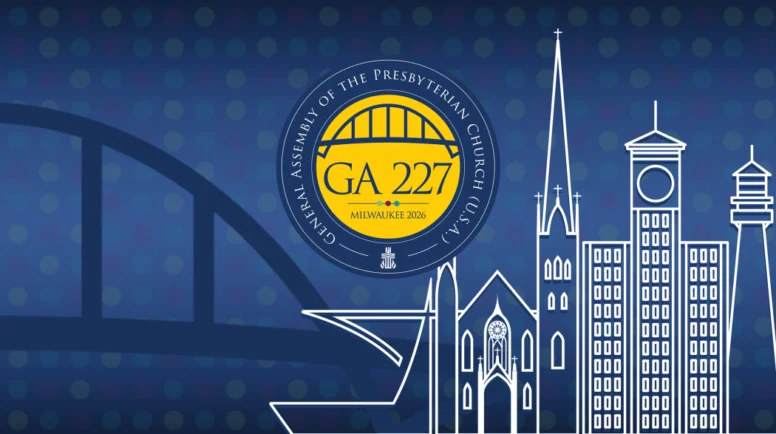
The Reformed Identity Around the World Committee of the 227th General Assembly (2026) will meet online June 22–24 to consider a broad slate of overtures addressing global peace, justice and the church’s international witness.
The committee, made up of commissioners and advisory delegates, is charged with helping the Presbyterian Church (U.S.A.) engage global issues in ways consistent with Reformed theology and existing General Assembly policy. Its docket this assembly includes matters related to nuclear disarmament, the Israel-Palestine conflict, historical reconciliation in Korea and advocacy for religious minorities in Syria. Global Language Resources will provide real-time translation services over Zoom for commissioners within the committee.
RIW-03, from Mission Presbytery and concurred by Coastlands, Greater Atlanta, Southeastern Illinois and Southern New England presbyteries, calls on the 227th General Assembly to renew attention to nuclear weapons policy.
The overture urges the church to “reaffirm the action of the 223rd General Assembly (2018), which called upon all members of the Presbyterian Church (U.S.A.) to take actions in defense of God’s creation by working for nuclear disarmament.” It also asks congregations to examine “the level of risk involved in relying on nuclear deterrence for safety” and whether “there is a mythology wrapped around these weapons that falsely attributes god-like power to them.”
“The problem is that nuclear deterrence, by its very nature, has to be perfect. Even a single failure could lead to a devastating war,” the overture’s rationale states. “Nuclear deterrence is, by definition, inherently flawed. It will fail. It cannot be perfect forever.”
“While eliminating nuclear weapons will not achieve the wholeness, well-being, and justice of God’s shalom, so doing is a crucial, necessary step in bringing God’s shalom into being,” explained the Advisory Committee on Social Witness Policy (ACSWP) comment supporting the overture with an amendment of a fifth recommendation to direct that committee “to revise existing and/or develop a new social witness policy about these issues, to be brought to the 228th General Assembly (2028).”
Several overtures address the Israel-Palestine conflict from differing perspectives and strategies.
RIW-04, from the Presbytery of the Redwoods and supported by 13 presbyteries, including Boston, Philadelphia and San Francisco, calls the church to “condemn the government of Israel’s violation of the U.N. Convention on the Prevention and Punishment of the Crime of Genocide in the war against Gaza that began in 2023.” It also encourages advocacy with U.S. leaders and economic actions.
Its rationale frames the issue with international legal and humanitarian reporting, asserting that some actions are “genocidal in character, as they are committed with the requisite specific intent … to destroy Palestinians in Gaza.”
ACSWP recommends approval with amendment, noting: “Political and economic actions that are imprecisely targeted can harm the most vulnerable people in Israel and Palestine.”
The Racial Equity Advocacy Committee (REAC) emphasizes moral responsibility, stating that the actions proposed in this overture are “consistent with how this Church has responded in other contexts of systemic harm.”
RIW-05, from San Francisco Presbytery and concurred by the Coastlands, Mid-Kentucky, Philadelphia and Pittsburgh presbyteries, proposes economic pressure. It calls for “a full trade embargo on Israel until the United Nations determines” specified conditions regarding occupation, apartheid policies and refugee rights are met.
ACSWP advises disapproval, stating the overture “risks harming the most vulnerable persons and communities in Israel and Palestine.”
However, the Advocacy Committee for Women and Gender Justice’s Advice (ACWGJ) urges approval of RIW-05: “The severe threat to Palestinian women and their reproductive freedom presented by the actions of the Israeli government and military leaves no choice but for our committee to approve RIW-05,” states ACWGJ’s comment. REAC also supports the measure as “a corrective, nonviolent measure intended to halt the escalation of violence, ensure compliance with international humanitarian law, and incentivize a return to diplomatic engagement.”
RIW-06, from Olympia Presbytery, calls on the 227th General Assembly to take a more explicit stance, including to “condemn unequivocally Israel’s war in Gaza” and to “call Israel’s war in Gaza perpetrated with U.S. support against the Palestinian people a genocide.”
RIW-08, from Susquehanna Valley Presbytery and concurred by Cayuga-Syracuse and Cascades presbyteries, addresses 1948’s Jeju April 3 tragedy in South Korea.
The overture calls the church to “acknowledge and grieve, during a worship service at this General Assembly, the loss of life and destruction of property during the Jeju April 3rd Tragedy.” It also directs consultation with Korean partners and preparation for joint commemorations.
Its rationale notes that the insurrection events of April 3, 1948, and the government’s response of counter insurrection “resulted in the death of 14,000–30,000 people, about 10% of Jeju’s population,” emphasizing the enduring need for truth and reconciliation.
ACSWP recommends approval, stating the overture “aligns with previous actions taken toward justice and repair with and within the Korean peninsula,” and describes the overture as having been “developed with our Korean denominational partners.”
The Unification Commission, acting as the governing board of Presbyterian Life & Witness, frames RIW-08 within the denomination’s broader commitments to reconciliation, truth-telling and partnership. In its comment, the UC stresses that the overture is intentionally structured to focus on lament and learning rather than assigning blame. “It should be noted that the overture does not assign fault, blame or make condemnations for the nature of the incident. It does call for a prayer for lament, which fits with the Presbyterian practice of lamenting anytime lives are lost due to the actions of leaders who represent us, even in times of war.”
The UC further situates the overture within existing denominational practice, explaining that such an approach “is also in accordance with previous GA actions … where the PC(USA) visited Korea and offered prayers of lament and healing for families of victims and survivors.”
RIW-09, brought by the Racial Equity Advocacy Committee, calls renewed attention to conditions in Syria since a regime change in December 2024.
It asks the church to “continue to advocate boldly for Syrian Christians and all minorities in Syria who face persecution” and to encourage prayer and awareness across the denomination.
The rationale describes escalating concern, noting “conditions for Christians in Syria have dramatically worsened” and that communities face “systematic intimidation and persecution.”
ACSWP places RIW-09 within the denomination’s longer history of engagement in the Middle East and frames it as a continuation of that witness. In its advice, ACSWP explicitly calls for action grounded in both compassion and precedent, writing, “The people of Syria have endured more than a decade of devastating conflict, displacement and humanitarian crisis. Our siblings in Christ and other minority communities continue to suffer under conditions of profound instability and being targeted for their faith and ethnicity.”
The committee connects that assessment directly to the church’s responsibility, adding, “Our denomination, which has a long history of presence through our partnering churches in the region, cannot remain silent in the face of such suffering.”
The Unification Commission affirms the concern while urging a broad and contextual approach, emphasizing “advocacy that is grounded in local relationships, attentive to context, and centered on religious freedom, protection and the dignity of all people.” The UC outlines the ways that Presbyterian Life & Witness is already engaged in advocacy related to Syria and the broader region through the Office of Public Witness and Global Ecumenical Partnerships.
The Reformed Identity Around the World Committee will meet online June 22–24. Proceedings will be available to view in English on livestream.