Moved by the stories told by Emmanuel St. Juste, pastor of the French-speaking Baptist Church in Stamford, Connecticut, members from area churches joined St. Juste and his congregation on visits to Haiti in 2001 and 2002 in short-term mission trips that exposed American churchgoers not only to the systemic poverty, environmental fragility, and political instability of Haiti, but also inspired them with the spirit of the people they met.
James Lipscomb, a former executive vice president and general counsel of MetLife, Inc., went on those first trips. On the initial visit, a cloud of dust from other vehicles shrouded the truck that carried the group as it traveled from Caesse to Cap-Haitien, viewing partner churches’ work before flying back to the U.S. Lipscomb said he hid his head on his lap, not only to avoid the dust, but also to talk to God.
“Why would God allow such poverty and desperation to exist in Haiti?” Lipscomb asked. “What had they done? What would happen to them? When would God show mercy to them?”
He then remembered God’s answers to the laments found in Job 38. God hadn’t abandoned the people of Haiti; in fact, he’d just sent many people to see and know them, and to act. On the dusty ride to the airport in the back of a truck, Lipscomb was convinced of a call to help those he’d met in Haiti.
When Lipscomb returned home, his wife, Nancy, said she “could see his intense desire to do something” with the people he’d met. The Lipscombs, now retired to Arizona and members of Pinnacle Presbyterian Church in Scottsdale, were willing to help in whatever way would best serve the people they’d met.
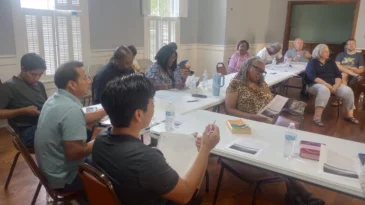
Upon their return, the trip participants held several meetings to debrief their visit and discern next steps. Recognizing the breadth of the needs they encountered, they knew any effort would be only a “drop in a deep bucket” of needs they saw. Convinced that long-term systematic change would have the greatest effect, they decided to focus on helping children living in severe poverty in Pastor St. Juste’s childhood home of Hinche, who would not otherwise receive an education.
Building for the future
In conversation with the community of Hinche, it was decided that a school would be most helpful, especially one that could prepare students for high school and college. One that would meet their daily needs for nutrition, social growth and character building. One that would introduce them to the latest learning methods and set them up to become future leaders in Haiti.
Julie Atkinson, the organization’s volunteer chief executive officer, says a foundational philosophy of what would become Center of Hope (Haiti), Inc., a U.S.A. nonprofit (COHH), was its collaborative approach to finding the best solutions to expand opportunities for children in the community.
“It didn’t feel like dropping in and trying to say, ’Okay, we know this, or we know that,’ but wanting to be partners with the community, wanting to build the trust, wanting to build the relationships,” said Atkinson, who is a member of Lafayette-Orinda Presbyterian Church in Lafayette, California (Bay Area). “What that looked like in the end was us coming together and providing what we understood to be the best education for the children.”
The churches together raised funds, and George Brunstad, a member of Wilton (Connecticut) Baptist Church, became the oldest person to swim the English Channel at age 70, raising $50,000 toward the effort. The funds were used to purchase 14 acres of land in Hinche; COHH was incorporated in 2004. Over the next six years, the orphanage and school were built, and COHH received official NGO status with the government of Haiti.
In 2011, the school officially opened with its first class of 15 students in grade one. Each subsequent year, the school has accepted 15 more students, adding classes through grade nine. Graduating ninth graders have all been placed in highly regarded private high schools, for which COHH also pays all costs, including tuition. As of June 2026, two classes of high school students have graduated and many of the graduates have gone on to university studies in fields such as medicine, nursing, engineering and teaching.
There are currently 127 students enrolled at COHH in first through ninth grades. More than 70 graduates now attend high school in grades 10-13. There are often 60-70 applicants for the 15 first-grade spots, and COHH administrators must make the difficult decision as to whom to admit. Students at the school receive uniforms, all school materials, continuous mentoring, and breakfast and lunch every day. A current fundraising goal for the organization is to provide scholarships to COHH students attending university.
An oasis of stability
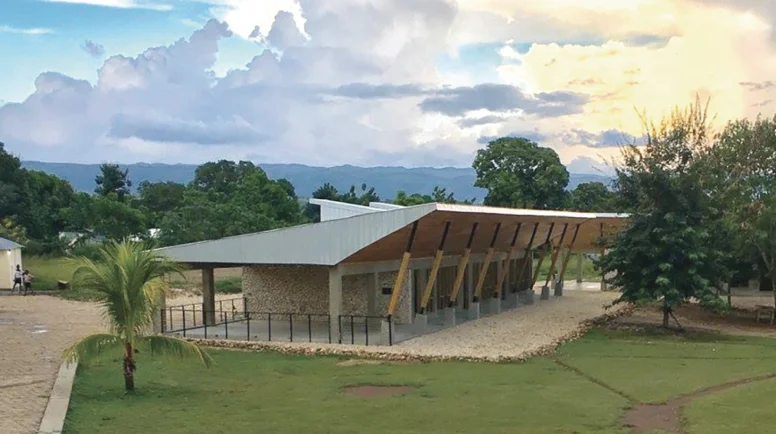
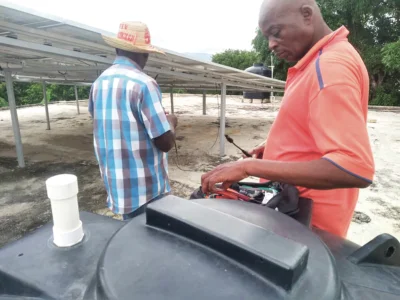
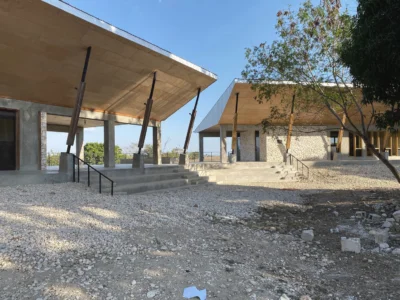
COHH’s impact on the community goes beyond educating its young people. COHH employs 33 people on its campus. In partnership with the Building Goodness Foundation, a Virginia-based nonprofit, to construct its campus, COHH paired skilled tradespeople from the U.S. with Haitian workers, training them in new skills – including skills in constructing earthquake-resistant buildings – while they worked at COHH. In turn, the workers use those skills to secure future employment. Wells and gardens on the campus are shared with the community. A solar installation that provides constant power to the school shares its excess power with its neighbors.
“We’ve transformed Center of Hope into an oasis for the community because what has grown up here has enabled the community to evolve,” said Antoine Charles, COHH’s executive administrator. He noted some hesitancy in the community when COHH first began, wariness of yet another nonprofit. But over time, trust was built as the organization invested in the area and its people. It has also meant COHH has largely escaped recent unrest and gang violence.
“We created construction jobs. We have over 30 people working here who can now take care of their families. And by adding literacy to the community, we’ve really changed it for the better,” he said. “If there was no Center of Hope in the area, maybe you would have more gang violence because most of the parents have no financial resources to send [their children] to school.”
Lovencia Augustin, a current ninth-grade student, will graduate from Center of Hope this year with top honors and attend the private Salesian High School in the fall. With one older brother and three younger siblings who have not attended COHH, she has achieved the most education of anyone in her family. She is ebullient when asked what the Center of Hope has allowed her to dream.
“Center of Hope means so much to me — it has given so much to me,” she said. “I plan to go to medical school to be an orthopedist following high school … There are so many vehicle and motorcycle accidents, so many sports accidents, that go untreated and leave people unable to work or live normally.
“I want to make a difference for them.”
Empowering potential
COHH board treasurer Bob Micera sees the outcomes for students like Augustin as the organization’s success. He visited the school in 2017 with James and came away with an appreciation for the school’s outcomes in individual students.
“Despite all the challenges you see – the poverty, widespread illiteracy, gang threats – kids have a smile on their face,” he said. “Innocence is something that stayed in my mind, and that you can give them the opportunity to retain that innocence for a little longer to use that to do something better with their lives. And that to me is a huge achievement.”
Atkinson, in her role as CEO, hopes to spread the message that there are “some really remarkable young men and women” in Haiti who are missing out on opportunities only because they lack resources. COHH and its donors, she believes, are the bridge that provides that empowering partnership.
“I’d like to think of it as just working together to try and boost this little part of the world that is all too easily forgotten because there’s a lot of potential in there.”