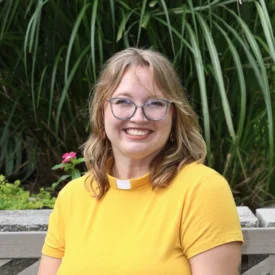
This is in response to Rachel Sutphin’s essay “Communing without bread.” Rachel is a dear friend. We’ve talked about our experiences, and I hope this piece offers a different perspective on Communion and eating disorders.
“This is the body of Christ, broken for you.”
Pastor Matt Gaventa shared those words emphatically from the Table at University Presbyterian Church in Austin, Texas, one hot September Sunday, days into my first semester at Austin Presbyterian Theological Seminary.
I was a master at pretending I was doing okay. In reality, my head was a mess. Amid moves, changes in community and life in general, the eating disorder I had said was “under control” most definitely was not. I had relapsed into a place of deep shame, body dysmorphia and pain.
I went to church that Sunday knowing it was Communion Sunday, knowing I’d hear those words and taste the bread and juice, and praying that maybe, just maybe, God could break through and reach even me.
Related reading: “Communing without bread” by Rachel Sutphin, Presbyterian Outlook
I first began struggling with bulimia in high school. For almost a decade, I continued an up-and-down fight with this difficult mental illness until a combination of therapy, medication, an intuitive eating dietitian and a lot of work and tears finally helped create a breakthrough.
Throughout the worst of my illness, Communion was one of the few tables that felt fully safe. Eating disorders isolate. They speak loud words of despair and hate. Food was the enemy. Eating, especially with others, was scary. But at the Communion Table, the truth of God’s sacred love broke through in simple sustenance.
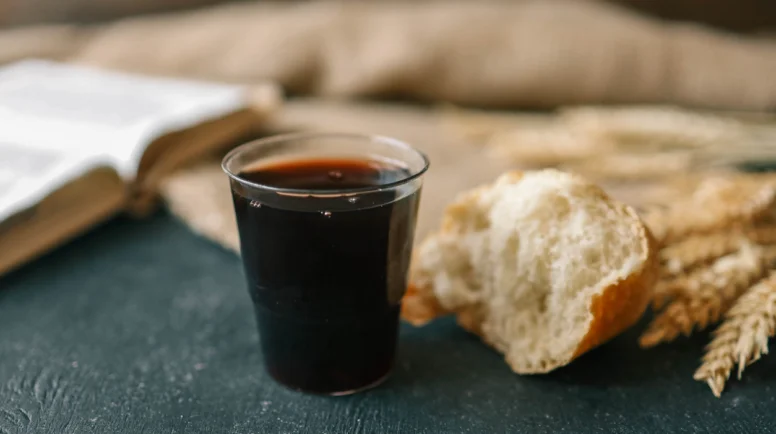
At the Table, we remember the holy and ordinary news that Jesus ate with friends and called it good. We hear how bread and drink are shared. We join Christians across time and place. And for those who have struggled with disordered eating, the Table can offer a place to practice what once seemed terrifying: eating with others and allowing food to sustain us.
We hear the words: “This is the body of Christ, broken for you.”
God loves us. We are created in God’s image. We are broken people in a broken world, but Christ still invites us to come as we are: to eat, pray, gather, take the bread and cup, and remember that even in our brokenness, we can be made whole.
That Sunday in seminary, when I was in so much turmoil, Matt held out the bread, and I heard this message: You get to eat. You are welcome in this sacred space. You get to remember that food is good and sustaining and that your body is beautiful.
I walked up to the Table, hands shaking. I ate the bread, crumb by crumb. I sipped the tart juice. Back in my pew, I prayed that the safety I felt at that Table could break through into other parts of my life. I prayed for the peace I found in that bread to spread outward to other meals.
Communion sustained me. Communion changed me. Not just that one time, but again and again, because the Table can transform.
Now, when I stand before my congregation holding out the bread and cup and offering the sacred words, “the body of Christ, broken for you,” I remember that young woman in her early 20s walking forward with shaking hands and hearing words that helped her heal. I hold the weight of this simple offering, and I pray that others might also find safety here and experience transformation in the simple act of a bite and a sip.
Everyone experiences the Communion Table differently. But I hope that, at the Table, you hear this message: You belong.
We can bring even the darkest, most painful parts of ourselves to the Table because there we join a community stretching across time — those who came before us, those who will come after us and the God who meets us there again and again.
And maybe, just maybe, at the Table we can begin to heal.