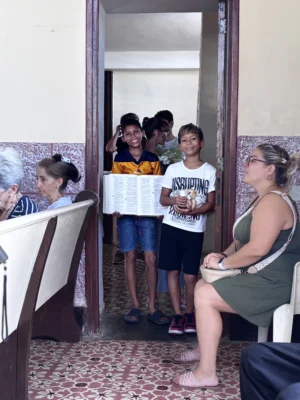
Three little boys came to the open doors of The Redeemer Presbyterian Church in Matanzas, Cuba. The congregation was gathered in the sanctuary about to begin worship when they heard a small voice ask, “Can we come in?”
“Yes! Welcome!” everyone responded.
The boys joined the youngest disciples at the front for the children’s sermon. As worship continued, there was a time for people to share their prayer concerns and thanksgivings. A grandmother gave thanks for her granddaughter’s seventh birthday. Another member shared that a congregant just celebrated their 100th birthday. A woman said that she had awakened that morning feeling so desperate and alone, not even wanting to get out of bed. But she decided to come to church anyway and discovered she wasn’t alone after all. They were all in the same boat together.
Then one of the little boys who’d come in raised his hand and asked, “Would you pray for our mom? She’s in prison.” I have carried that moment with me ever since.
A visit to our partners in Cuba is always full of contrasts: joy and hardship, laughter and tears, hope and uncertainty. Electricity may be out for days. Food is expensive and not easy to obtain or keep from spoiling. Transportation is a constant challenge. I expected to see people barely surviving. Amid very real day to day struggles, I saw churches flourishing, people dreaming, creating, welcoming, serving and expanding ministries. Churches refusing to let difficult circumstances define who they are or what they can do. What are our siblings in Cuba teaching us about mission? What are they teaching us about being the church?
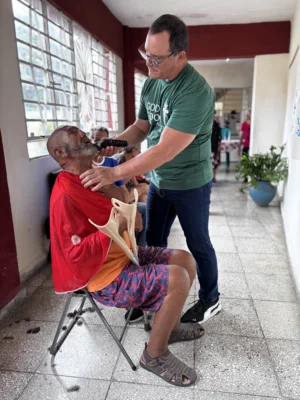
At El Jordan Baptist Church, pastor Alexei, her husband pastor Matei and their congregation have created a place of welcome for some of the most vulnerable people in their community. They offer meals, showers, clean clothes, laundry and prayer. After breakfast, several members, including pastor Matei, brought out scissors and clippers. As he expertly trimmed a gentleman’s hair and beard, I asked, “Were you a barber before you went to seminary?”
“No,” he laughed. “We just saw that people needed haircuts, so I taught myself by watching YouTube videos.” This has become even more true for Cuba in recent years: whatever is needed, they simply figure it out together.
El Jordan hosts monthly gatherings called “Light of Tomorrow,” where people share their knowledge and passions, from reciting a poem carried in their heart since childhood to sharing a lesson they learned as a teacher, to playing the cello. People who had been isolated or living on the street now have a place where they are known and valued.
Behind the church, I saw an unfinished space: cinder-block walls, an uneven dirt floor and old lumber. I saw a construction project that looked unfinishable. Pastor Alexei saw a dining room. The church has outgrown its current space for feeding people, and she is already imagining a place where people without homes can gather around a table. Our Cuban siblings see not just what is lacking, but what could be.
And their ministry is growing. Twelve teenagers made professions of faith and were baptized during vacation Bible school.
At God’s Mission Church, pastor Eris told us about the congregation’s beginnings as a house church. During COVID, they worshiped beneath a huge almendro tree. As the church grew, they acquired a vacant lot and began building a sanctuary.
Then a hurricane destroyed three-quarters of what they had constructed.
They rebuilt it in four months. When I asked pastor Eris how this was possible, he showed me a photograph of people still working at 1:15 in the morning. “With the help of the Lord and many friendly hands,” he replied. These are churches who refuse to stop dreaming.
Now they are dreaming again — of a dining room, classrooms, and more space for ministry. They are reaching out to people living on the pavement, families with loved ones in prison and people recovering from addiction.
These churches aren’t pretending Cuba’s difficulties don’t exist. They know those difficulties intimately. But they are also saying, “These circumstances do not get to have the final word.”
God was inviting me to see Living Waters for the World (LWW) partnerships from a new perspective.
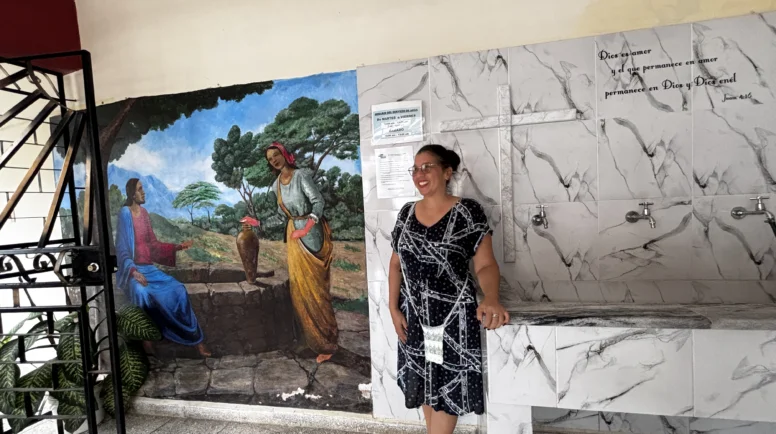
One of the most visible examples is solar power. Last fall, Cuba had 72 LWW water partners. None had solar power. With electricity disappearing for hours or days at a time, water purification systems could sit idle simply because there was no power to run them.
The cost of installing solar power for every system was daunting. Where would we find that kind of money?
Moraima González, LWW’s coordinator in Cuba, said, “It will be difficult, yes, but not impossible.”
Churches and individuals across the United States, Canada, Germany and beyond responded. Today, 67 of Cuba’s 77 LWW water partners have solar power. A solar miracle!
The miracle isn’t simply that money showed up. The deeper miracle is what these solar systems make possible: Cuban churches continuing to welcome their neighbors, provide clean water, and carry out the ministries God has already placed before them.
This is an important reminder for our understanding of mission: we don’t solve Cuba’s problems. We simply join God where God is already at work.
On that Sunday in Matanzas, pastor Gustavo preached from Matthew 9:35–10:8, the story of Jesus telling his disciples, “The harvest is plentiful, but the laborers are few.”
Gustavo described discipleship as “love moving.” Love that doesn’t simply feel compassion but asks, how can I help? Love that notices the neighbor who is hungry, lonely, forgotten or afraid — and moves toward that person.
As I listened, I thought about the people back home who have helped make LWW’s water partnerships possible: people praying, fundraising, donating and packing equipment that has blessed so many communities in Cuba. It began with our first water partnership at the Evangelical Theological Seminary in Matanzas in 2009 and spread to 1,200 communities in 28 countries around the world.
That’s love moving, too.
Our partners in Cuba and around the world remind us when we forget that mission is about recognizing where God is already at work and asking how we can join in. Our Cuban siblings aren’t waiting for someone else to be the church for them. They are being the church.
They are opening doors, feeding people, making room at the table, teaching themselves new skills, rebuilding after hurricanes, dreaming about what comes next, serving clean water and welcoming children whose mothers are in prison.
They are repeatedly choosing to let love move.
And perhaps that is the question they leave with us: where is God already at work around us — and what would it look like for us to join in? Our friends in Cuba have much to teach us. The harvest is plentiful. The laborers are ordinary people like us. And the work is not ours to accomplish alone. We simply join God where God is already at work. And then we let love move.