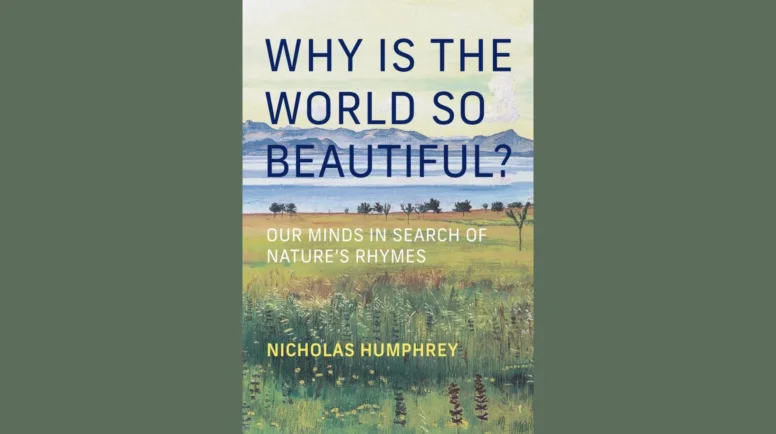
Why is the World So Beautiful?: Our Minds in Search of Nature’s Rhymes
By Nicholas Humphrey
The MIT Press, 224 pages
Published October 6, 2026
Why are we so lucky to live in a world filled with beauty? And how do we explain the remarkable convergence between what human beings find beautiful and what the world displays?
These are but a few of the questions evolutionary neuropsychologist Nicholas Humphrey seeks to answer. After finding prior arguments about the function of beauty insufficient (“beauty is merely a byproduct of natural selection”) or unpersuasive (“beauty is useless”), Why is the World so Beautiful? synthesizes insights from science and aesthetics to demonstrate that these two worlds reinforce, rather than contradict, the other.
Humphrey borrows a metaphor from poet Gerard Manley Hopkins – “all beauty may be called rhyme” – and offers examples from mathematics, geometry, architecture, rap, philosophy and poetry. Humphrey argues that rhyme – or two different and distinct entities that belong together – provides a sense of order and telos. It’s why humans, when encountering beauty, often say to themselves, “This is how the world ought to be.” Rhyme, then, offers a feeling of security and, Humphrey will go so far as to claim, love.
Humphrey argues that rhyme – or two different and distinct entities that belong together – provides a sense of order and telos.
Much attention may be devoted to his claim (provocative to evolutionary psychologists but likely not to Christians) that the presence of beauty in the world suggests the presence of an artist (or for us, a Creator). Yet, I found other parts of the book more inspiring, particularly the connections to everyday life. Beauty is found not in uniformity, but in difference. Beauty may be found in work done decently and in good order. Beauty does more than evoke awe and wonder; it offers a secure home, a rhyming relationship, and a purpose. Humphrey might argue that Christians began to create and cherish beauty not because they could explain the psychology behind it, but because it helped reveal the world as it ought to be — and that we live this out by curating soaring sanctuaries and beautiful liturgies. It’s hard to miss the deeply theological language flooding the pages.
At times, the book is heady, theoretical and jam-packed with experiments from the field of evolutionary psychology. Elsewhere, it’s full of practical advice to live with beauty (make friends with rhyming people, furnish your home with rhyming artifacts, keep company with rhyming plants and animals, worship the creator for the rhymes of nature). These could have been the basis of the entire book; instead, the reader is left with a mere paragraph.
While this emphasis may leave the reader wanting, this creative work inspires the theological imagination, including the claim that pondering beauty opens us to see and receive more beauty, fueling our weekly worship and daily life. Further, beauty as a rhyme of two different entities that belong together may revive Paul’s theology of the church as one body with many different members, while property committees might be encouraged to consider not just the “what” but the “where” of their ministry.
Fyodor Dostoevsky once wrote that beauty would save the world; Humphrey would also say that beauty created the world and continues to create the world anew. I would confess that Beauty has made us and saved us — and that Beauty is named God.
Presbyterian Outlook supports local bookstores. Join us! Click on the link below to purchase Why is the World so Beautiful? from BookShop, an online bookstore with a mission to financially support local, independent bookstores. As an affiliate, Outlook will also earn a commission from your purchase.
Sign up for Page Turners, our monthly email newsletter, to receive book-related content in your inbox once a month.