July 4, 2025, Washington, D.C. – As the United States celebrated its 249th anniversary of independence and President Donald Trump’s “One Big Beautiful Bill” act was signed into law, Presbyterians from many corners are speaking out about the policies and budget priorities of this administration, calling them unjust.
The newly adopted budget includes more than $1 trillion in tax cuts over a decade for the wealthiest Americans, according to the Center for American Progress. The budget makes $185 billion in cuts to food benefits for the poorest Americans, nearly $500 billion in cuts to clean energy initiatives, and almost a trillion dollars in cuts to Medicaid funding, all while increasing the debt ceiling by $5 trillion and increasing military spending by $150 billion and immigration spending by more than $100 billion.
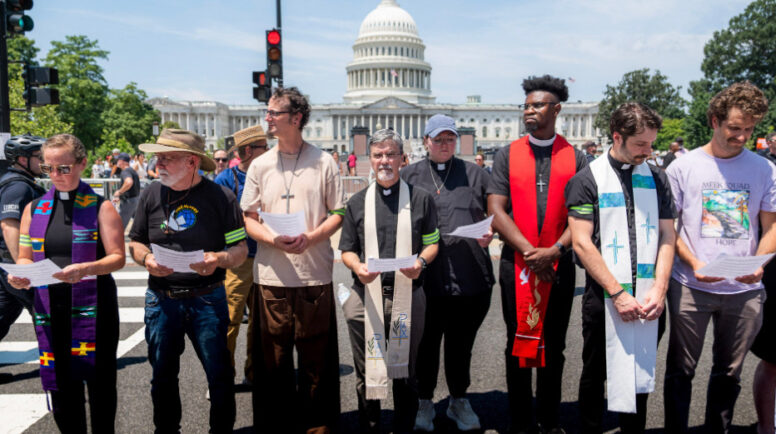
The budget debate and its repercussions follow weeks of public protests, which included hundreds of “No Kings” rallies across the country in response to what many see as an overreach by the executive branch of government. The protests were also in response to federal troops being deployed in Los Angeles along with increased arrests, detention and deportation of undocumented and visa-holding persons, many without justification or due process.
A statement by the Office of Public Witness of the PC(USA)
A June 23, 2025, statement by the Office of Public Witness of the Presbyterian Church (U.S.A.) directly addressed these actions by the government and assured Presbyterians that their protest and concern for those affected were both biblical and within the denomination’s traditions.
 “Presbyterians are called to a response due to our history of speaking against government overreach,” the statement read. “We have a long history of calling for resistance to any laws or commands that contradict God’s word. Our policy reflects this belief, as for centuries we have maintained the belief in being lawful citizens but have also acknowledged that there comes a time for resistance against tyranny.”
“We have a long history of calling for resistance to any laws or commands that contradict God’s word.”
Citing the “Honest Patriotism” policy statement as theological and contextual grounding for this position, the statement continued, “The 223rd General Assembly (2018) acts to lift up our church’s long commitments to active civic engagement, responsible citizenship, and prophetic witness; believing these commitments to be rooted in our faithful response to God’s call for Christians to be stewards of creation; and witnessing the corrosion of democratic institutions.”
“We Cannot Remain Silent”
On May 1, 2025, Albany Presbytery of New York adopted a statement titled, “We Cannot Remain Silent: A Statement on the National Moment,” covering a range of topics.
Its synopsis reads:
God alone, as witnessed to in Scripture and embodied in Jesus Christ, is our ultimate allegiance and the object of our trust and obedience. We reject the elevation of loyalty to any personality, political party, or community above our duty to love God through love of others. In the name of Christ, we call on our fellow Christians to object to the anointing of political figures as messiahs and to resist the restriction of moral kinship to people who resemble or think like us. We urge our fellow Christians, as well as people of different or no religious commitment, to marshal the freedoms of democratic citizenship to redirect our politics to the common good. The principles of love and justice demand that we reshape public life in the US toward decency and mutual care.
Using phrasing from The Barmen Declaration, the statement continues:
 “We reject the inhumanity in the current federal administration’s policies of internment and deportation directed toward immigrants in the US, as well as in the threats posed to our common well-being by arbitrary cuts to governmental services. In the name of Christ, we call on federal authorities to cease deportation sweeps, to establish a more compassionate response to the complexities around immigration, and to augment rather than reduce governmental investment in human services and civil protections.”
General Presbyter of Albany Presbytery Rob Trawick said the statement was a grassroots effort produced by a pastor’s group that meets regularly. The presbytery’s proximity to the U.S./Canada border places it in an enhanced enforcement zone for immigration. He said the area has seen increased Immigration and Customs Enforcement (ICE) raids, though none have yet entered churches.
“There was a sense that this was something the church supported — the church, broadly speaking. And they wanted to articulate that,” he said of the pastors’ effort to draft and publish the statement.
“There is a significant, not small, group of Christians who don’t support this, and in fact, who don’t support it on biblical principles. So our anti-racism task force sort of spearheaded it, but several of our pastors decided to write a statement and model it on The Barmen Declaration.”
The presbytery held a town hall meeting to discuss the statement before taking it up at a presbytery meeting. Trawick said the language was modified slightly to clarify the presbytery wasn’t speaking for all its congregations. There was some opposition to the statement, “maybe one or two, although vocal,” he noted, but the statement passed overwhelmingly during a special meeting of the presbytery.
“The Reformed tradition has always believed that part of our vocation is to be engaged in the political sphere,” he said. “We’re not Anabaptists, and we believe that care for God’s creation involves the body politic and involves being faithfully engaged in the body politic. So ignoring threats to the common good is an abdication of our call to be disciples.”
“Ignoring threats to the common good is an abdication of our call to be disciples.” — General Presbyter of Albany Presbytery Rob Trawick
In a religious culture overtaken by individualism and demagoguery, Trawick said people of faith have the opportunity to do good for others, especially for the vulnerable, because our faith demands it.
“There is no way to imagine Christianity without community,” he said. “I was in a church service recently, and they were preaching on a variety of biblical passages, and they mentioned the great commandment, ‘love the Lord your God with all your heart.’ And that’s where they stopped.
It struck me: the damning piece of heresy in [this] theology is erasing the neighbor, even going so far as to edit Scripture, to edit out the neighbor. It’s not peripheral to Scripture, it’s central to Scripture.”
A letter from the stated clerk
A July 1, 2025, letter to the church from the Rev. Jihyun Oh, stated clerk of the General Assembly and executive director of the Interim Unified Agency of the PC(USA), added to these statements with a strongly worded condemnation of tyrannical leadership posing as Christians.

“We find ourselves in a nation in which leaders who purport to be Christian are attacking those who preach the mercy and love of Christ Jesus, arresting those who pray for justice, and using their position of leadership to harm the most vulnerable and to enrich themselves and their friends and allies by impoverishing those who have much less,” she said.
Saying these leaders seek power over truth, winning over communion and the good of the whole, who “build up dividing walls of hostility, threaten the vulnerable, and ridicule the marginalized.”
“This is not Christian,” she asserted. “This is not Christian leadership.”
Oh affirmed the denomination’s commitment to diversity and inclusion of marginalized communities within the PC(USA), and pledged support for these same communities beyond the walls of the church.
“[Presbyterians] will continue to stand with and for the most vulnerable in our society…” — Stated Clerk of the General Assembly Jihyun Oh
“We will continue to stand with and for the most vulnerable in our society, whether that is because of status, identity, ability, resources, or any other factor; all bear the image of God…” she said.
“As Presbyterians, the Lord of our conscience calls us to stand up against the abuse of power and authority, especially when it is done in the name of Christ but not in the image and likeness of Christ and his earthly ministry.”