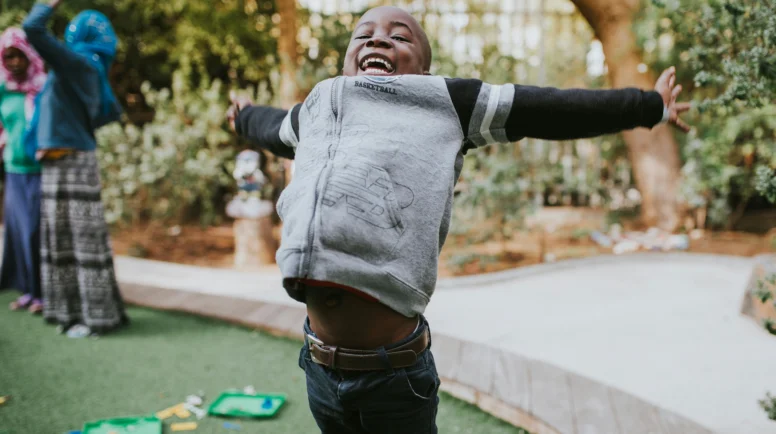
Throughout my career as a student and an educator, I have been blessed to be in spaces that emphasized the personhood of Black children. From my Sunday school classroom, where posters adorned our classroom featuring Biblical characters with African complexions and hair textures, to scholars in the congregation who taught Black history, all the way to elders who speak affirmations and prophetic possibilities over my sons. Children of every hue need spaces where they are seen, but in a time and context where the thriving of Black people is under relentless political attack, it is time for Black churches to reclaim their role as a vital third space for Black children. Furthermore, if we sincerely take Matthew 25 seriously, it is incumbent upon our denomination to grow our work from charity to justice.
Black children, like children of any social location, are not a monolith. In the minds of too many, however, Black children are reduced to the question asked of W.E.B. Du Bois: “How does it feel to be a problem?” As a result, programs are constructed from a deficit perspective. Not enough effort goes toward upending the oppression that holds all of us in captivity. We are too often content demonstrating a level of charity that maintains hegemony. For instance, if you were charged with developing programming for Black children, would you think of their flourishing, or would you assume these were “at-risk” children?
This myopic view of Black children cuts across social locations. Those who are resourced and have opportunities are fed the lie that what they are living through is an inauthentic display of Blackness. Our children who are under-resourced are too often disrespected — as if they live lives devoid of culture, expectations, or genius. When you view a person in this deleterious manner, it is dehumanizing. Even more, when we view children from this fixed perspective, we ascribe limitations that stifle. We must respect children as the image bearers that they are. They are quite capable of surprising you with joy and demonstrating their gifts in a manner that makes the world a better place.
This is intergenerational work that calls us to partner with Black children and abandon prescriptive tendencies. I think of programs like Freedom School at Concord Baptist Church in Brooklyn, New York, and Daughters of Imani at First United Presbyterian Church in Richmond, Virginia, as examples of programs where young people are trusted to be visionaries and, as a result, have created third spaces where Black families know that their children will be seen and loved. To do this well, we must continually unlearn the biased and oppressive lens that White supremacy offers and embrace a Christlike lens that sees Black children as fearfully and wonderfully made.
We have an opportunity to nurture spaces that allow us to live fully into the gospel. We cannot live into the reality of Pentecost homogeneously. We must be about the work of collaboration.
On the Day of Pentecost, the Apostle Peter quotes the prophet Joel, saying, “Your sons and daughters will prophesy, your young men will see visions, your old men will dream dreams” (Acts 2:17). We have an opportunity to nurture spaces that allow us to live fully into the gospel. We cannot live into the reality of Pentecost homogeneously. We must be about the work of collaboration. There are organizations in our presbyteries and synods that are doing this work well. What will it look like for us to partner without aiming to replicate the power structure of the world? What good can be done if we faithfully invest our resources in this way?
I still believe the church is a vital part of the safety net for Black children, but the church must mature its relationship with Black children from a doubtful posture to a faithful one. The church must mature its antiracist praxis from book clubs and discussions into multicultural power sharing and advocacy. Churches need to evolve from charity-driven approaches to justice-oriented actions. And if they cannot, or will not, get right when it comes to the genius of Black children, the church will get left — and will be left clinging to a nostalgia that has no remedy for the future and haunted by the deficit that occurs when we neglect the genius of Black children.