 The most significant lie I ever told in my teenage years was a cover-up: instead of staying the night at a friend’s house in my hometown of Cincinnati like I told my mother, I went to a concert in Indianapolis with other friends and stayed the night there. It wasn’t the first lie I had ever told, nor would it be the last.
As a matter of fact, that statement is a lie itself. I’m not from Cincinnati. I’ve never been to Indianapolis. Yet, it is published here. If someone read it without prior knowledge of my life, they would most likely believe it — which means that information would be “true” in a way for that person. How do we understand truth when our perception of what is true is something that can only be formed by our own experiences and insights — all of which are imperfectly human? How can we know what is real when reality can be realistically manipulated or manufactured by generative AI? How do we fundamentally know when someone is telling us the truth about anything?
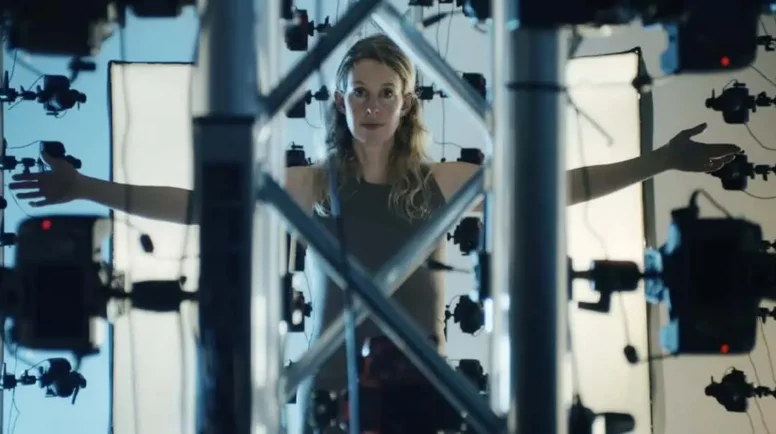
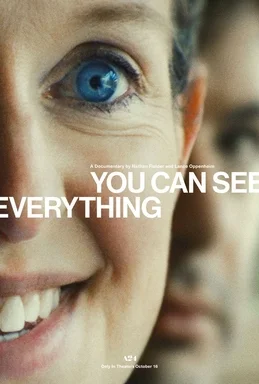
These are questions asked by the new documentary, You Can See Everything, a crucial piece of media about the nature of truth in the 21st century. On the surface, the film observes Elizabeth Holmes, the infamous founder of health technology company Theranos, who was convicted of fraud, and her partner Billy Evans in the weeks before she reports for her federal prison sentence. They give the documentary crew, led by interviewer Nathan Fielder, access to document almost every inch of their personal lives. Yet, as the days move closer to her reporting to prison, Fielder suspects there are things that Holmes and Evans are not telling or showing them.
As the documentary shows interviews with Holmes — her face extremely close to the camera — we see a shaky grasp on what the truth is. She continuously maintains her claims about the blood testing device at the center of the Theranos scandal were misinterpreted, even in the face of thoroughly researched journalism and the legal system “proving” them to be fraudulent. As Fielder tries to reason with and point out the public’s perception of her words that led to her conviction, he also questions his own perception of the sincerity she holds about her claims. Do the facts and data behind a statement make it true? Or is truth established by a person’s belief in the reality of that statement?
Halfway through the nearly three-hour runtime, Holmes reports to the Federal Prison Camp in Bryan, Texas to begin serving her sentence. The documentary then shifts towards Evans as he begins to exert control not just over Holmes’s life while she is prison, but also the access that Fielder and the crew have to her. He uses Holmes’s accounts to engage in social media, passing as her and making vulgar statements he maintains she approves of. He refuses to assist Fielder in bringing cameras into the prison to interview Holmes, claiming it is impossible. At one point, he makes a blanket threat to ruin the lives of anyone he believes has wronged Holmes before abruptly retracting it. Yet again, Fielder questions the truth behind Evans’s statement and actions and the nature of truth. Even as Evans has appears to be controlling, vindictive and deceitful in his statements and actions, he also seems to fully believe the truth he has perceived that drives them.
By the film’s end, there are no conclusions reached about the truth of anything Holmes or Evans has presented. Yet, in this lack of conclusion, another more nebulous conclusion is apparent — one that elevates this documentary from simple observations to a watershed moment in 21st century media.
We can never ultimately know for certain what is going on inside someone else’s head. It is impossible to comprehend an “objective” truth behind what a person is saying because we are all human beings with our own individual perceptions of reality, which includes all the biases, blindnesses, and unique experiences that we carry in those perceptions. We can only choose whether we trust what another person is telling us, which makes the idea of ultimate truth a slippery and intangible thing to us.
It is this unknowability of truth that causes us existential fear, dread and anxiety and informs how we present ourselves to the world and connect with one another. It also influences our understanding of what exists beyond our limited human comprehension, what many of us call God.
We might lie to ourselves and to each other about what we know about the unknown, convincing ourselves that this knowledge can in fact be true. We might attempt to control our perception and others’ perception of the unknown so that we can maintain our own sense of reality and what we stand to gain from it. We might investigate and interrogate the world around us to try and find the objective truth, convincing ourselves that such an aim is achievable.
The unknown will always remain unknown to us, regardless of any technological advances, claims of new revolutionary knowledge or the myriads of other ways we attempt to address our fear of it. In the end, as You Can See Everything seems to suggest, our only choice is to accept that the unknown will always exist. All we can do is decide where to put our trust and determine what we believe to be true.