AUSTIN, TEXAS – The first of three Presbyterian Church (U.S.A.) colloquia on ecclesiology (try saying that fast!) drew a slim crowd, but also heartfelt discussion about everything from how the church can be truly welcoming to why short-term mission trips often fail to make a lasting impact.
Neal Presa, moderator of the 2012 General Assembly, convened these conversations because he thinks it’s vital for Presbyterians to talk about “what is the purpose of the church?”
Presa and Vice Moderator Tom Trinidad hosted the first — a colloquium on ecclesiology (the theological study of the Christian church) — on April 23-25 at Austin Theological Seminary. The Austin colloquium was sponsored jointly by Presa, Austin Seminary and the Committee on Theological Education.
A second colloquium is planned for Dec. 9-11 at Princeton Theological Seminary in Princeton, N.J., to be followed Dec. 11-13 by a discussion on unity and diversity (also at Princeton). All are open to the public, and the presentations will be archived for use across the church.
A third colloquium likely will be scheduled for 2014.
So why do this? Presa contends that focused conversations on why the church exists — what its purpose is — can help Presbyterians as they ride the tumultuous waters.
“Too often, when we Presbyterians have encountered many challenges in our history, the knee-jerk reaction, if you will, is to restructure,” but not to ask “the theological question of ‘What has Jesus Christ always called the church to be about?’ ” Presa said in an interview.
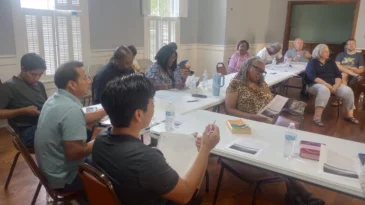
Seven Presbyterians wrote papers that were discussed at the Austin gathering. The discussions lasted for hours; here are a few snippets of that conversation:
Surprise. Darrell Guder, Henry Luce Professor of Missional and Ecumenical Theology at Princeton Theological Seminary, described the post-Christian time in these terms: “We are in a compost heap.” Messy, smelly, hard to sort out. Massively productive. “We should be open,” Guder said, “to surprises from all quarters.”
Baptism and Eucharist. Should churches only serve Eucharist to the baptized? That’s a huge conversation in the church, said Marney Wasserman, pastor of Trinity Presbyterian Church in Tucson, Ariz. When people respond to the invitation to meet Christ at the Eucharistic table, “we feed them, but we don’t stop there. There is an invitation to something deeper than just a meal on Sunday morning … . People need to be invited to the whole thing.”
Grace. John Leedy, pastor of University Church, Austin, spoke of the transformational experience at the Eucharistic table. “The debts that we owe to God for the grace of this life, especially for his grace and mercy — we are standing at a moment where we cannot possibly imagine a way to repay … . The grace they receive is a costly grace. Everything on the table says that. The broken body. The poured-out blood. That’s why holiness matters.”
Witness. Austin seminary student Ruth Elswood spoke of the powerful witness provided by the campaign led by the Coalition of Immokalee Workers in Florida, which has been pressuring supermarket and restaurant chains to pay higher prices for the tomatoes that migrant workers pick. These Central American and Haitian immigrants “hold little power and are largely invisible to most of us,” Elswood said; they are “clinging to the margins so they will not be deported back to lives of even more extreme poverty than they face in the fields of Florida.”
By standing with them, in marches and peaceful demonstrations, praying in the produce departments of grocery stores, pastors and other people of faith draw the attention of their neighbors. Their witness shows “this must be a God who inspires, strengthens, teaches and above all cares for God’s people. Worship occurs in many settings, not only in our sanctuaries.”