KNOXVILLE – “Be yourself” — find your own sense of authentic Christian identity, Paul Roberts, the president of Johnson C. Smith Theological Seminary, preached during closing worship at Big Tent 2015.

In a way, that’s exactly what the Presbyterian Church (U.S.A.) — which is finding new footing in a world in which the foundations of church life have shifted — is doing, and what Big Tent, held July 30-August 1 at the University of Tennessee at Knoxville, was all about.
Here are the numbers. Official Big Tent registration was roughly 800 people (counting speakers and denominational staff), down from 963 in 2013. Three worship services, two group Bible studies, networking opportunities, a mid council consultation just prior to Big Tent, too many workshops to count.
The format also was different. Instead of 10 or so conferences running concurrently, the planners gave Big Tent 2015 a single theme — “Live Missionally” — with programming organized by the PC(USA)’s national staff. Instead of hotels and restaurants, most participants slept in single beds in dorm rooms and ate in a college cafeteria. The idea: build community, keep costs low.
“We need to recalibrate as a church,” said stated clerk Gradye Parsons, speaking in a workshop on what’s ahead for the PC(USA). He ran through more numbers: declining membership; increasing numbers of young adults with no religious affiliation; a denomination that remains 92 percent white in a country in which whites aren’t expected to be the majority within 30 years. “We can’t just do church better,” said David Loleng, the PC(USA)’s associate for evangelism. “We need to do church in a different way.”
The “be yourself” part of Big Tent also involved the energy Presbyterians brought for particular aspects of ministry, for confronting contemporary problems and for their connections with one another.
One example: African immigrants celebrated ways in which Africans are rising into national leadership in the denomination (so many people showed up for that workshop they ran out of chairs, so the whole group moved outside — literally under a big tent — laughing and singing as they walked).

“Who here has ever felt they didn’t belong?” asked Lydia Temba, born in Zambia, who told of how her first instinct when asked to be a Young Adult Advisory Delegate to the General Assembly was to decline, worried about finances and her lack of expertise. She pushed back her fears and said “yes” — and the experience gave her insight into the wider connectional church and ignited a passion for further work in ministry. “You make a difference when you say ‘yes’ to being a leader,” said David Ofori Jr., a former moderator of the Presbytery of New York City.
In the evening, as Presbyterians lingered in conversation in the open-air plaza outside the dormitories, the voices of African Presbyterians raised in song floated through the sky like a blessing.
The workshops reflected the breadth of Presbyterian involvements. To name just a few: combatting sex trafficking of children; addressing racism and violence; supporting Christians in the Middle East; cultivating new worshipping communities and new ways of being church; training elders and church leaders. Too much was said to capture it all, but here are a few clips from the Big Tent soundtrack.
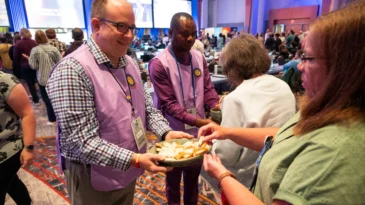
- “Communion can be the most isolating partof worship for people with disabilities.” — Sue Montgomery, pastor of Nickleville Presbyterian Church in Pennsylvania.
- When the neighborhood around North Avenue Presbyterian Church in Atlanta began changing, the church decided to stay put, and congregants went out to meet the neighbors and pray for the nearby businesses, the medical center, the homeless community. They also discovered the problem of child sex trafficking, right near the church. “It was something we didn’t see,” said pastor Scott Weimer, until Presbyterians walked out of the building and began paying attention.
- Instead of sending the kids and teenagers off by themselves, what about intergenerational worship? Suggestions from Jason Brian Santos, the PC(USA)’s associate for collegiate ministries: What if the whole congregation did a confirmation project together, or created art from the worship message and talked about what it meant, or held multigenerational Vacation Bible School at night, with a communal meal?
- In 73 percent of the American households using safety net programs (such as Medicaid or SNAP, the Supplemental Nutrition Assistance Program), at least one person is working full- time, said Sister Simone Campbell, a lawyer; executive director of NETWORK, a national Catholic social justice lobby; and leader of the “Nuns on the Bus” project to raise public awareness of justice concerns. Campbell calls on Christians to practice “holy curiosity” — to meet the poor and struggling, talk with them, hear their stories. Pick one thing to work on — one place where you can make an impact in righting injustice. Then engage in “sacred gossip” — “share what you’ve learned about the reality of folks who are struggling, and how we are all part of this one body.”
- How can Presbyterian congregations combat racism with peacemaking? Alonzo Johnson, a PC(USA) mission associate for peacemaking, encourages collaborative ways of making connections. Among his suggestions: consider what assets your church has to offer (people, a community garden, meeting space, a big kitchen) and build connections with other faith groups and the community (schools, businesses, neighborhood groups). Lift up justice issues in preaching and teaching, consider Justice Sundays or a month-long focus. Bring in speakers and community discussions or book studies involving contemporary problems such as racism, gun violence, inequities in education, incarceration rates, and affordable housing. “We have to be collaborative,” Johnson said. “If we don’t, we will die, or not be heard.”

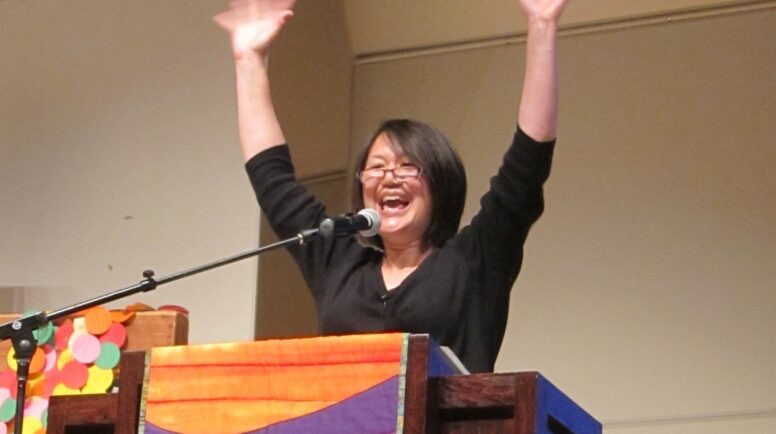
Laurene Chan, director of Youth Ministries at Cameron House in San Francisco, preached on July 31 about the importance of churches having open doors and individual Christians open hearts. “We are the ones who need freeing, release from our own fears, our own resentments . . . our fears of losing control, our paralysis of overanalysis,” she said.
“Brothers and sisters in Christ, open your doors.”