“How’s seminary?”
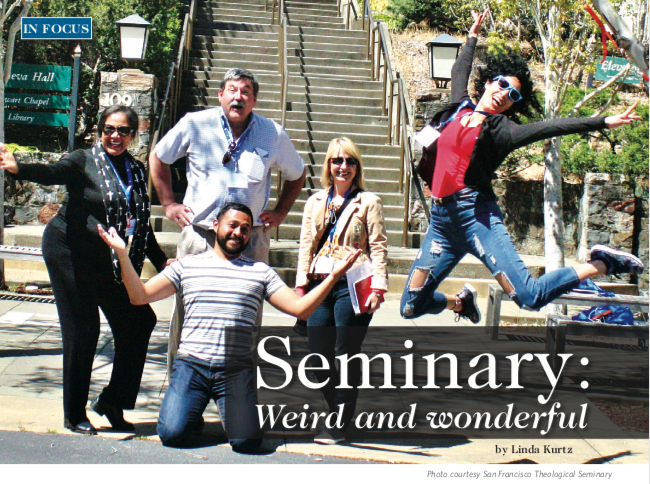
I used to cringe at this query posed by those who thought they were asking a simple, innocuous question. During my first year of seminary, the only word that I could find to accurately sum up the experience was “weird.” (It was so gratifying to hear a friend who just completed her first year of seminary use the same word just a couple of weeks ago when I asked her this same question.) It has taken me three years to figure out sufficient words to describe the rigorous exercise in academics, relationships, faith and emotion that seminary entails.
Honestly, “weird” might still be the best word.
Ironically enough, “weird” is the word I’d choose to use to describe how I found myself in seminary to begin with. I’m not a PK (pastor’s kid). I didn’t serve as a Young Adult Volunteer. I didn’t even start going to church until middle school. So it’s really anyone’s guess why one frigid January evening, God called me to seminary.
Sensing the call
I was 25, experiencing what I now fondly refer to as my quarter-life crisis. I was out of college and had moved back home to pursue my desire to work with nonprofits near Washington, D.C. My parents were gracious enough to put up with me crashing their empty nest, but I was hardly home between work and all the time I spent at church. Not three months after receiving my bachelor’s degree, the church I grew up in (it’s still that, even if the “growing up” didn’t begin until I was 13), Burke Presbyterian, called me to serve on session. At 22, I was ordained, promising to serve the people with energy, intelligence, imagination and love – but not even entirely sure why those people believed I was up to the task.
Three years and four pastors (and a whole new appreciation for interim ministry) later, I had fallen in love with worship planning, long-range visioning and even short-term budgeting (mostly). And I really fell for the youth and young adults of my church. So that fateful winter, I accompanied several college students to the Montreat College Conference, praying that they would grow in their relationship with God and one another. What I didn’t expect was to run into a college friend who then introduced me to the director of admissions at Union Presbyterian Seminary in Richmond, Virginia. What I couldn’t believe was feeling so clearly called to seminary instantly – a feeling I can only describe as a lightbulb moment and the clearest I’ve understood a call yet in my life.
The seminary path
 Looking back, I suppose there are pretty significant breadcrumbs that mark the meandering path that brought me to seminary. But I wasn’t prepared for the call itself. I had no idea what “inquiry” and “candidacy” and “an application essay interpreting a passage from Luke” meant and how I should start them. And once I got all of those balls rolling – once I began the ordination process and was accepted to seminaries – I certainly wasn’t prepared for seminary itself. Is it even possible to prepare yourself for an experience that will change how you think about God, yourself and the world; how you understand your faith; how you understand your life in relation to God’s story?
When I ultimately enrolled at Union Presbyterian Seminary, I felt convicted about campus ministry — perhaps, in part, due to the way God called me to seminary in the first place. I wanted to learn how to create space for college students exploring their faith, a space that was lacking in my own college experience. I wanted to empower them to explore their own calls to ministry, whether those calls were inside or outside of a church. But as my seminary education evolved, so did my own sense of call.
I suppose I should have expected this, but it took me slightly by surprise when I realized I felt moved in a different direction. Today, I’m most excited about parish ministry, which actually makes me an anomaly among many of my friends and classmates. I know the work will be beautiful, difficult and heartbreaking. But seminary has given me a little taste of this already.
Asking the hard questions
Seminary is an experience of the head and heart. It pushes you mentally, spiritually and emotionally. Some days feel like a dream as you learn how to live into your God-given talents. Other days feel like you’ve been hit by a truck as some of the most fundamental tenants of your faith are exposed to light for the first time – light that makes you squint uncomfortably as you examine what you always thought to be true and wonder if it still is.
 For me, that was year three — the year I took theology and Old Testament at the same time. I thought I had steadied the rocking boat of my faith during my second year of seminary when I learned the fundamentals of Presbyterian polity, the history of the New Testament and the basics of “baby” Hebrew. (Sure, learning to read right to left was a challenge, but the language is just so beautiful.) I was halfway through my four-year program and starting to feel like I had theological education figured out.
And then came year three. It started off with wonderful curiosity, learning about the doctrine of creation and the biblical creation story at the same time. But then came the doctrine of God and the rest of the Pentateuch. What did my theology professor mean when she said the only way we know what we (think we) know about God is through human conception — and possibly projection? What did my Old Testament professor mean when he said the Pentateuch is too ancient to definitively know who wrote it and why? How can God be omnipotent when the world seems so terrible? How we can find truth in Old Testament texts that look suspiciously cohesive, indicating they were likely edited with a particular purpose in mind?
It sounded dramatic when I said it out loud, but the only thing I could call it was a crisis of faith. I didn’t know what I thought to be true anymore. Who was God? Why had I not thought of any of these things before now? How was I ever going to be able to share this stuff with a congregation one day? Over time, these questions felt less like a crisis and more like lifelong companions to wrestle with. This is one of the most valuable lessons seminary has taught me: The hard questions are worth asking – and worth staying with for a while.
Seminary in the world
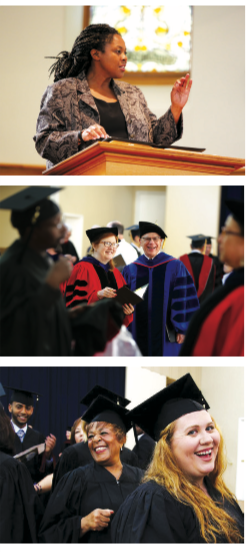
I am grateful for all that my professors have offered me these last three years, and the academics at Union are unparalleled (yes, I might be biased). But seminary isn’t just about the classroom. Seminary is a testament to the power of lived experience that shapes how you sense God at work through you and in the world. At Union, we often talk about how opportunities like parish internships or clinical pastoral education (a hospital chaplaincy internship) can help us understand where we might be called… or where we probably are not. And while the latter may not sound quite as helpful for discerning where God is calling me to do ministry, it’s important nonetheless. In fact, having the chance to engage in short-term internship experiences has been one of the most valuable parts of seminary. The summers I spent on ministry teams at Montreat Conference Center and as a chaplain with Atrium Health contained some of the most transformative moments of my seminary journey thus far. They revealed to me more about myself than I could have imagined — more than I realized I needed to learn. They allowed me to put into practice some of my classroom learnings (even “how does an omnipotent God let bad things happen?”). They reinforced my pastoral care professor’s teaching that empathy is essential (not answers). And they showed me how ministry can be challenging and beautiful — even in the same moment.
This is also true for my job. A month into my first semester of seminary, I found myself applying for – and being hired as – the communications specialist for NEXT Church, a relational network of Presbyterian leaders whose mission is to strengthen a vibrant Presbyterian Church (U.S.A.) that shares the good news of Jesus Christ in ways that matter to and have impact on God’s evolving world. The job was originally appealing for its obvious intersection between communications (my former area of work) and parish ministry (my future calling). But my involvement with NEXT Church has turned out to be so much more than that. It has shown me ministry in ways my professors aren’t able to in the limited time we have together. I’ve heard innovative new ideas for church and ministry that are shaking up the 1950s model of doing things. I’ve been inspired by people living faithfully and without fear into God’s calling for their lives and their church. I’ve been exposed to the principles of community organizing and new means of assessment and metrics. I’ve met people who I consider mentors and role models, some of whom will be the first I call in that first year of ministry when my world feels upside down. This work has been the perfect accompaniment to my studies, another way to engage in lived experience as I continue to be molded into the pastor I’m becoming.
An odd, wondrous, weird calling
I’ve now begun my final year of seminary. God willing, I’m less than a year away from seeking my first call. And I run the gamut of emotions just thinking about it. I’m excited to see where I will wind up. I’m terrified of my first funeral (will I cry?), my first wedding (again, will I cry?), my first sermon (will they hear God’s word?), my first Sunday school class (am I actually terrible at facilitating discussion?). If I’m called away from Richmond, I worry I’ll be sad; if I stay, I worry I’ll be too comfortable. I can’t wait to develop relationships with people in the congregation I’ll serve. I’m not excited about the first time someone asks me how old I am or if I’m seeing anybody.
But despite of – or because of – this range of feelings, I know I am equipped as best I can be for this odd, wondrous and, well, weird calling that is ministry. There is only so much preparation I can do. God was with me when God nudged me into seminary, and God will be with me when God brings me out. Because life – not just seminary, not just textbooks – is what equips God’s people for ministry. And when it comes time for me again to commit to serving God’s people with energy, intelligence, imagination and love, I will say those words knowing I have lived and learned so much in my years in seminary – and there will be so much more to come.
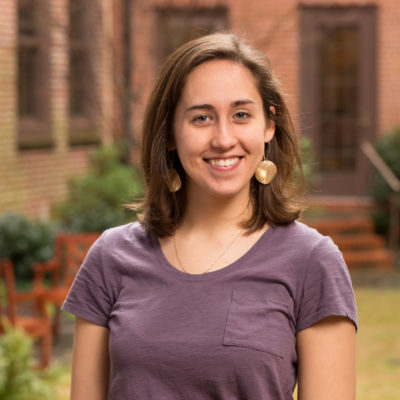 LINDA KURTZ is a student at Union Presbyterian Seminary in Richmond, Virginia. She also serves as the communications specialist for NEXT Church and is a candidate for ordination from National Capital Presbytery. When she’s not reading or writing, Linda enjoys being outside and taking photos of anything but people.