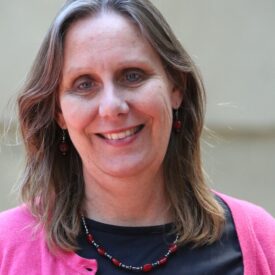
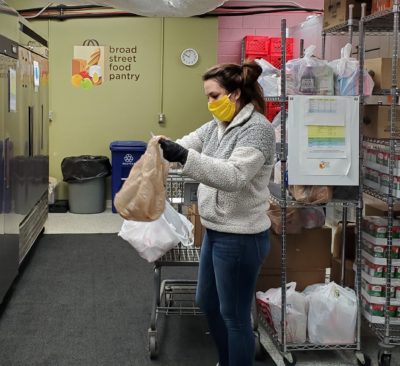
The COVID-19 pandemic has taught Kathy Kelly-Long, director of the Broad Street Presbyterian Church Food Pantry in Columbus, Ohio, about the connections between food insecurity and systemic injustice — and just how close many Americans live to the financial brink.
Analysis of weekly Census Bureau surveys by the Institute for Policy Research at Northwestern University found food insecurity rates becoming “sharply elevated” during the pandemic for U.S. households with children. There are clear racial disparities: The rates of food insecurity among Black households with children were nearly twice as high as they were in white households, and that rates for Hispanic families were 60% higher than whites.
“Our numbers have gone up drastically” in recent months, Kelly-Long said. “April was like, ‘Oh, my goodness, how will we ever do this?” May and June brought a bit of a plateau and a chance to breathe. “July was above April. August will likely be another 10 to 20% above July” — and without a new stimulus package for relief, people without jobs and facing potential eviction are really getting scared.
The numbers also are up because the pantry has changed its policies in response to the pandemic. By the end of July, the pantry had about 1,100 household visits – compared with 580 for all of 2019.
“We used to limit our shoppers to a specific service area,” Kelly-Long said. “We would help anyone one time,” but for ongoing needs people needed to live in the area around the church, in specific high-needs neighborhoods. And people could come to the pantry only once a month.
With the pandemic, that changed — partly to reduce the amount of contact needed to impose the restrictions. “That’s been a great thing, because it showed us that we can stretch and we don’t have to be so restrictive,” inquiring about the ZIP code where people live or keeping track of when someone last visited the pantry, Kelly-Long said. “We don’t have to feel like we’re the food police.”
The pandemic has brought other changes too. Many regular volunteers, some of whom are older or have health concerns, are staying home out of caution.
The youth group from Broad Street Presbyterian used to come to the pantry one Sunday morning a month to pack up food and deliver it to nearby senior centers — giving the teenagers a chance to talk to the older people, to share coffee and doughnuts and conversation. “The youth were able to see firsthand what hunger might look like,” to see what it’s like to be older and living alone, Kelly-Long said.
Now, the pantry delivers food boxes to the lobby, and the center distributes it. The human touch has disappeared, as it has at the pantry itself, where “we greet people at their cars as they come” — they’re handled a box or bag of food, rather than being able to come in and make their own selections. “Everything about COVID has dehumanized us,” she said. “If I’m talking to you and I have a mask on, you can’t see my face.”
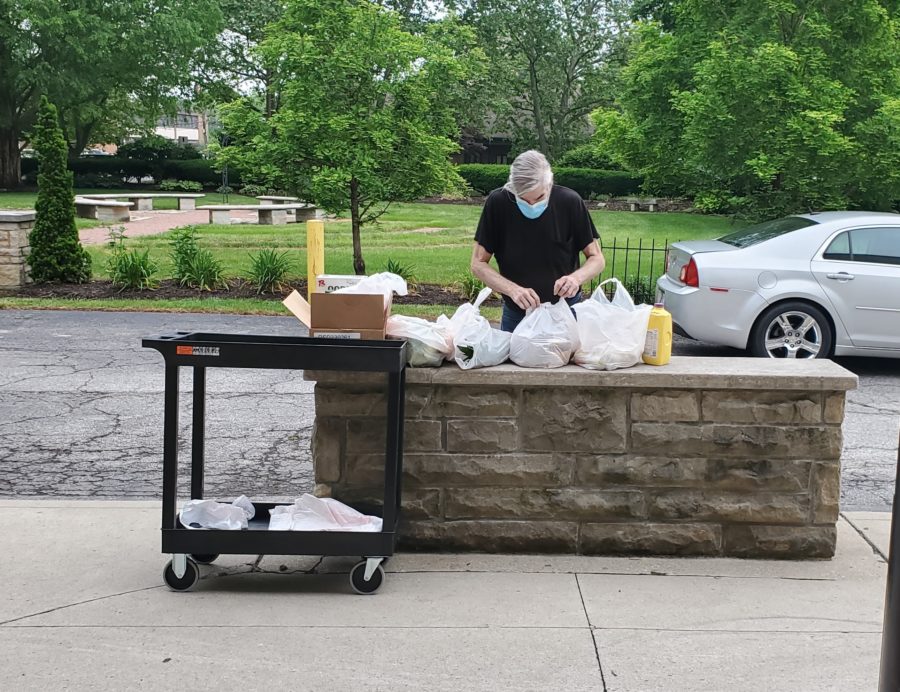
Despite the limitations, the Broad Street pantry is working on innovations — including trying to develop an online system and perhaps a mobile app so people can indicate their food preferences before their food is boxed up. Some caseworkers come by regularly to pick up food for families who don’t have cars, or older people who can’t drive.
A woman who has done catering for the church is cooking extra meals for families with children who previously got free or reduced-price lunches at school. She works with local farmers to get freshly-sourced ingredients, cooks meals and freezes them, with two or three servings per container. The pantry purchases meals from her and gives them to families with school-aged children.
Kelly-Long also is looking ahead to what winter might bring — and whether it might be possible if the COVID-19 caseload drops in the area to bring people safely back into the building. “We don’t want whether or not you can get food to be predicted on whether or not you have a car,” she said. Probably 20 to 30% of the people the pantry serves arrive on foot and volunteers bring food out to them. Even if the temperature drops, she wants to find a way for them to be able to get food.
As much as anything, the pandemic has brought home for her how intertwined systemic issues are with food insecurity and how congregations need to find ways to work as well on underlying justice concerns on issues such as housing, education and employment.
“It took me a while to realize that when we give people food, it’s really just a Band-Aid,” she said. “The issue goes far deeper than that. It’s living wages. It’s fair housing. A lot of it goes back to racial inequity — the fact that people of color have never had the opportunity to build wealth.”
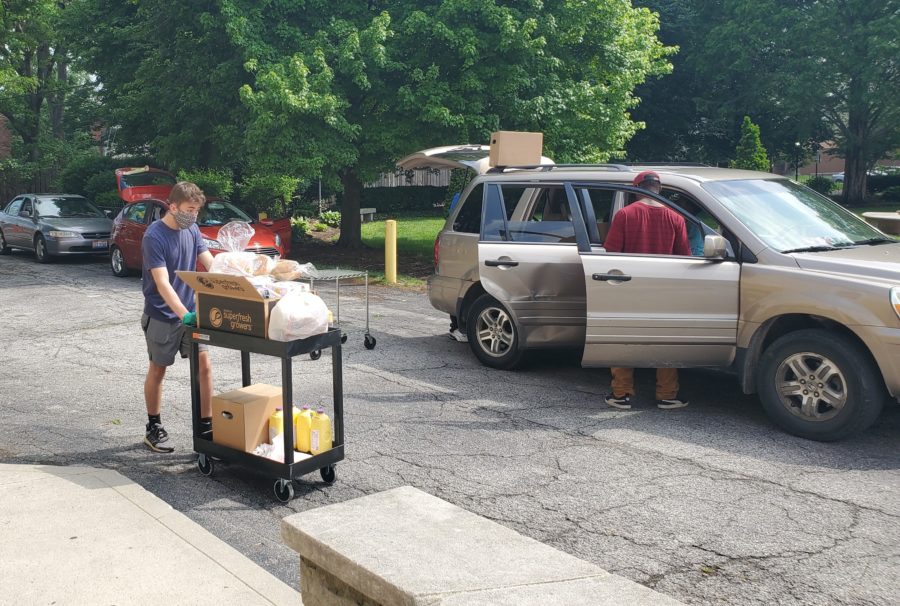
At the pantry, she sees people from every race and age group.
“We’re seeing people come from further and further away” — probably a 30-mile radius. People tell her, “this is my first time” asking for help.
“What it’s really done is show us the cracks that were already in our system,” Kelly-Long said. “A lot of people couldn’t even handle a $400 emergency.”
Already, for so many, the pain of the pandemic has gone way beyond that.