Amid all the bad news of the pandemic, there is one thing that remains true and steadfast: the good news of the gospel of Jesus Christ. The gospel continues to transform lives, inspire new ways of ministry and engage holy creativity. The pandemic has forced reluctant and resistant churches to enter into the techno-charged 21st century, reaching out to families and children experiencing unprecedented stress and who need to know they belong to the faith community even when the church closes its doors. As a result, parents and children have a support system they desperately crave as pastors and Christian educators find innovative ways to break the traditional “sound barrier” magnified by the public health crisis. Churches are crossing borders and boundaries, reaching into homes, communities and villages, impacting lives as never before.
“It’s in the DNA of church educators to be creative, to find ways to nurture faith in whatever situation they find themselves in, to teach and spread the great news of the gospel, whether in times of great abundance or during difficult times. The pandemic has posed the most significant challenge in our congregations,” says Rebecca Davis, associate professor of Christian education at Union Presbyterian Theological Seminary in Charlotte, North Carolina.
Since faith is relational in nature, ministry’s first priority is to build, sustain and nurture relationships, she adds. Pastors and educators use online video communication platforms like GoToMeeting and Zoom to teach and interact with children. Livestreaming short children’s messages through Facebook or YouTube has become a staple in ministering to the young. The pandemic has made it clear that people of all ages need to interact visually with others, especially if they cannot meet in person.
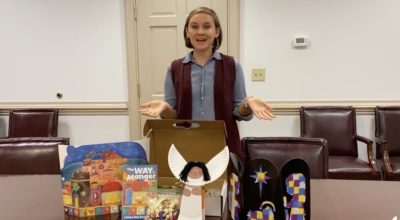
Parents are getting more involved and engaged with their children as well. Weekly, or in some cases monthly, families pick up Sunday school kits that include a Scripture lesson, complete with background information for understanding historical and theological context, and hands-on activities that parents and children can do together.
In these ways, parents are not left alone wondering how or what to teach their children. It takes a village, and the faith community fosters faith in various ways, even though parents are the primary faith educators.
 “The pandemic has revealed what we haven’t done, but must do better to equip parents to educate at home,” adds Davis. “I never met a parent who didn’t want to nurture faith in their children. We have to be more intentional to equip parents with content and tools, and live into our baptismal vows as a congregation to partner with parents.”
In other words, we are called to embody communion and community, as this is at the heart of spiritual formation, explains Davis. “This is our deepest yearning, and the hope for what it will be like when the pandemic is over.”
Embodying, embracing and expanding the faith community calls educators and pastors to reach out and offer more opportunities to partner with seminaries and other local congregations in profound but simple ways.
“We can’t assume that people know how to dig deeper. What’s essential is to reflect on the intersection of one’s faith and life as it’s lived out in the world – that is what it is all about – faith lived out in every aspect of our lives, in courtrooms, classrooms and living rooms. We can’t abandon finding new ways to connect life and faith that is vibrant, alive and dynamic,” Davis continues.
Keeping safe isn’t the same as staying sane, as any parent of school-age children will testify, including Kelly Kaufman, parish associate for children’s ministry at Olivet Presbyterian Church in Charlottesville, Virginia. Intimately acquainted with the challenges parents of school-age children face daily as the mother of two, ages 8 and 3, she experiences the chaos of unexpected and unplanned school closures, the demands of virtual education and the difficulty of quarantining and isolating — all the while trying to maintain a job without the support system parents have come to rely upon.
“Ministering to children and their families, as well as being a parent in their same position, and feeling the fluctuation of emotions they are feeling, I want the church to be that support system,” Kaufman says. “My goal as a children’s minister is to offer a variety of different ways to engage families with the life of the church. Everyone needs something different. Some are comfortable to gather in person, some aren’t, and some are completely overwhelmed.”
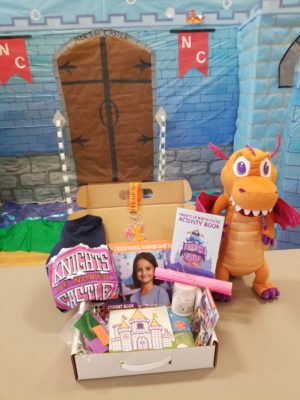
One way Olivet Presbyterian Church connects with families is through “kingdom kits,” monthly boxes with stories and craft activities that families are invited to pick up at the church. Themes have included: create, serve, family and tell. Supplements to the kingdom kits are posted on the church’s website. Also, preschool packs are available each month as supplement for toddlers through pre-K.
Whenever the weather permits, Olivet Presbyterian Church hosts outdoor gatherings. Parents are encouraged to bring their children, along with bikes and scooters, to ride around the church property. Being in the company of other families with safe physical distancing not only breaks the feeling of being isolated, but also provides a safe space for parents to fellowship and share their joys, concerns and frustrations.
“We’ve hosted an online meeting for parents to discuss parenting with a psychologist during this difficult period trying to negotiate all the demands placed on families now,” says Kaufman, noting that the church offers these resources so that children and families can maintain and deepen the sense of community.
Reaching into homes to provide an ongoing relationship with the faith community and church leaders prompted Kaufman to become even more creative through online “bedtime prayers” – a story and prayer time – every Sunday night.
 Kaufman also organized an outdoor “Bible and brick” event where families are encouraged to bring their own bins of Legos or building blocks, build things and listen to stories. Before the colder weather set in, outdoor movie nights gave families a social alternative. Each family would pay for pizza and a bag of popcorn that the staff purchased and delivered to spaces designated for individual families. During Advent, candle lighting services with prayer, a short reflection and special music were offered outdoors as well.
“Families are hungry for community. I schedule spontaneous pop-up events too, and we will go for a hike on a day that the weather permits. Winter is challenging, and people are overdosing on screen time. We provide the resources, and it’s there if people want it. We even have storytelling with music,” she says. All such efforts have led a half-dozen new families to join the church since the shut-down nearly a year ago.
Offering parents a place and a time to share their lives and find spiritual support, The First Presbyterian Church in Asheville, North Carolina, hosts youth parent meetings every month. Parents connect and learn from one another as they talk about their children’s needs during these unprecedented times when students and parents experience high anxiety.
“We’ve worked hard to shift things online, including videos and lessons, as we respond to the spiritual needs of our families,” says Julie Hester, one of the church’s pastors.
Faith-at-home kits, with a variety of materials for spiritual education, are provided for families. Meeting outdoors, scheduling picnic dinners on the lawn and having children play their musical instruments during the warmer weather while physically distancing has helped build community.
Parents are under so much stress, says Hester. “The church is always searching out new ways to help by staying mindful and connected. Old ways aren’t working right now, and we are asking God for a fresh vision and not being afraid to try something different. We risk failure, but at the same time, it’s exciting.”
Since teens have a great need to socialize and connect with their peers, especially as schools close down and social opportunities are forbidden, youth groups gather outdoors whenever possible. Playing games and discussing challenging social justice issues such as racism and hunger have supported their spiritual growth, discipleship and social responsibility, says Hester.
After all, these ministers agree that God is the God of new beginnings. Although the transition has not been easy for many pastors, educators and congregations, many view this time as transformational. Churches everywhere are likely to never “do church” in quite the same way again, at least not exclusively. With children’s messages being livestreamed every week and as families can tune in to a church in ways they haven’t previously been able to, livestreaming offers a nonthreatening way for families to explore and investigate local churches without leaving home.
At the beginning of the pandemic, the ministerial team of the First Presbyterian Church of Myrtle Beach, in South Carolina, did the hard work of reevaluating its family ministries as the state hunkered down, shuttered schools and postponed youth sports. The need for spiritual nurture and hope was more significant than ever, and families found themselves with fewer distractions and more time. The team reached out to their families and asked how the church could help.
“We looked at what we usually did with families that they enjoyed and found meaningful, and asked them how we could still offer up the ministries and keep safe,” says Macy Cottom, director of children and family ministries.
 Through these conversations, the team established virtual lessons with music, reading a children’s book or Scripture verses and an
art activity. When summer came, and the pandemic was still making in-person gatherings unsafe, they found a way to offer virtual Vacation Bible School.
The opening and closing ceremonies of VBS was filmed and emailed to the families for students to watch. Little suitcases, packed with material to complete the activities, were sent to the 40 participating families.
Church families began to invite their friends to join spiritual formation programs online. Like many other churches, as the summer progressed, other programs were added back but done differently — for example, “The Way,” a kindergarten through 5th grade educational program, was now held outside, for one hour rather than two, incorporating choir, recreation and a Bible story.
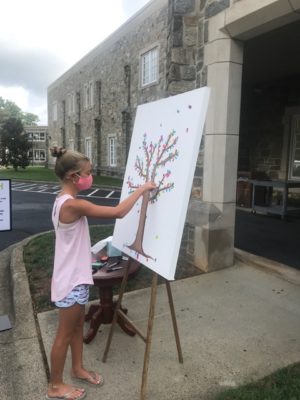
“We do all we can to be a resource to our families, including sending Advent boxes home, and we will likely do the same for Lent,” she says, “but it is up to our families to take advantage
of them.”
In East Stroudsburg, Pennsylvania, the East Stroudsburg Presbyterian Church youth group meets online and organizes different activities like “flamingo-ing” to cheer up those isolating at home. Families wake up to find a pink flamingo in their front yard, leaving them to find a family’s yard where they can then plant the plastic creature secretly.
“We are trying to be creative to make sure all generations of the church are connected in new ways and still provide some specific things for the families. We don’t want to overwhelm them with more things to do as our youth are already doing so much online,” says Nicole Vogel, who posts weekly children’s sermons on Facebook and their website apart from the livestreamed worship services.

The congregation gathered outdoors to decorate pumpkins, and then delivered the pumpkins to homebound members to bridge the generational divide last autumn.
As churches have been forced to fit into a new template, what has followed is deep thankfulness for opportunities available through technology that were not available in the past, says Davis. Just as the Risen Christ suffered no physical boundaries, nor does the church.
Sherry Blackman, a journalist, poet and author, serves as the pastor of The Presbyterian Church of the Mountain in Delaware Water Gap, Pennsylvania, as well as a truck stop chaplain at the Travel Center of America in Columbia, New Jersey, a validated ministry of Newton Presbytery.