 The Committee on the Office of the General Assembly (COGA) has voted to ask for an exception to the Presbyterian Church (U.S.A.)’s pandemic travel ban so it can hold a hybrid meeting in September — meaning at least some committee members would travel to meet together in person. Their request goes to J. Herbert Nelson, the PC(USA)’s stated clerk.
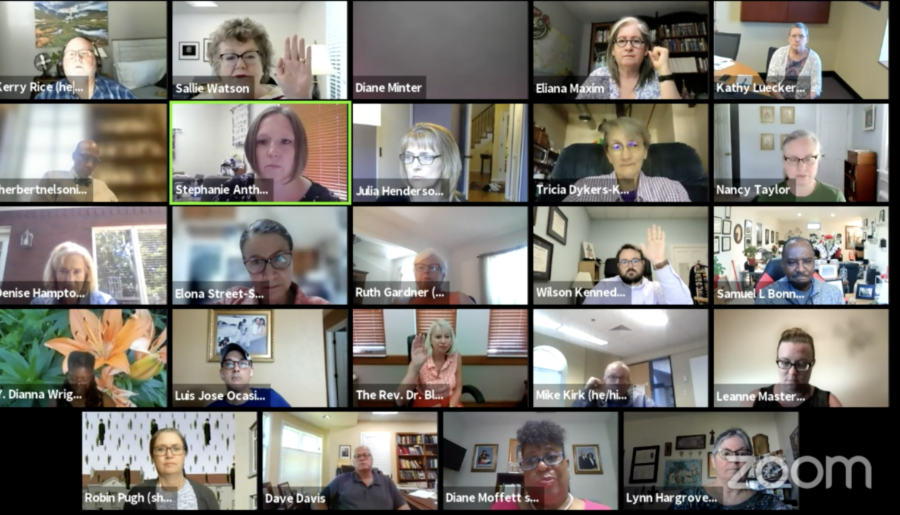
COGA voted 6-5 during a Zoom meeting June 17 to ask for permission to hold a hybrid meeting Sept. 27-29 in Louisville, Kentucky. To some extent, the division on the committee reflects the kind of discussions that congregations and other church groups are having about whether to begin meeting again in person and with what restrictions — acknowledging there may not be consensus on what is safe and what is not.
The Presbyterian Mission Agency Board does not plan to begin holding in-person meetings again until 2022.
Among points raised in this discussion:
- What are the expectations for staff members who are expected to be part of the meeting — but who may not be comfortable with in-person gatherings?
- If someone gets sick from an infection related to the meeting, is there legal liability?
- What are the budgetary implications — with PC(USA) agencies relying on reduced travel costs to balance their budgets this year?
- “Are we all vaccinated?” as COGA member Blythe Kieffer wondered? And is that a question that’s appropriate to ask?
Kerry Rice, the PC(USA)’s deputy stated clerk, said Office of the General Assembly employees at the Presbyterian Center have begun wearing masks again at the office. Some workers had raised concerns, he said, including parents of children too young to be vaccinated and some who have been vaccinated but have underlying health conditions that potentially make them more vulnerable to infection.
 Committee member Sam Bonner said that while many are eager to get back to normal, “it will be a different normal” — with hybrid meetings becoming the norm.
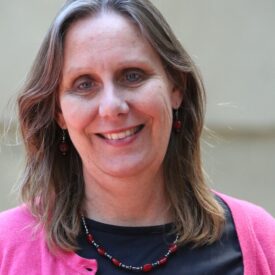
By having a hybrid meeting in September, COGA could test out technology and model what the 2022 hybrid General Assembly might be like, said COGA member Wilson Kennedy. “We are going to be reflective of what the whole denomination is having to deal with,” as congregations make decisions about returning in person and hybrid worship, said COGA vice moderator Eliana Maxim.
The PC(USA)’s response “is disjointed,” with different agencies and entities making different decisions about when and how to resume in-person meetings, Rice said.
 And COGA member Robin Pugh said it’s probably not appropriate to ask whether particular people have been vaccinated — “that’s personal information.” As an educator who possibly will be teaching in-person in the fall, she also understands the complexity of individual decisions about whether to travel to an in-person meeting. While she is vaccinated, Pugh said some of her students and colleagues are not, and she’s reluctant to risk infecting others.
“There’s still so much that’s unknown,” she said.
Some other issues that floated up during COGA’s monthly meeting:
 Big Tent. Maxim reported on conversations with PC(USA) agency leaders about the possibility of at some point reviving Big Tent, as a forum for fellowship and leadership development rather than official business — and with all the agencies being asked to share in the costs. “There was no interest,” Maxim said.
There also are questions about whether the PC(USA) can afford to go back to a “big box” General Assembly held at a convention center, with space for both business sessions and related events. If that’s what some Presbyterians want, the discussion needs to include models for funding it that go beyond relying on per capita funding, Maxim said.
Advisory delegates. COGA approved a recommendation to initiate conversation with the Presbyterian Mission Agency Board about establishing a working group to discuss the role of advisory delegates to the General Assembly — perhaps to bring recommendations on that to the assembly in 2022.