by Sid Batts
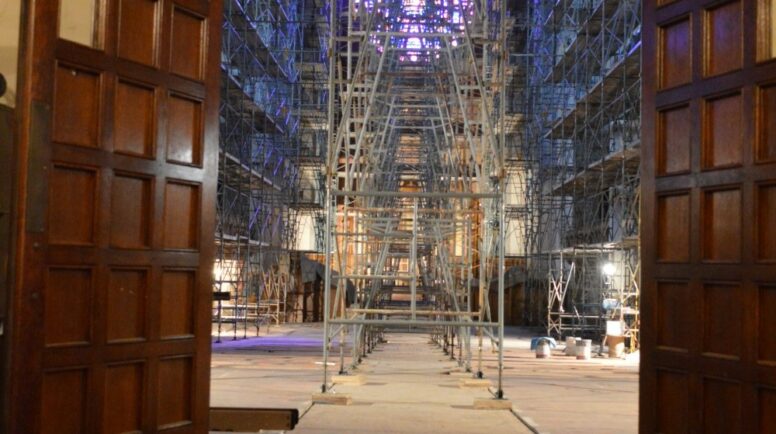
On the Sunday before Christmas, our congregation re-entered our sanctuary after a 20-month hiatus and a $15 million renovation. It was worth it! Here’s why.

First Presbyterian is a 2,900 member congregation on the edge of downtown Greensboro, N.C., a city of 275,000. We are a tape-measured home run from a new minor league baseball park and just a few blocks from a new performing arts center that is currently under construction. Downtown is experiencing a decade-long renaissance. Add in the Atlantic Coast Conference home office, the Greensboro Coliseum, a new aquatic center, and six college campuses … and somehow this city has survived the collapse or relocation of such iconic companies as Burlington Industries and Jefferson-Pilot and the loss of economic engines from textiles and furniture. And then came the great recession!
But it was worth it.
 We live in a church culture that has traded place for space. The latest generation of large sanctuaries built in the U.S. is mostly warehouses or large seat arenas, “worship centers” that resemble modern theaters or auditoriums for the performing arts. Generally, the technology in those places is out-of-this-world sophisticated and effective. These spaces are impressive, functional and pragmatic. But in the eye of this beholder, they are not beautiful nor do they evoke a sense of God’s awe, majesty, mystery, transcendence or presence. I’d say that’s important for the worship of God.
“Thin places,” from Celtic spirituality, refers to places “where the boundary between heaven and earth is especially thin … where we can sense the divine more readily.” From that notion I’d say there are physical places where people can more readily experience the presence of God. We inherited some sense of this “theology of place” from our Jewish ancestors (i.e., the land and the Temple).

We are lucky — or blessed — at First Presbyterian because our forefathers and foremothers of the 1920s had the crazy idea of hiring a noted Manhattan architect to build a Gothic cathedral in a small southern city of 25,000. Hobart Upjohn got inspiration from the 13th century cathedral in Albi, France, a fortress-like edifice that is one of the largest brick structures in the world. It took two centuries to build it! What Upjohn designed was a Greensboro cathedral where the exterior reminds one of “A Mighty Fortress” while the interior is a statement of beauty, combining symbols, art, wood carvings, stained glass, hand-painted stencils and ornate lanterns under a 90-foot ceiling. Oh, did I tell you we found asbestos in the ceiling?
But it was worth it! Perhaps to believe it was worth it, you’d also have to believe that “thin places” have a role in worship, in experiencing God’s presence and in spiritual transformation. And, you’d find yourself resonating with the thoughts of archbishop Justin Rigali on sacred architecture: “Beauty is the center of gravity of all the liturgical sciences. Beauty changes us. It disposes us to the transforming action of God … . ”
Then he quotes Benedict XVI (I was surprised!) “Authentic beauty … unlocks the yearning of the human heart, the profound desire to know, to love, to go towards the Other, to reach for the Beyond. If we acknowledge that beauty touches us intimately … that it opens our eyes, then we rediscover the joy of seeing, of being able to grasp the profound meaning of our existence, the Mystery of which we are part.”
If you could hear the people in this congregation talk about this place, hear the tone in which they speak of the weddings, the baptisms, the funerals, the midnight Christmas Eve candlelight service, the processing bagpipers, the organ’s deep tremor on Good Friday or the soaring Hallelujah chorus on Easter, you’d be convinced that this sanctuary meets the criteria of a “thin place.”
 Was the renovation primarily a preservation project? Far from it. We are much more concerned with our future than our past. We sought a renovation that brings us into the 21st century. As a result, our renovation included replacing all of the original 1920s wiring, plumbing and heating unit; upgrading lighting, audio, video and sound — including a hearing loop in the sanctuary floor; and adding unobtrusive flat-screen monitors on the rear columns.
In addition to the sanctuary, we renovated the adjacent Smith Building, also built in 1929. This created a welcome center that includes a café-solarium-bookstore-coffee shop, offered a new user-friendly front entrance, and moved church staff offices into the Smith Building vortex to facilitate informal communication, connection and synergy. This renovation has an eye for the future, creating a place to welcome a new generation of community-seeking, tech-savvy millennials and Gen X/Yers trying to find spiritual footing.
 But is this renovation “missional”? In addition to the church’s mission of worship, education, spiritual formation, congregational care, evangelism and being community, on our campus we feed 150 homeless guests two nights a week, sponsor the Step-Up job/life training ministry, lease affordable space to Habitat for Humanity, house Faith Action (a community ministry for new immigrants), educate hundreds of children in two preschools, host a senior community program, run a jobs ministry for unemployed or underemployed professionals, and are involved in a dozen other “missional” ministries. Don’t you think it’s hard to segregate buildings from what is missional?
Twenty months is a long time, unless you consider the 200 years it took to build our inspiring French sister. But the 20 months taught us the meaning of flexibility … and friendship with neighbors. While our nontraditional worship service remained in our Life Center, our traditional services moved across the corner to the smaller sanctuary of our long-time Jewish friends, Temple Emanuel. We held Christmas Eve services in the larger and splendid chapel of the Episcopal Canterbury School, held larger funerals in the spacious sanctuary of First Baptist Church, and we had something akin to opening day: an Easter service at the Greensboro Grasshoppers minor league ballpark, where I preached “The Sermon on the Mound.”
It was worth it.
SID BATTS has been the senior pastor at First Presbyterian, Greensboro, since 2001.