Them. It so easily becomes a four-letter word. Them. Republicans to Democrats. Democrats to Republicans. Conservatives to liberals. Liberals to conservatives. Them. Muslims. Jews. Christians. Palestinians. Israelis. Afghans. Pakistanis. Iraqis. Americans. Them. When “them” is a rivalry, well, that’s one thing. You know the kind of “them” I am talking about.
Pro-life … pro-choice. Them. NRA … gun control advocates. Them. Same sex marriage supporters … National Organization for Marriage. Them. Fox News … MSNBC. Them. Fundamentalist Christians. Mainline Protestants. Roman Catholics. New atheists. Us and them.
I was in a meeting in Louisville a few months ago. The conversation turned to a disagreement brewing between two different groups of staff within the Presbyterian Church (U.S.A.). The disagreement was not theological. It was not driven by an issue like ordination standards or worship styles. But the conflict was real and, as I learned, pretty bitter. And reconciliation was not being served by the abundance of “us and them” thinking. The committee chair received a request that there be a moratorium on the words “they” and “them.” Use names. Titles. Office number. Anything other than “them!”
A colleague of mine out in Ohio was leading his session through a discussion of proposed changes in the Book of Order a few years ago. The discussion about ordination and human sexuality was going along rather predictably. Same folks. Same opinions. Nothing new in the debate. The moderator noted a low level of energy that indicated the elders themselves didn’t expect anything to change. Then a new elder, who never said much at a session meeting, chimed in. “I think the church should change the rules and ordain gay and lesbians because my son is gay and he would make a great elder or deacon and his name is Jeff.” The pastor said to me “the discussion in our session was never the same again.” It was no longer “them,” but “Jeff.”
The people of God don’t have the luxury of allowing “them” to become a four-letter word as if life in the community of faith were a cable news show where a liberal leaning host invites a tea party candidate on to grill him and try to expose his understanding of history. Or as if being a faith leader today grants you the authority to pronounce that all who disagree with you on the matter of abortion should be excommunicated or are in the hands of Satan. As if a Reformed gathering of faith like ours, steeped in the tradition where people of good conscience can disagree about important things, could ever settle for the rhetoric of our life together being shaped by a politically staged event, or radio talk shows, or a two party political system that has elevated “us and them” to an apocalyptic, scorched earth way of life.
I’m not sure there is any room for “them” (the term “them” with all the scandalous and disgusted tone I can muster, in the Body of Christ. Until it wasn’t about them, but Cornelius. The conversation about “them” in the New Testament Church was never the same.
While Peter was still speaking, the Holy Spirit fell upon all who heard the word. The circumcised believers who had come with Peter were astounded that the gift of the Holy Spirit had been poured out even on the Gentiles (Acts 10:44-45). In her work on this passage, Beverly Gaventa points out that this is the only time in Luke and Acts that the Holy Spirit comes prior to the act of baptism. The unilateral, unrequested, non-mandated, boundary-shattering act of God. The Holy Spirit fell upon even them. Peter orders that the Gentiles be baptized in the name of Jesus Christ. Then, according to the text, the baptized invited Peter to stay for several days. Not just lunch, not just for the reception, stay for a few days. Peter stayed with “them.”
According to Luke, when Peter returned to Jerusalem, the apostles and believers had already heard that the Gentiles had accepted the word of God. Those apostles and believers didn’t ask Peter about the Spirit thing, the speaking in tongues and extolling God part. They didn’t ask him to defend his actions theologically. They didn’t ask for the Scriptural support for baptizing those Gentiles. No, the circumcised believers criticized Peter, saying, “Why did you go to uncircumcised men and eat with them?”
Peter responded not with high rhetoric and a doctrinal argument like Paul and Paul’s epistle to the Romans; not with the wisdom of the ages like quoting Proverbs or Ecclesiastes; not with the prayer and devotion of invoking the Psalms; not even with the fire of proclamation like the prophets. No, Peter explained step by step the story of him and Cornelius. Peter said, If then God gave them the same gift that God gave us when we believed in the Lord Jesus Christ, who was I that I could hinder God! (Acts 11:17).
Preacher you just can’t tell a story, like Peter did? When asked to defend himself, before he sought the truth revealed in a text, before he tried to wrap his head around doctrine, before he plunged into a good, old-fashioned theological argument, Peter told the story of him and Cornelius. And in that story, Peter proclaimed the unilateral, unrequested, non-mandated, boundary-shattering act of God.
In 2004 Peter Gomes, the minister of the Memorial Church at Harvard University, delivered the convocation address at Harvard Divinity School. Gomes stood right in front of then president of the university, Larry Summers. It was a tense moment because the president had made it clear to the university and to Peter Gomes privately that he had little time or commitment to the divinity school and Memorial Church in his broad vision for the university. The address became an occasion for defending the existence of theological education in a university curriculum, an existence that claims and grows out of its own Protestant Christian roots — the roots upon which that university was founded.
At one point Peter Gomes noted the irony that the setting for the address, for the opening of the semester in the divinity school, was a theater not the stately gathering place of Memorial Church. The reason? Gomes said, “One of our students in recent years accused me of praying too ‘theistically.’ I’m not sure what she meant, but I knew she didn’t like it.” He went on to say, “I speak as an out-of-the-closet Protestant Christian with decidedly Trinitarian tendencies, and as such I believe that the well-laid Protestant Christian foundations of this school are broad enough not only to embrace Christianity as its central tradition, but also the great wealth of religious traditions, which because of that foundation, have come now to join us. If this school’s future is to be worthy of its past, that future dare not compromise the essential Christian identity of the place, without which no other identity here would be possible.”
You hear the irony of his argument? The inclusiveness and hospitality and respect of the other embedded in the historic Protestant Christian identity is what allows the place to flourish in all its plurality. Without that outward lean of the tradition, no other tradition would be present at all. Not only that, few if any of the other traditions would have ever welcomed the other to begin with. Roman Catholic. Orthodox Jew. Muslim. Even a secular approach like that of the former Harvard president and the student who thought the prayers were too theistic. Those who don’t agree, don’t belong. They ought not to be welcomed. They become “them.”
For Gomes it was an address, not a sermon. So he stopped a bit short, really. There is a prior step in his description of the well-laid Protestant Christian foundation of Harvard Divinity School and the university of which it is a part. That would be the unilateral, unrequested, non-mandated, boundary-shattering act of God. The embrace of the other radiates not from the tradition, but from God. Presbyterians remain committed to things like “God alone is Lord of the conscience” and “people of good conscience can disagree about important things” not because we, or the tradition, have been particularly good at it; far from it. We remain committed to it and stand for it and live into it because of God; the grace of God, the unmerited, undeserved, unpredictable grace of God.
There is no room for “them” in the Body of Christ — that word that comes with all the intended sinful disdain of humanity’s collective use of the term. God is so much greater than our hearts (I John). We are no longer Jew or Greek, there is no longer slave or free, there is no longer male or female; for all of you are one in Christ Jesus (Galatians). The unilateral, unrequested, non-mandated, boundary-shattering act of God.
Remember, before we were “us” in the story of salvation history … we were “them.”
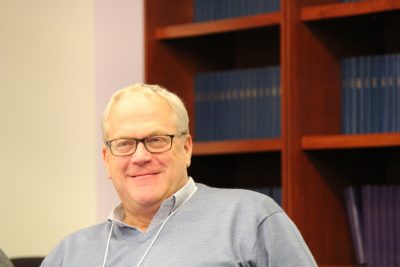 DAVID A. DAVIS is pastor of the Nassau Church in Princeton, N.J.